Best fertilizer for new sod: Top 5 Powerful Picks 2025
The Foundation of Healthy Turf: Choosing the Right Starter Fertilizer
The best fertilizer for new sod is a balanced starter formula with NPK ratios like 15-15-15, 16-16-16, or 10-20-10. For quick results, look for these top options:
| Best Fertilizer Type | NPK Ratio | When to Apply | Best For |
|---|---|---|---|
| Balanced Starter | 15-15-15 | 4-6 weeks after installation | All-purpose use |
| High-Phosphorus | 10-20-10 | 4-6 weeks after installation | Root development |
| Liquid Starter | 8-8-8 + Carbon | 4-6 weeks after installation | Quick absorption |
| Organic Starter | 4-4-4 | 4-6 weeks after installation | Kid/pet-friendly yards |
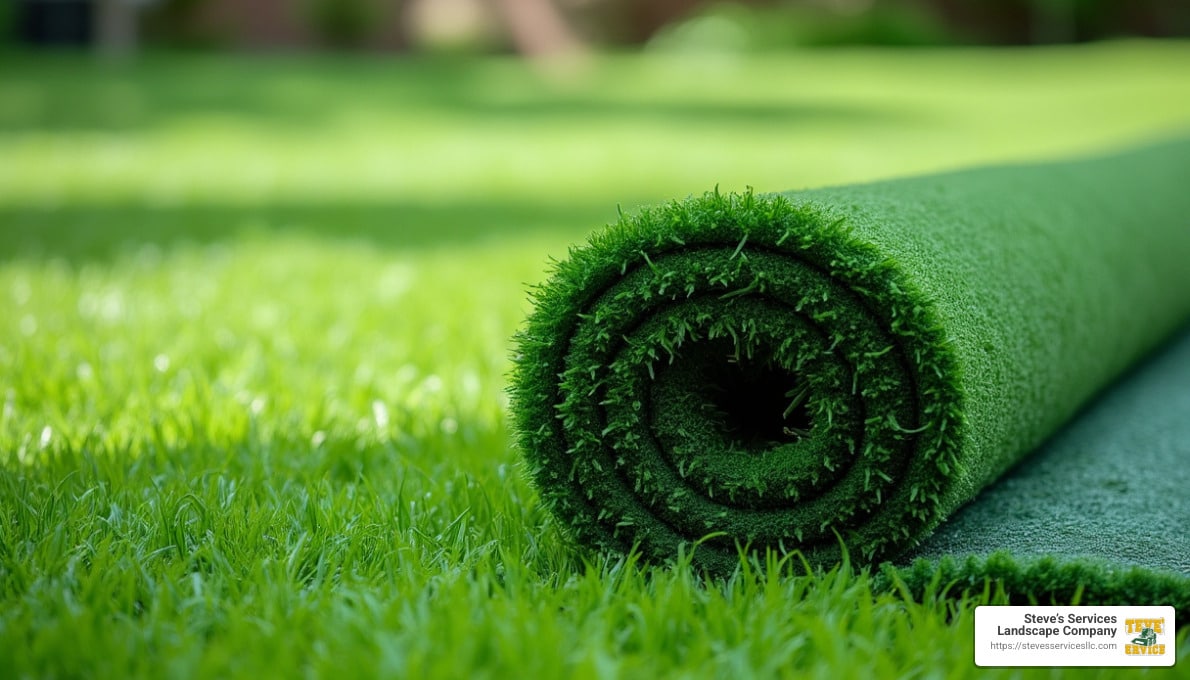
You’ve invested in beautiful new sod, and now you want to ensure it establishes a strong root system and thrives for years to come. The best fertilizer for new sod provides the perfect balance of nutrients to support root development without burning delicate new grass.
Contrary to what many homeowners believe, you shouldn’t fertilize new sod immediately. As Michael Romine explains, “Wait about one month from the time that it’s been laid down, four to six weeks, and then we recommend that you put out a balanced fertilizer such as a triple 15.”
This timing allows your sod to establish initial roots and begin actively growing before introducing additional nutrients. When you do fertilize, apply at half the rate listed on the bag to prevent burn damage to your new lawn.
I’m Steve Sylva, owner of Steve’s Services Landscape Company with over 25 years of experience helping Massachusetts homeowners select the best fertilizer for new sod and establish healthy, vibrant lawns that withstand our region’s unique climate challenges.
Best Fertilizer for New Sod: Editor’s Picks Overview
I’ve spent countless hours watching new sod transform from fragile green carpet into established, resilient lawns across Massachusetts. After years of testing products in Burlington, Danvers, and Everett neighborhoods, I’ve learned that choosing the best fertilizer for new sod isn’t just about grabbing any green bag from the garden center.
Those three numbers on fertilizer bags? They’re your roadmap to success. The N-P-K ratio tells you exactly what you’re feeding your lawn: Nitrogen (N) for lush green blades, Phosphorus (P) for strong root networks, and Potassium (K) for overall lawn health and stress resistance. For new sod, we want to focus on root establishment without forcing too much top growth too quickly.
Starter fertilizers differ significantly from regular lawn food. Starter formulas typically contain higher phosphorus levels to encourage those critical early roots to dive deep into your soil. They often include quick-release nutrients that your new grass can access immediately. Meanwhile, regular fertilizers push more nitrogen for leaf growth and typically use slow-release technology that’s great for established lawns but not ideal for newly laid sod.
When deciding between granular and liquid options, consider your specific situation:
| Feature | Granular Fertilizer | Liquid Fertilizer |
|---|---|---|
| Application | Spread with broadcast or drop spreader | Applied with hose-end sprayer or tank sprayer |
| Absorption Speed | Slower, gradual release | Immediate uptake through leaves and roots |
| Duration | Typically lasts 4-8 weeks | Usually lasts 2-4 weeks |
| Burn Risk | Higher if not watered in properly | Lower when diluted correctly |
| Ease of Use | Requires spreader equipment | Simple hose attachment for most homeowners |
| Weather Concerns | Can wash away in heavy rain | May need reapplication after heavy rain |
I can’t stress this enough: that first fertilizer application is where most homeowners go wrong. “I’ve seen beautiful new sod installations turn crispy brown overnight because someone got too generous with the fertilizer,” shares our head landscaper. That’s why we always recommend applying at half the rate listed on the fertilizer bag for your first feeding.
For those concerned about kids, pets, or environmental impact, organic options provide peace of mind. They typically have gentler NPK ratios like 4-4-4 and release nutrients more slowly, virtually eliminating burn risk. The trade-off is waiting a bit longer to see results, but the soil health benefits are worth considering.
Your best fertilizer for new sod choice depends on your specific soil conditions, grass type, and how quickly you need results. Let’s look at our top five recommendations that have consistently delivered exceptional results for our Massachusetts customers.
Product 1: Triple-15 Balanced Starter (15-15-15)
Ah, the trusty Triple-15 balanced starter fertilizer – it’s like the reliable family sedan of the fertilizer world. Not too flashy, but it gets the job done beautifully for new sod in our Massachusetts climate. This all-purpose blend delivers equal parts of the big three nutrients your new lawn craves, creating the perfect balance for those crucial first months.
What makes Triple-15 so effective is its “Goldilocks approach” – not too much of any one nutrient, but just right. The 15% nitrogen gives your grass blades enough food to maintain that fresh green color without forcing excessive top growth that would drain energy from root development. Meanwhile, the 15% phosphorus is busy below the surface, encouraging those roots to dig deep and establish themselves. And let’s not forget the 15% potassium, which helps your new sod stand strong against our unpredictable New England weather swings.
Most Triple-15 products offer a clever dual-action feeding system. You’ll get some quick-release nitrogen that feeds your lawn immediately (instant gratification!), plus slow-release compounds that continue nourishing your turf for weeks afterward. This prevents your new sod from experiencing the lawn equivalent of a sugar rush followed by a crash.
Why it’s the best fertilizer for new sod
The magic of the 15-15-15 ratio is how it promotes balanced development both above and below ground. Think of it as raising twins – you want them both to grow at a similar pace! While some specialty fertilizers might favor either top growth or root development, Triple-15 ensures neither system outpaces the other, creating a more stable foundation for your lawn’s long-term health.
I love how Michael Romine puts it: “You’re just trying to give it a little kick in the pants.” That perfectly captures what we’re doing with a balanced starter fertilizer. You’re not force-feeding your lawn or pushing unnatural growth – you’re just providing gentle, balanced nutrition that supports your sod’s natural establishment process.
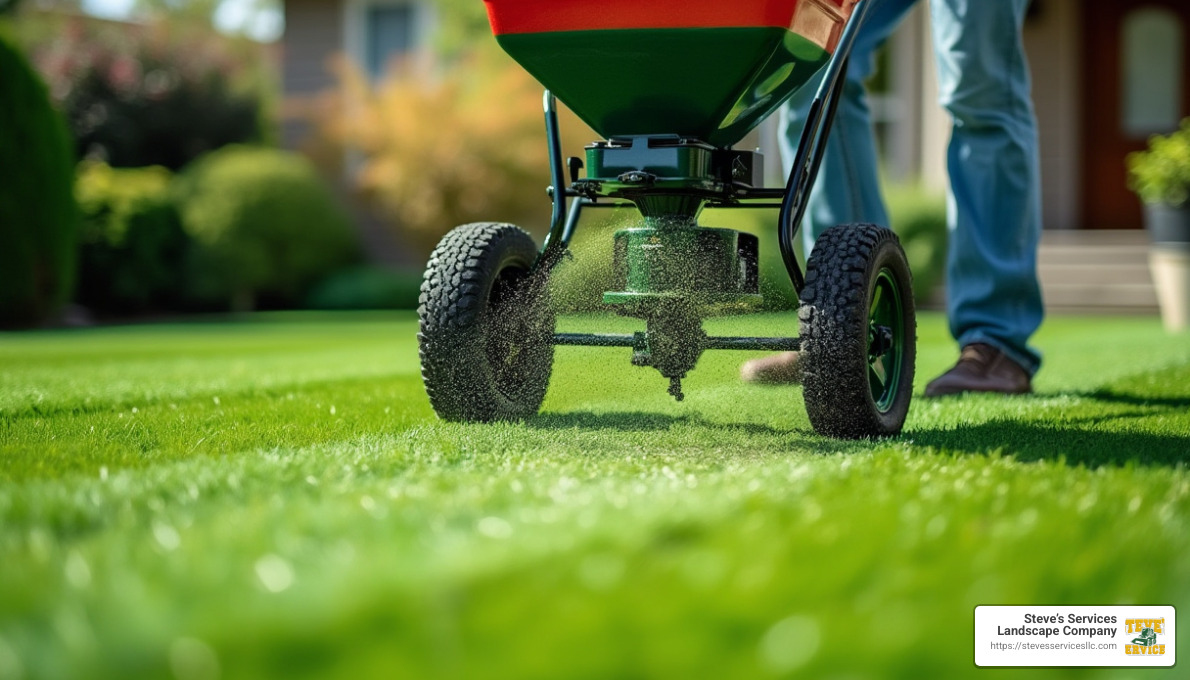
Here’s a pro tip from our team at Steve’s Services: when applying the best fertilizer for new sod like Triple-15, always use half the manufacturer’s suggested rate for that first application. If the bag suggests a spreader setting of 13 for established lawns, dial it back to 6.5 for your new sod. This conservative approach minimizes any burn risk while still providing all the nutrition your new lawn needs.
In our 25+ years of experience serving communities from Lynnfield to Winchester, this balanced approach has consistently produced the most reliable results across different soil types and grass varieties. Whether you’re establishing a new lawn in sandy Gloucester soil or clay-heavy Burlington yards, Triple-15 delivers the even, moderate growth that helps new sod transform into a thriving, established lawn.
Product 2: High-Phosphorus Boost (12-24-12)
When your new sod needs serious help establishing roots quickly, especially in our challenging Massachusetts clay soils, a high-phosphorus starter fertilizer might be your lawn’s best friend. The 12-24-12 formula is my go-to recommendation for properties where root development needs an extra push.
This powerhouse formula contains double the phosphorus compared to nitrogen and potassium, and there’s solid science behind this approach. Phosphorus serves as the energy transfer nutrient in plants and plays the starring role in developing those crucial early root systems. Think of it as the foundation-builder for your lawn – when that fresh sod first touches your soil, it’s desperately trying to send roots downward, and phosphorus is what fuels that process.
What makes the 12-24-12 ratio particularly valuable is its quick-release nature. Unlike slower options that take their sweet time, these high-phosphorus starters make nutrients available almost immediately. This gives your new lawn a rapid establishment boost – particularly helpful if you’re installing sod later in the season when growing time is limited before winter arrives.
Best fertilizer for new sod in compacted soils
Throughout my years working with lawns in Revere, Saugus, and Stoneham, I’ve encountered countless properties with soil compaction issues. The 12-24-12 formula truly shines in these tough situations because the concentrated phosphorus helps young roots muscle their way through dense soil layers.
Phosphorus has a quirky characteristic compared to nitrogen – it barely moves in soil at all. This limited mobility means it needs to be right where those developing roots can find it. The high concentration in this formula ensures adequate phosphorus reaches the critical root zone even in the most stubborn soil conditions.
Water thoroughly after application! This isn’t optional with high-phosphorus formulas. Without proper moisture, these concentrated nutrients can cause salt buildup around tender roots – essentially the opposite of what we’re trying to achieve. At Steve’s Services, we always follow application with a deep watering that penetrates at least 6 inches into the soil.
Before you reach for this phosphorus powerhouse, I strongly recommend getting a soil test. While these formulas work wonders in many situations, they may be unnecessary or even restricted in areas where soil already contains adequate phosphorus. Some Massachusetts communities have regulations limiting phosphorus application due to environmental concerns about runoff into waterways, so it’s always best to check first.
For more scientific information about phosphorus and its critical role in root development, check out Randy Lemmon’s fertilization guide which provides excellent research-backed insights on nutrient timing.
Product 3: Carbon-Infused Liquid Starter (8-8-8 + carbon)
Summer in Massachusetts can be tough on new sod, which is exactly why we’ve fallen in love with carbon-infused liquid starters at Steve’s Services. These innovative products combine a perfectly balanced 8-8-8 NPK ratio with carbon compounds that do wonders for your soil structure and wake up those beneficial microbes beneath your new lawn.
What makes these liquid formulations truly special is their nano-sized nutrient particles. While traditional granular fertilizers are sitting around waiting to dissolve (taking their sweet time about it too!), these liquid solutions get to work almost immediately. The nutrients are instantly available to both the roots and grass blades thanks to advanced Catalyst Technology™. Your new sod starts receiving nutrition within hours instead of days – and when you’re anxiously watching your new lawn, that quick response is incredibly reassuring.
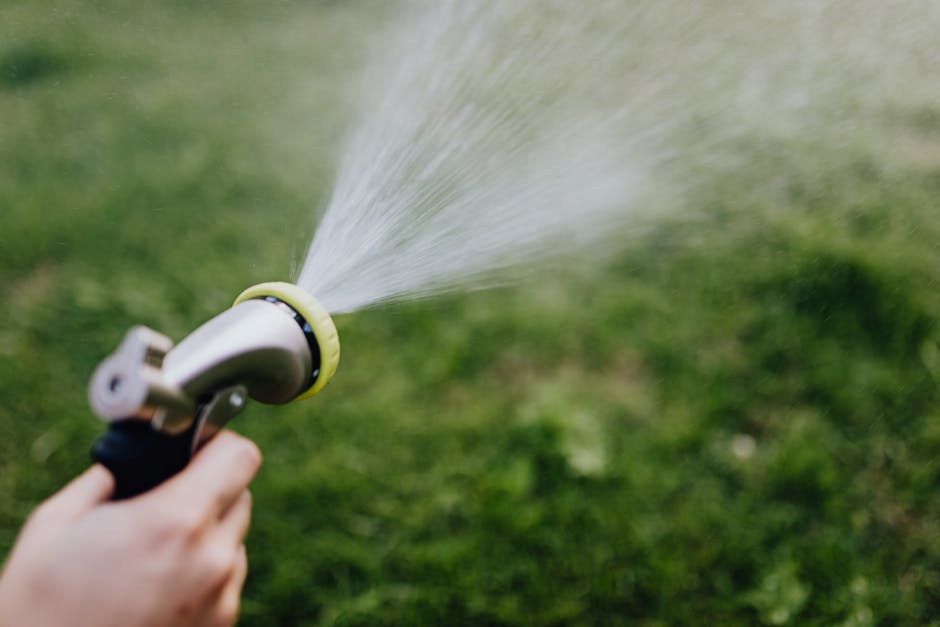
The application process couldn’t be more straightforward. Most of these products come with a hose-end sprayer attachment that connects directly to your garden hose. Just attach, turn on the water, and spray – no need for expensive spreaders or complicated equipment. Even coverage happens naturally as you water, giving your new sod the uniform start it deserves.
Why it’s the best fertilizer for new sod during heat
When the Massachusetts summer heat cranks up, your newly installed sod becomes particularly vulnerable. I’ve seen many beautiful new lawns struggle during hot spells, which is precisely why carbon-infused liquid starters shine in these conditions.
First and foremost, these formulations dramatically reduce burn risk. The diluted application method combined with those carbon compounds creates a buffering effect against fertilizer salts. This means you’re far less likely to see those dreaded brown patches that can appear when granular products get too hot.
Another benefit that my customers absolutely love is the quick visual feedback. There’s something deeply satisfying about seeing your investment respond with a beautiful green color within days of application. This immediate green-up isn’t just cosmetic – it’s a sign that photosynthesis is kicking in and your turf is establishing itself.
The added carbon compounds might be my favorite feature of all. Beyond just feeding your grass, they’re working to improve your soil’s structure, boost microbial activity, and help retain precious moisture during those hot days. As our turf specialist often says, “Carbon-based fertilizers improve overall soil health beyond traditional NPK focus.” This holistic approach makes an enormous difference, especially in newer developments where construction may have stripped away much of the natural topsoil.
For the best results during hot weather, we always recommend applying these liquid fertilizers during the cooler parts of the day – early morning or evening is perfect. This reduces evaporation and gives your sod more time to absorb those nutrients. Most liquid starters can be safely reapplied every 2-3 weeks at a reduced strength, creating a gentle, consistent feeding schedule that supports establishment without risking nutrient burn.
When summer heat threatens your new sod investment, a carbon-infused liquid starter provides the perfect balance of immediate nutrition and reduced stress – exactly what your lawn needs during those challenging first weeks.
Product 4: Organic Granular Starter (4-4-4)
When you’re installing new sod around your Massachusetts home, especially if you have little ones or four-legged friends running around, our organic starter fertilizer might be your perfect match. These natural, compost-based products typically come with a modest 4-4-4 NPK ratio, but don’t let those lower numbers fool you—they pack a powerful punch for your lawn’s long-term health.
Unlike synthetic options, organic starters get their nutrients from Mother Nature’s pantry: composted poultry manure, bone meal, and plant materials that break down gradually. This slow-release approach isn’t just feeding your grass—it’s feeding an entire underground ecosystem of beneficial microbes that will support your lawn for seasons to come.
I’ve seen how these organic options have transformed lawns across Medford, Melrose, and North Reading. Many Massachusetts communities now have phosphorus regulations to protect our local waterways (something we take seriously at Steve’s Services), and organic fertilizers typically comply with these rules while still delivering the phosphorus your new roots desperately need.
Best fertilizer for new sod when kids & pets are present
If your backyard doubles as a playground, organic starters offer peace of mind you just can’t put a price on. The low salt content means less risk of burning sensitive paws or irritating skin when your dog inevitably rolls around on the freshly treated lawn. And without harsh synthetic chemicals, you won’t lose sleep worrying about what might happen if your curious toddler decides to taste-test a blade of grass.
Environmental safety is another huge benefit. When you choose organic products, you’re teaching the next generation about environmental stewardship while protecting local wildlife and water resources. I’ve had customers tell me they’ve noticed more beneficial insects and birds returning to their yards after switching to organic lawn care methods.
Soil health improvement is where organic fertilizers truly shine. That complex organic matter works like magic on your soil structure, helping it retain moisture better during those hot Massachusetts summers while creating a thriving microbial community. Think of it as building a solid foundation for your home—it might take a little longer, but the results last for generations.
While you’ll need to be a bit more patient—typically waiting 2-3 weeks to see visible results compared to the quick green-up from synthetics—the long-lasting benefits make it worthwhile. For best results, try to time your application just before a light rain, which helps kickstart the biological breakdown process that makes those nutrients available to your new sod.
For more comprehensive information about organic lawn care approaches, you can check out our detailed organic lawn care guide that covers everything from soil testing to seasonal maintenance schedules.
Product 5: Dual-Technology Liquid + Granular Kit
If you’re looking for the complete package for your new sod, dual-technology kits might be your perfect match. These clever combo packs combine the immediate boost of liquid fertilizers with the staying power of granular products – giving your new lawn exactly what it needs, when it needs it.
I’ve seen many Massachusetts homeowners struggle with timing their fertilizer applications just right. These kits take the guesswork out of the equation by providing a strategic one-two punch: first, a quick-release liquid starter that feeds your grass immediately when roots are just beginning to establish, followed by a slow-release granular formula that continues feeding for weeks afterward.
What makes these systems really shine is their comprehensive approach. Beyond just the basic NPK nutrients, most combo kits include essential micronutrients like iron (for that deep green color), manganese, and zinc. These trace elements might seem minor, but they’re crucial for photosynthesis and overall plant health – especially in our Massachusetts soils where certain micronutrients can be lacking.
Best fertilizer for new sod for busy homeowners
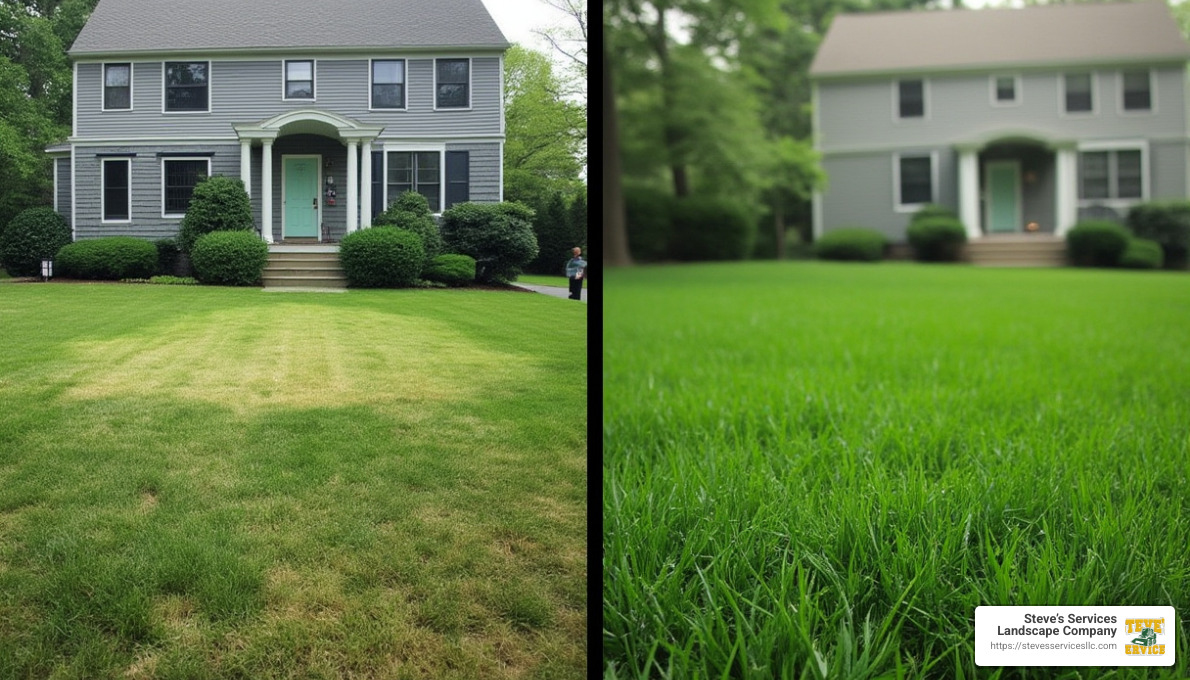
Let’s be honest – between work, family, and everything else life throws at you, babysitting your new lawn isn’t always at the top of your priority list. For our busy clients in Reading, Wakefield, and Woburn, these all-in-one kits have become incredibly popular, and for good reason.
The pre-measured bottles eliminate any confusion about application rates. You won’t find yourself squinting at tiny print on the back of a fertilizer bag, trying to figure out if you should be applying 3 or 5 pounds per thousand square feet. Each component comes ready to use in exactly the right amount for optimal results without risking over-application.
Equipment requirements are minimal too. Most kits include simple hose-end sprayers for the liquid components that attach directly to your garden hose. The granular products typically come in shaker containers or easy-spread bags that don’t require expensive broadcast spreaders. This simplicity is perfect if you’re new to lawn care or don’t want to invest in specialized equipment.
Perhaps most valuable is the month-long coverage these kits provide. A typical 30-day program includes 3-4 applications spaced throughout the critical establishment period. This ensures your new sod receives consistent nutrition during its most vulnerable phase without you having to remember complex feeding schedules.
“After the first 30 days, switch from a starter fertilizer to a regular fertilizer regimen for ongoing lawn health,” advises our turf specialist at Steve’s Services. The good news is that most dual-technology kits make this transition clear with detailed instructions for continuing care once the initial establishment period is complete.
While you’ll typically pay more upfront for these all-in-one solutions compared to single products, they eliminate the need to purchase multiple fertilizers separately. For many of our clients in Burlington, Danvers, and surrounding areas, the convenience and peace of mind are well worth the investment when protecting their new sod installation.
After all, when you’ve invested in beautiful new sod, giving it the right start with a comprehensive feeding system just makes sense – especially when it’s designed to be as hassle-free as possible.
How to Choose & Apply the Best Fertilizer for New Sod
Getting your hands on the best fertilizer for new sod is just the beginning of your lawn success story. How and when you apply it makes all the difference between a patchy disappointment and a lush, envy-of-the-neighborhood lawn. After helping hundreds of Massachusetts homeowners establish beautiful lawns, we’ve learned a thing or two about getting it right.
Before you open that fertilizer bag, take a moment to understand what your soil actually needs. A simple soil test will reveal your soil’s pH and existing nutrient levels, saving you from wasting money on nutrients your soil already has in abundance. Most of our clients are surprised by their test results! Massachusetts residents can get affordable soil testing through the UMass Extension Service, which provides detailed recommendations specific to our region’s growing conditions.
When it comes to application, your spreader settings matter tremendously. Here’s a pro tip that will save your new sod from potential burn: set your spreader to half the rate recommended on the fertilizer bag. For most starter fertilizers, this means applying about 0.5 pounds of actual nitrogen per 1,000 square feet instead of the full pound rate that established lawns might receive.
Michael Romine puts it perfectly: “Never, ever just… throw it out with your hand. That is the world’s worst thing that you can do for anything.” We call this “chicken feeding” in the industry, and it’s a recipe for patchy growth and burned spots that can take months to recover.
After application, water thoroughly! This critical step washes the fertilizer off grass blades (where it can burn) and into the soil where roots can access it. A deep watering also prevents fertilizer salts from drawing moisture out of your grass tissues – the primary cause of that dreaded fertilizer burn.
Best fertilizer for new sod timing checklist
The when matters just as much as the how. For Massachusetts lawns, follow this timeline for the best results:
First, prepare your soil before installation by working a balanced starter fertilizer into the top 2-3 inches. This gives new roots immediate access to nutrients as they begin to establish.
For the first 4-6 weeks after installation, focus exclusively on proper watering. Your new sod needs consistent moisture to establish roots, but doesn’t need additional fertilizer just yet. Patience here pays off!
Around the 4-6 week mark is when you’ll apply your chosen starter fertilizer at half-rate. By this time, roots have begun establishing downward growth and can efficiently use the nutrients you’re providing.
Time this first application strategically – early spring, late spring, or early fall provide ideal growing conditions for the cool-season grasses we commonly use in Massachusetts.
After 8-10 weeks, transition from your starter formula to a regular maintenance fertilizer with higher nitrogen for established turf. Your lawn has different nutritional needs once it’s put down roots.
Kentucky bluegrass and fescue (our most common Massachusetts turf grasses) respond best to fertilization in early spring and fall when they’re actively growing. Avoid heavy feeding during summer heat when these grasses naturally slow their growth patterns.
Even application techniques
The difference between a professional-looking lawn and an amateur one often comes down to application technique. Here’s how we achieve those perfectly even results:
For most home lawns, a broadcast (rotary) spreader provides the most efficient coverage. While drop spreaders offer precision, they require more careful technique to avoid striping. Make perpendicular passes across your lawn for complete coverage – first in one direction, then make a second pass at a 90-degree angle to the first.
Start with what we call the “edge first technique” – apply a header strip around the perimeter of your lawn, then fill in the middle with back-and-forth passes. This prevents accidentally throwing fertilizer onto driveways or gardens.
Maintain a steady walking pace while operating your spreader. It seems simple, but changing speeds alters the application rate and creates uneven feeding. Think of it as a relaxed stroll, not a race.
If any fertilizer lands on hard surfaces like driveways or walkways, sweep or blow it back onto the lawn promptly. This prevents staining and keeps nutrients from washing into storm drains where they can contribute to water pollution – something we take seriously in our watershed-conscious Massachusetts communities.
Watering practices after fertilizing
The magic happens when you nail your post-fertilization watering routine:
Water deeply immediately after applying fertilizer. You want enough moisture to penetrate about 6 inches into the soil profile, encouraging roots to grow downward rather than laterally near the surface. In most soil types, this takes about 30-45 minutes of steady watering per section.
Plan to fertilize and water in the morning hours when wind is typically calmer and evaporation rates are lower. This maximizes the effectiveness of both your fertilizer and your watering efforts.
As your sod establishes, gradually reduce watering frequency while increasing duration. This “weaning” process trains roots to grow deeper in search of moisture, creating a more drought-resistant lawn long-term.
Keep an eye out for signs of fungal disease, especially after fertilization during humid periods. Brown patches, mushrooms, or slimy areas may indicate fungal activity that requires prompt treatment. New sod with its constant moisture needs can be particularly susceptible.
Be flexible with your schedule based on Mother Nature’s plans. If significant rain (more than 0.5 inches) is forecast within 24 hours of your planned application, consider postponing. Heavy rain can wash away your fertilizer investment before it has a chance to work its magic.
For more detailed information about proper watering schedules for new sod, check out the USDA Cooperative Extension office resources, which provide region-specific guidance based on scientific research.
By following these guidelines from Steve’s Services, you’ll maximize the effectiveness of your fertilizer while minimizing environmental impact and protecting your investment in new sod. And remember, if the DIY approach feels overwhelming, our team is always here to handle the technical aspects of lawn establishment for you, ensuring your new sod gets exactly what it needs, when it needs it.
Frequently Asked Questions about Fertilizing New Sod
What NPK ratio should I use on brand-new turf?
I get this question all the time from homeowners across Everett, Lynnfield, and other Massachusetts communities. For most new sod installations, you’ll want to stick with a balanced NPK ratio like 15-15-15, 16-16-16, or 8-8-8. These provide equal amounts of nitrogen, phosphorus, and potassium – the three nutrients your new lawn needs most.
Think of it as giving your new lawn a balanced meal rather than loading up on just one nutrient. Your grass needs nitrogen for that lush green color, phosphorus to develop strong roots, and potassium to build disease resistance and overall hardiness.
If your soil test shows you’re low on phosphorus (which is common in many Massachusetts yards) or if you’re dealing with compacted clay soil (I’m looking at you, Revere and Saugus homeowners!), consider a phosphorus-rich formula like 10-20-10 or 12-24-12. The higher middle number gives your new roots an extra boost to establish themselves quickly.
For properties near waterways or in towns with phosphorus restrictions, you’ll need to look for low-phosphorus or phosphorus-free options. In these cases, focus more on proper soil preparation before the sod goes down.
The best fertilizer for new sod ultimately depends on your specific soil conditions. When in doubt, go with a balanced formula and apply it at half-strength – it’s always better to underfeed than overfeed new turf.
How soon after laying sod should I fertilize?
Here’s a common misconception I hear from excited new sod owners: “I need to fertilize right away to help it root!” Actually, that’s not the case at all. You should wait 4-6 weeks after installation before applying your first round of fertilizer.
Why wait? Your new sod needs time to establish its initial root system first. Fertilizing too early actually works against you by encouraging top growth before the roots can properly support it. It’s like asking someone to run before they can walk!
Plus, most professional sod farms (including all the suppliers we work with at Steve’s Services) fertilize their sod shortly before harvest. This means your new lawn already has nutrients to support those first few weeks of growth.
As my colleague Michael Romine puts it, “Wait about one month from the time that it’s been laid down, four to six weeks, and then we recommend that you put out a balanced fertilizer such as a triple 15.”
During this waiting period, focus entirely on proper watering. Keep the soil consistently moist (but not soggy) with daily watering for the first two weeks. Then gradually reduce frequency while increasing duration to encourage those roots to grow deeper. Your patience during this period will be rewarded with a stronger, more resilient lawn.
Is granular or liquid better for rookie lawn owners?
If you’re new to lawn care and feeling a bit overwhelmed, don’t worry – both granular and liquid fertilizers can work well for your new sod. It’s kind of like choosing between an automatic or manual transmission car – both will get you where you need to go, but one might feel more comfortable based on your preferences.
Granular fertilizers tend to be more forgiving for beginners because you can actually see where you’ve applied the product. They’re less likely to cause severe burn if you accidentally overlap a bit, and they typically provide a slower, longer-lasting feeding that requires fewer applications throughout the season. The basic broadcast spreaders you need are relatively inexpensive (around $30-50) and simple to use.
Liquid fertilizers have their own advantages. If you don’t want to invest in a spreader, most liquid products connect directly to your garden hose with a simple attachment. They’re great for lawns with slopes where granules might wash away, and they typically show quicker results, which can be satisfying when you’re anxiously watching your new lawn establish.
For most first-time sod owners in our Massachusetts service area, I recommend starting with a quality granular starter fertilizer. Just remember to set your spreader to half the recommended rate for that first application – this conservative approach minimizes risk while still providing the nutrients your lawn needs.
If you’re still unsure about proper application techniques, give us a call at Steve’s Services. We’d be happy to handle that first fertilization for you and show you exactly how it’s done. After all, your new lawn is an investment worth protecting!
Conclusion
Changing your property with fresh sod is a significant investment, and choosing the best fertilizer for new sod plays a crucial role in that success story. After working with hundreds of Massachusetts homeowners, I’ve seen how proper fertilization can make the difference between a struggling lawn and one that thrives for years to come.
Think of your new sod like a toddler who’s just learning to walk – it needs the right support at the right time, but too much “help” can actually set it back. That’s why timing and moderation are everything when it comes to fertilizing new turf.
Let me share what really works based on our years of experience serving communities from Burlington to Wakefield:
First, patience truly pays off. Those first 4-6 weeks after installation are all about root development, not feeding. Your sod already comes with enough nutrients to get established – pushing extra food too soon is like forcing dessert on someone who just finished a big meal.
When you do reach that 4-6 week mark, a balanced starter fertilizer gives your lawn exactly what it needs – not too much, not too little. That 15-15-15 formula is our go-to recommendation for most Massachusetts properties because it supports both what’s happening above and below ground.
The best fertilizer for new sod is only effective when applied correctly. I can’t stress enough how important it is to use half the recommended rate for that first application. I’ve seen too many disappointed faces standing over burned patches of new sod because they thought “more must be better.” Trust me – it’s not!
Watering immediately after fertilizing isn’t just helpful – it’s essential. A thorough soaking moves those nutrients down to the root zone where they can actually do some good instead of burning the grass blades.
The equipment you use matters too. I remember visiting a client in Melrose who had tried to save money by hand-broadcasting fertilizer. The result looked like a patchwork quilt of dark green and yellow spots. A basic broadcast spreader is worth every penny for the even coverage it provides.
Once your sod is established, transitioning to a regular maintenance schedule appropriate for your specific grass type will keep it looking its best through our challenging Massachusetts seasons.
At Steve’s Services, we’ve helped countless homeowners avoid the common pitfalls that can derail new sod establishment – fertilizing too soon, applying at full strength, inconsistent watering, and improper spreading techniques. These simple mistakes can cost you hundreds or even thousands in replacement costs down the road.
Proper fertilization works hand-in-hand with appropriate mowing height (never remove more than ⅓ of the blade at once), consistent watering practices, and regular monitoring for potential problems. This holistic approach creates a resilient lawn that can withstand our New England weather extremes.
Whether you’re tackling your lawn care independently or looking for professional support, our team at Steve’s Services Landscape Company is here to help you achieve the lush, vibrant lawn you envision. After all, a beautiful lawn isn’t just about curb appeal – it’s about creating an outdoor space where memories are made.
For more detailed guidance on caring for your new sod, visit our comprehensive guide at Steve’s Services sod care resources. Your lawn’s success is our success!