
Why Beech Hedge Pruning Makes All the Difference
Beech hedge pruning is the key to maintaining a dense, healthy hedge that provides privacy and beauty year-round. Here’s what you need to know:
Quick Guide to Beech Hedge Pruning:
- When to Prune: Late summer (mid-August) for maintenance; February for renovation
- Best Tools: Sharp secateurs for clean cuts; loppers for thicker branches
- Ideal Shape: Trapezoid (wider at bottom, narrower at top) for light penetration
- Key Benefit: Proper August pruning encourages the hedge to retain leaves through winter
A beautifully maintained beech hedge transforms your property. It offers privacy, noise reduction, and something most deciduous hedges can’t match—year-round screening. This happens because of a phenomenon called marcescence, where beech hedges hold onto their dead leaves throughout winter when pruned at the right time.
But here’s the thing: timing and technique matter. Prune at the wrong time or with the wrong approach, and you risk gaps, brown leaves, and a scraggly appearance. Prune correctly, and you’ll have a dense, attractive hedge that keeps its foliage even in the coldest months.
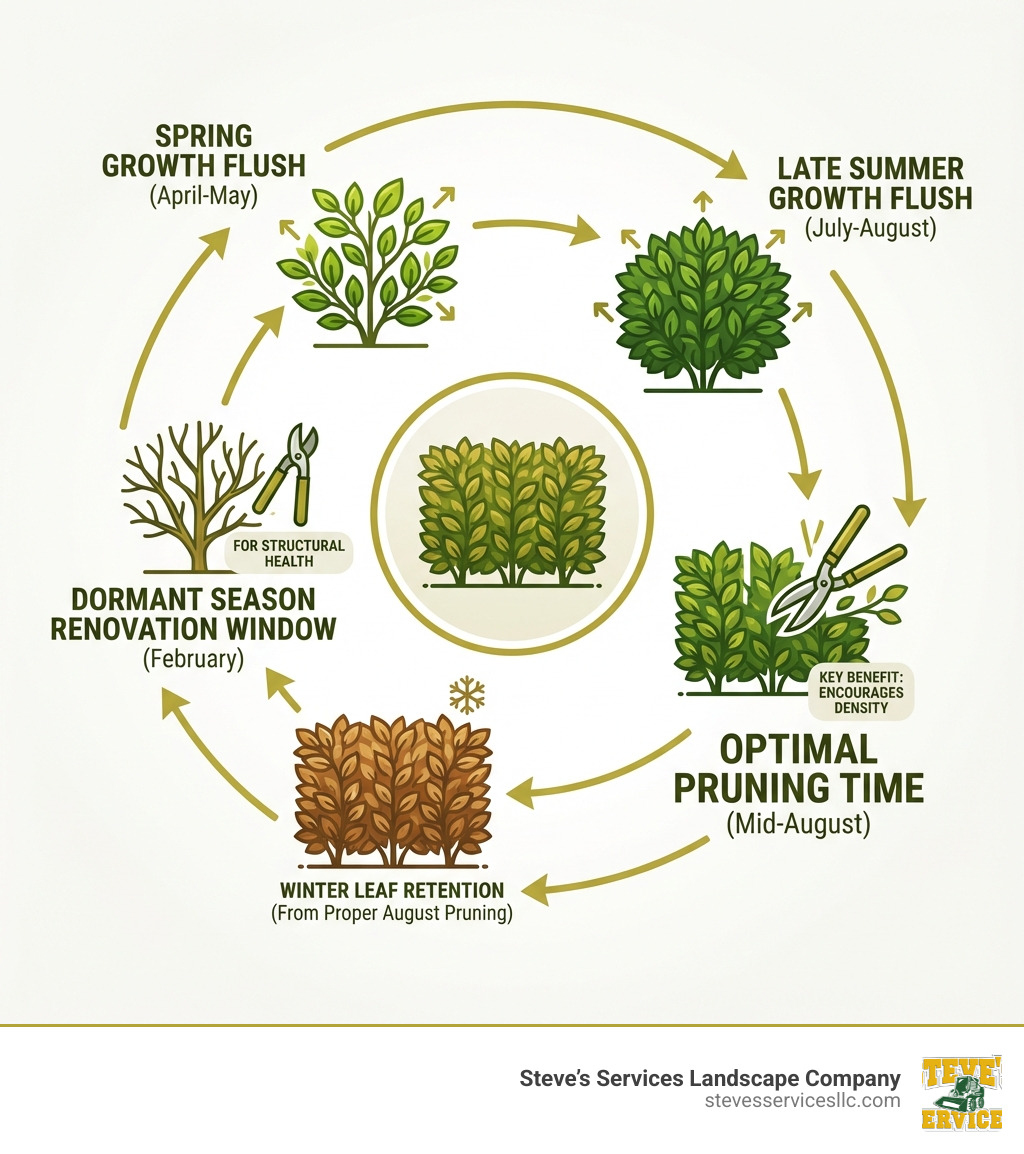
Beech hedges put on two flushes of growth each year—one in spring and another in late summer. Professional pruning after each flush maintains the hedge’s shape and encourages denser growth. The average growth rate of 30 to 60 centimeters per year means regular maintenance isn’t optional—it’s essential.
I’m Steve Sylva, and over my 25+ years in the landscaping industry, I’ve refined the art of beech hedge pruning to help Massachusetts homeowners achieve that professional look. At Steve’s Services, we understand the unique challenges and timing requirements that make beech hedges thrive in our New England climate.
Why Professional Pruning is Crucial for Your Beech Hedge
A beech hedge, left to its own devices, will eventually revert to a scraggly tree or bush. While beautiful in its natural form, it won’t provide the neat, dense boundary most homeowners desire. This is where professional beech hedge pruning comes into play, offering a multitude of benefits that extend far beyond mere aesthetics.
First and foremost, regular and expert pruning contributes significantly to hedge density and structural integrity. When we prune, we’re not just cutting; we’re encouraging the plant to produce more branches and leaves. This stimulation leads to a fuller, more robust hedge with fewer gaps or bald spots. A dense hedge offers superior privacy and noise reduction, becoming a solid green wall rather than a see-through screen.
Secondly, professional pruning ensures aesthetic appeal. A well-pruned beech hedge is a statement piece in any landscape. It looks tidy, purposeful, and contributes to the overall curb appeal of your property. Without proper shaping, a hedge can become unruly, detracting from your home’s exterior. Our skilled team knows how to create clean lines and consistent shapes that improve your landscape’s design.
Moreover, proper pruning is vital for encouraging healthy growth. By removing dead, diseased, or crossing branches, we improve air circulation and sunlight penetration throughout the hedge, reducing the risk of fungal diseases and promoting vigor. This also helps prevent that scraggly appearance, ensuring every part of your hedge receives the light and air it needs to thrive.
Perhaps one of the most unique benefits of correctly timed beech hedge pruning is maximizing winter foliage retention. Beech hedges are deciduous, meaning they naturally lose their leaves. However, with precise pruning in late summer (typically mid-August), we encourage a flush of new growth that the hedge holds onto throughout the winter. This remarkable characteristic, known as marcescence, allows your beech hedge to provide year-round screening, a distinct advantage over many other deciduous hedging plants.
At Steve’s Services, our approach to beech hedge pruning is rooted in understanding the plant’s biology and growth patterns. We don’t just trim; we cultivate. This professional care ensures your hedge remains a healthy, beautiful, and effective feature of your landscape for years to come.
For more information on how we can keep your entire landscape looking its best, explore our landscape maintenance services.
The Professional Calendar for Beech Hedge Pruning
Timing is paramount when it comes to beech hedge pruning. Pruning at the wrong time can stress the hedge, lead to sparse growth, or even prevent it from retaining its beautiful winter foliage. As experienced landscapers in Massachusetts, we follow a precise calendar to ensure optimal health and appearance for your beech hedges.
For newly planted beech hedges, we focus on formative pruning. This initial shaping encourages strong branching from the base upwards. We typically perform a light trim of terminal growth buds at planting and repeat this during the first two winters when the plants are dormant. In August of the second summer, we’ll also give it another light trim. If the plants are sparse, we might shorten leading and longer shoots by up to one-third in winter or immediately after planting, repeating this in the second year if necessary. From the third year onwards, the hedge will be ready for regular maintenance.
Maintenance pruning for established beech hedges is ideally performed twice a year to keep them dense and tidy.
- The primary trim for established hedges is in late summer, specifically the second week of August. This timing encourages a flush of new leaves that the hedge will then retain throughout the winter, providing that coveted year-round screening.
- For an even bushier hedge, an additional light trim can be done at the end of June (around Midsummer’s Day). During this summer maintenance cut, we typically trim new stems back by half to two-thirds of their length, leaving one-third of the new growth.
When dealing with neglected or severely overgrown hedges, we undertake renovation pruning, also known as hard pruning. This is best done in the dormant season, typically February, before new growth begins. This allows the hedge to recover without the added stress of actively growing foliage.
A critical consideration for all pruning activities in Massachusetts, and indeed across the Northern Hemisphere, is avoiding the bird nesting season. Generally, this period runs from March to August. Under wildlife protection acts like the federal Migratory Bird Treaty Act, it is an offense to damage or destroy wild bird nests. Therefore, before any significant trimming, especially during these months, our team always conducts a thorough check for nesting birds. If nests are found, we postpone pruning until the young birds have fledged. This is not just a legal consideration for wildlife but also an ethical practice we uphold. While light shaping might be permissible if no birds are nesting, severe trimming is strictly avoided during this sensitive period.
The Art and Science of Professional Beech Hedge Pruning
Achieving a perfectly manicured and healthy beech hedge requires more than just a quick trim. It’s a blend of skilled technique, understanding plant physiology, and using the right tools. At Steve’s Services, we approach beech hedge pruning as both an art and a science.
Our professional tool selection is crucial for clean, precise cuts that promote healing and prevent disease. For smaller branches and detailed shaping, we rely on sharp secateurs or hand pruners. These tools make clean cuts, which are essential because rough cuts can damage the leaves, causing them to turn brown and look unsightly. For thicker branches, loppers are indispensable, allowing us to cut through branches up to 1.75 inches thick with ease. For longer hedges and maintaining an even surface, we use high-quality powered hedge trimmers, ensuring efficiency and a consistent finish.
An important distinction in beech hedge pruning is between Green Beech (Fagus sylvatica) and Copper Beech (Fagus sylvatica ‘Purpurea’). While the pruning techniques are largely the same, their appearance and optimal placement differ. Green Beech hedges boast lush, vibrant green leaves throughout the growing season, turning a beautiful yellow-orange in autumn before the leaves brown and are retained in winter. Copper Beech, on the other hand, provides striking dark coppery-brown to purple foliage in spring and summer, often flushing red in autumn. Copper Beech varieties develop their best color when planted in full sun, while some yellow-leaved forms prefer partial shade to avoid scorching. Regardless of the variety, the goal is always a dense, healthy hedge.
The importance of clean cuts cannot be overstated. A clean cut heals quickly, minimizing the plant’s exposure to pathogens and reducing the risk of infection. When making cuts, especially for larger branches, we ensure they are clean and free of ragged ends. For very large cuts (those with a diameter greater than 2.5 inches), we may even apply a wound treatment to further protect the plant, although cuts of this size on beech may not heal readily. This meticulous approach to cutting is a cornerstone of our professional service, directly contributing to the long-term health and vitality of your hedge and preventing disease.
For more information on how we can expertly care for your bushes and shrubs, visit our page on bush pruning.
How Professionals Shape a Beech Hedge for Optimal Health
When we approach beech hedge pruning, our objective isn’t just to make it shorter or narrower; it’s to sculpt it for long-term health and aesthetic perfection. The ideal form for a beech hedge, and indeed most formal hedges, is a trapezoidal shape (often called an A-shape). This means the hedge is wider at the base and gradually tapers inward towards the top, making it slimmer at the crown.
This specific shaping offers several critical benefits:
- Sunlight Penetration: The wider base allows ample sunlight to reach the lower branches. If the top were wider than the bottom, the upper canopy would shade out the lower parts, leading to sparse, bare sections at the base. This “A-shape” ensures uniform leaf coverage from top to bottom, keeping your hedge dense and healthy all the way down.
- Snow Load Resistance: In Massachusetts, we’re no strangers to heavy snowfall. A trapezoidal shape is inherently more stable under snow loads. Snow tends to slide off the angled sides rather than accumulating on a flat, wide top, which can cause branches to break or the hedge to splay open.
To achieve this precise shape, especially for a perfectly straight and level hedge, we often employ using guide lines for precision. We use landscaping twine pulled taut between bamboo poles or stakes positioned along the hedge’s length. A hanging level on the twine ensures the line is perfectly straight, providing an undeniable visual guide for both the top and sides. This meticulous preparation is key to achieving a level top and consistently angled sides that define a professionally pruned hedge.
Professional Techniques for Young vs. Established Beech Hedge Pruning
The approach to beech hedge pruning varies significantly depending on the age and establishment of the hedge. Our techniques are custom to encourage the desired growth and form at each stage of its life.
For pruning young hedges, the focus is on encouraging branching and developing a strong, dense structure from the ground up. When we first plant a beech hedge, we might lightly trim the terminal growth buds off each shoot. This simple step tells the plant to put energy into lateral growth rather than just growing taller, leading to a bushier base. For sparse young plants, we may also prune by shortening leader shoots (the main upright stems) by up to one-third in winter or immediately after planting. We might repeat this in the second year. This early intervention is crucial for forming a dense screen that retains its leaves well into winter.
Once a beech hedge is mature and has reached its desired height and width, the goal shifts to pruning established hedges for maintaining desired size and shape. This is typically done with our main maintenance prune in mid-August. During this trim, we focus on trimming new growth by two-thirds, ensuring the hedge remains within its boundaries while still encouraging the growth that will provide winter screening. For hedges that need to be even bushier, an additional light trim in late June helps manage the second flush of growth. This regular, precise trimming keeps the hedge looking neat and prevents it from becoming overgrown and unruly.
Expert Methods for Renovating Overgrown Beech Hedges
Sometimes, we encounter beech hedges that have been neglected for years, becoming tall, wide, and unsightly. These overgrown hedges can seem daunting, but with our expert methods for renovating overgrown beech hedges, we can bring them back to life.
This process involves what we call hard pruning, which means cutting back significantly, even into old wood. The good news is that beech hedges are remarkably resilient and tolerate cutting into old wood without lasting damage. In fact, you can reduce the height and width of an overgrown beech hedge by 50% or even more. However, this is a major operation and can be a shock to the plant.
To ensure the hedge’s health and successful recovery, we recommend a staged renovation over 2-3 seasons. We begin this process in late winter or early spring, typically February or March, when the hedge is dormant and before new growth starts.
Here’s how we typically approach it:
- First Spring (February/March): We first reduce the overall height of the hedge, often by up to 50%, using a taut string line as a guide for an even cut. We then tackle one side of the hedge, cutting it back significantly to its desired width. We use sharp pruning saws for larger branches and apply wound treatment to any cuts larger than 2.5 inches.
- Allow for Recovery: We leave the second side of the hedge untouched for a full growing season. This allows the plant to recover, put out new growth on the pruned side, and maintain enough foliage on the unpruned side to photosynthesize and support its recovery.
- Second Spring (February/March): The following spring, we prune the remaining side, again reducing it to the desired width. We continue to feed and mulch the hedge to encourage vigorous new growth.
- Third Season (Optional): In some cases, for extremely overgrown or weakened hedges, the renovation might extend into a third season, or we might delay cutting the second side for another year if the initial regrowth is minimal.
After such a significant prune, we encourage regrowth by feeding the hedge with a balanced fertilizer, loosening the topsoil, watering well, and applying a thick layer of mulch. This comprehensive approach ensures that even the most overgrown beech hedge can be refreshd, restoring its beauty and health within two to three seasons.
For larger scale landscape projects and cleanups, remember Steve’s Services is here to help. Find more about our landscape cleanup services.
Post-Pruning Care and Health Management
Once your beech hedge pruning is complete, the work isn’t entirely finished. Proper post-pruning care is crucial for the hedge’s recovery, health, and vigorous regrowth. At Steve’s Services, we ensure that every hedge we prune receives the attention it needs to thrive.
Immediately after pruning, especially if it was a hard cut or during a dry spell, post-pruning watering is essential. Beech hedges, particularly young ones, require consistent moisture to recover and establish new growth. We ensure the soil around the base of the hedge is adequately watered, allowing the moisture to penetrate deeply.
Fertilizing for recovery is another vital step, particularly after significant pruning or renovation. We apply a balanced fertilizer, such as Growmore, to replenish nutrients and stimulate new growth. This is typically done in the second spring after initial planting or after a hard renovation cut. Before applying fertilizer, we gently loosen the top few inches of soil to ensure the nutrients can reach the roots effectively.
To further support the hedge, we recommend mulching benefits. Applying a thick layer of organic mulch, such as bark chippings or well-rotted compost, around the base of the hedge (about 40-60 cm wide and 10 cm deep) provides numerous advantages. Mulch helps retain soil moisture, suppresses weeds, and gradually releases nutrients into the soil as it breaks down. It’s important to avoid piling mulch directly against the woody stems to prevent rot.
Beyond immediate post-pruning care, ongoing health management involves regular inspection. We are diligent about identifying and removing dead or diseased branches. Any branches that appear discolored, withered, or show signs of disease are cut back to the nearest healthy branch or bud. This prevents the spread of potential infections and directs the plant’s energy towards healthy growth. Dead and diseased branches are always disposed of safely, often by burning or burying, to ensure any pathogens are contained.
Regular landscape maintenance is key to a thriving property. Learn more about our comprehensive regular landscaping maintenance programs.
Common Pests and Diseases Affecting Beech Hedges
While generally robust, beech hedges can sometimes be susceptible to certain pests and diseases. Early detection and professional intervention are key to maintaining their health.
One common sight that can cause alarm is the Beech Woolly Aphid. These tiny, sap-sucking insects appear as fluffy white masses on the undersides of beech leaves and stems. While they produce a sticky honeydew that can coat leaves, leading to sooty mold, large infestations rarely cause significant long-term harm to established hedges and often serve as a food source for local wildlife. However, for aesthetic reasons or if the hedge is young and vulnerable, we can discuss appropriate management strategies.
More serious threats include fungal diseases like Honey Fungus, which can cause dieback and eventual death of the hedge, and Beech bark disease, which affects the bark and can lead to cankers and overall decline. Beech leaf disease is also a growing concern, causing dark banding on leaves and premature defoliation.
Other common problems homeowners might notice include general leaf discoloration, dieback of branches, or simply poor growth. These issues can often be symptoms of underlying problems such as nutrient deficiencies, improper watering, or the onset of pests or diseases.
Our professional service includes regular monitoring and treatment for these issues. We keep a watchful eye on your hedges for any signs of distress. If problems are identified, we take swift action, implementing necessary treatments and preventive measures to safeguard the health and vitality of your beech hedge.
Frequently Asked Questions about Beech Hedge Pruning
How far back can a beech hedge be cut?
A beech hedge is remarkably resilient and can be cut back hard, often by 50% or even more, into old wood. This ability makes them excellent candidates for renovation. However, this is a stressful process for the plant, and for its long-term health, professionals at Steve’s Services recommend a staged approach. We typically spread significant reductions over two or even three seasons, tackling the height and one side in the first dormant season (February/March) and the remaining side in the following dormant season. This allows the hedge ample time to recover and put out new growth.
Why do my beech hedge leaves stay on in winter?
This fascinating phenomenon is called marcescence. While beech is a deciduous tree, young and clipped beech hedges, when properly maintained, retain their dead, brown leaves throughout the winter. This provides excellent privacy and screening even when other deciduous plants are bare. The key to this is precise beech hedge pruning in late summer (around mid-August). This timing encourages a flush of new growth that the hedge holds onto through winter, rather than shedding it. This unique characteristic is one of the main reasons beech hedges are so popular in Massachusetts.
What is the ideal shape for a beech hedge and why?
The ideal shape for a beech hedge is a trapezoid, meaning it’s wider at the base and gradually tapers inward towards the top. This “A-frame” shape is not just for aesthetics; it’s crucial for the hedge’s health and longevity. The wider base allows sunlight to reach the lower branches, preventing them from becoming bare, sparse, or dying off due to lack of light. This ensures the hedge remains dense and healthy from top to bottom. Additionally, a trapezoidal shape helps prevent snow accumulation on top during our Massachusetts winters, which can otherwise cause branches to break or the hedge to splay open.
Conclusion
Mastering beech hedge pruning is a blend of understanding the plant’s natural growth, employing the right tools, and executing precise techniques. The key takeaways are clear: timing is critical, with August being ideal for maintenance to ensure winter foliage retention, and February reserved for more extensive renovation. The ideal trapezoidal shape is not just visually appealing but vital for the hedge’s health, ensuring light penetration and resilience against snow.
Proper pruning for health and aesthetics transforms your beech hedge into a dense, vibrant, and year-round feature of your landscape. It prevents scraggly growth, encourages new foliage, and protects against disease. For homeowners in the Burlington, Danvers, Everett, Lynnfield, Medford, Melrose, North Reading, Reading, Revere, Saugus, Stoneham, Winchester, Woburn, Malden, or Wakefield, MA area, achieving that perfect look without the hassle is possible. The expert team at Steve’s Services Landscape Company provides professional hedge trimming near me to keep your beech hedges pristine and healthy year-round.
