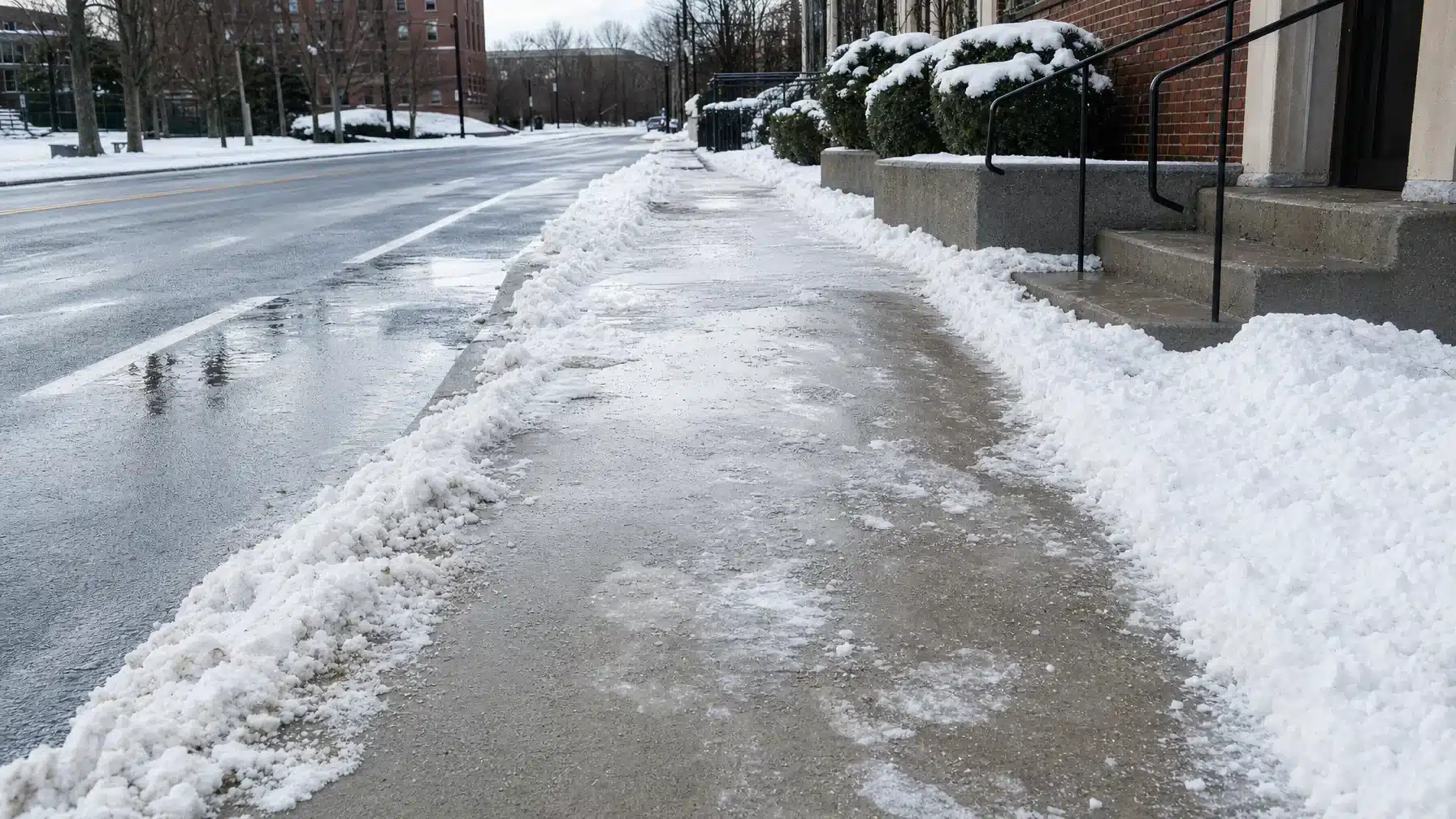
How to Document a Commercial Snow-Clearing Concern
To report a commercial snow removal concern, identify the property and exact location, record when you observed the condition, describe what was visibly present and ask a specific question for review. Keep what you know separate from what needs confirmation, especially the service time, agreed scope and cause of the condition.
Treat the report as a request for clarification, not a finding that work was incomplete or someone was at fault. The structure below is a general communication aid for property managers, not an established Steve’s Services reporting procedure.
Note Do not enter an active clearing area or walk onto a hazardous surface to gather information. Do not delay urgent help to take photographs or finish a report; this guide is not an emergency-response procedure.
Identify the location and observation time
Start with the property name and street address. Then identify the affected entrance, walkway, parking section or loading area using existing signs or shared location labels. Avoid relying on “out front” or “the back lot.” If you use left or right, state the direction you were facing.
Record the date and time you observed the condition, separately from when you sent the message. Label an approximate observation time as approximate rather than making it look exact.
Separate service timing from your observation
Do not use your arrival time as the clearing time. Seeing equipment elsewhere on the property does not establish when the particular area in your report was serviced.
- Known timing: state the available service information and where it came from.
- Estimated timing: label it as an estimate and explain its basis.
- Unknown timing: write “service time unknown” and ask for clarification.
Describe the condition without diagnosing it
Describe what you can actually see and where it extends. Use observable details rather than conclusions such as “the crew missed this” or “the treatment failed.” If you cannot identify a surface condition from your viewing position, say that it is unclear instead of testing it by walking onto it.
Explain the practical access concern: which entrance, delivery activity or pedestrian connection is affected, and what you observed about its use. Distinguish an observed interruption from a possible impact you want reviewed. Do not turn the report into a declaration of safety, accessibility compliance, negligence or contract breach.
Attribute information supplied by an occupant or staff member rather than presenting it as your own observation. Likewise, leave the cause of a later change unresolved unless you directly observed it. Ask whether the location is included in the agreed scope instead of assuming that it is.
Attach photographs with context
If photographs can be taken safely, include a wider view showing the location and a closer view of the visible concern. Label the attachments to match the location in your message, note when they were taken and explain the viewing direction. If a useful view would require approaching equipment or crossing the affected surface, describe the limitation instead.
Keep people, license plates and unrelated personal information out of the frame where practical.
A photograph is supporting context, not the whole report. By itself, it does not establish the agreed service scope, conditions during clearing, service timing or responsibility for a later change. Include the written details even when the photograph seems self-explanatory.
Copy this snow-clearing concern report
Use the following prompts in a message to your contractor through the reporting channel already agreed for the property. Replace each prompt with your information, leaving anything unknown marked as unknown rather than filling gaps with assumptions.
- Subject: Snow-clearing concern for review, add the property and specific location.
- Location: Give the property name, street address, entrance or area label, nearby fixed reference and viewing direction.
- Observation time: Enter the date and time; mark approximate if applicable.
- Visible condition: Describe what you personally observed and the area affected. Note any viewing limitation.
- Access or operational concern: Describe the observed impact, or identify a possible impact requiring review.
- Service timing: Give known information and its source, an estimate and its basis, or write “unknown.”
- Supporting information: Identify labeled photographs with capture times, a relevant service message or a separately attributed report.
- Requested clarification: Please review this condition, confirm whether this location is within the agreed scope and clarify the relevant service timing and any proposed next step.
Record the reply and confirmed next step
Keep the original message, attachments and contractor’s reply together. Record what was clarified, what remains open and any next step explicitly confirmed. Distinguish your request from the contractor’s proposal and from an agreed action; acknowledgment of the message is not confirmation of a return visit or resolution.
If you later observe a change, add a separately timed update rather than replacing the original description. Keep follow-up messages tied to the same property and location so the discussion remains clear.
Steve’s Services provides commercial snow removal services for property owners in the greater Everett, MA area. For service information, visit the Snow Management page. For a concern about an existing arrangement, use your established contractor contact and the report prompts above.