Hydroseed for lawns: 7 Powerful Benefits for a Beautiful 2025
Why Hydroseed for Lawns is Revolutionizing Massachusetts Landscapes
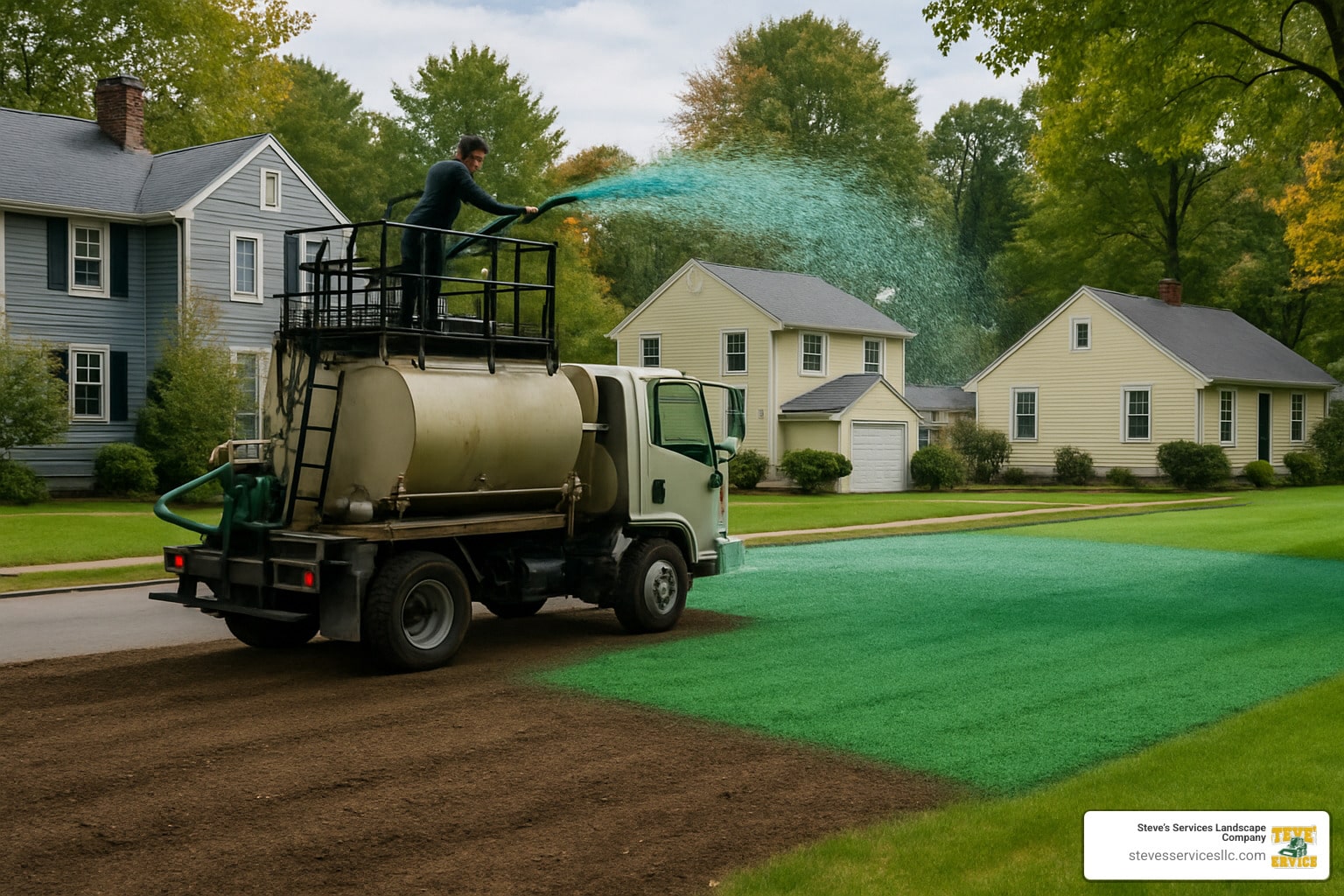
Hydroseed for lawns is a modern planting method that sprays a mixture of grass seed, mulch, fertilizer, and water onto prepared soil for faster, more uniform grass establishment than traditional seeding methods.
Quick Answer: What You Need to Know About Hydroseeding
– What it is: A slurry of seed, mulch, water, and fertilizer sprayed onto soil
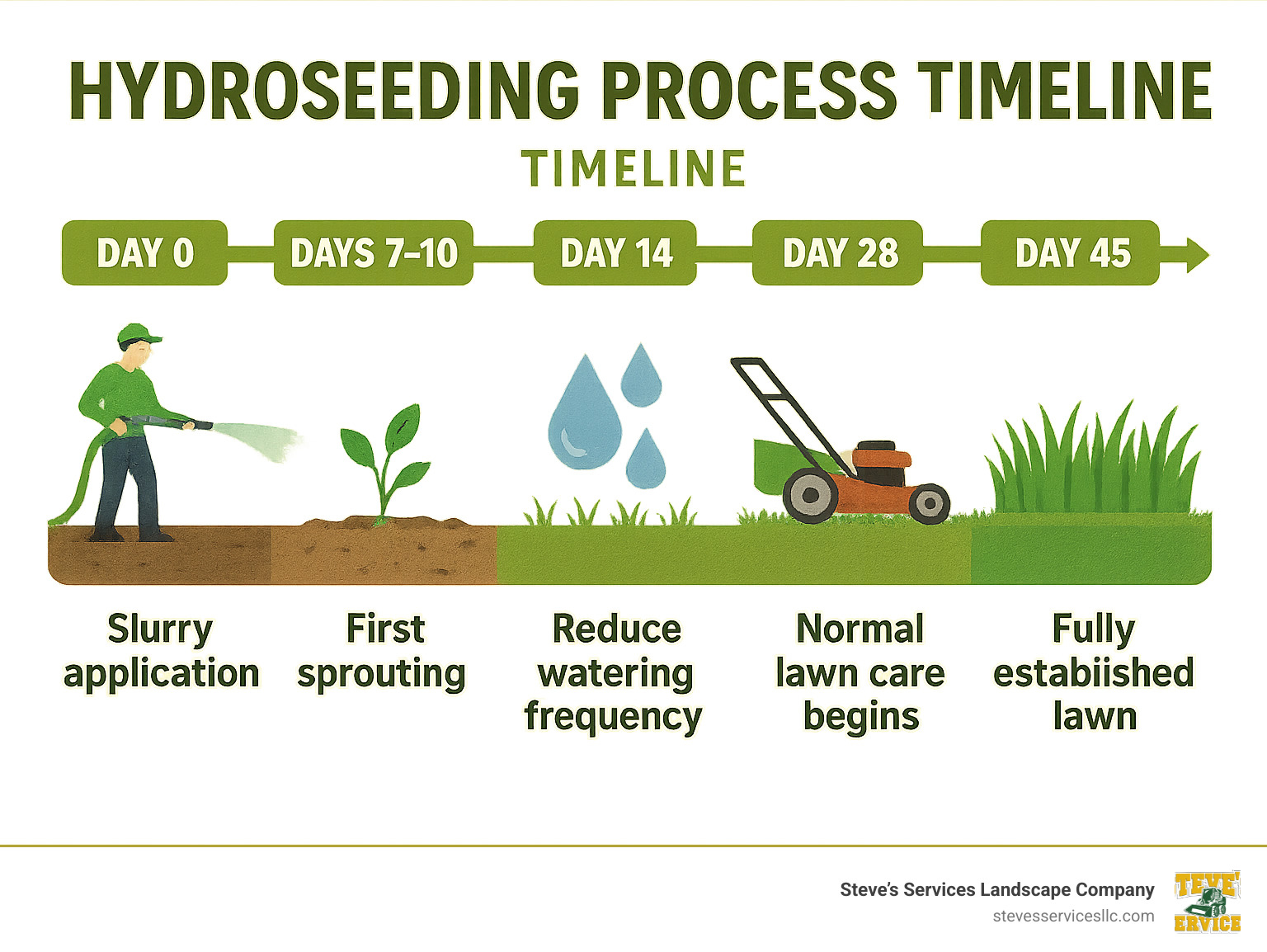
– Speed: Grass sprouts in 7-10 days vs. 3-4 weeks for broadcast seeding
– Cost: $0.06-$0.60 per square foot (averages vary widely by region and prep work)
– Best for: Large areas, slopes, erosion control, and uniform coverage
– Timeline: Mowable lawn in 4-6 weeks with proper watering
Unlike traditional seed-and-straw methods that can blow away or create patchy results, hydroseeding creates an ideal growing environment where seeds stick to the ground and germinate quickly. This spray-applied method costs significantly less than sod installation while delivering faster results than broadcast seeding.
I’m Steve Sylva, owner of Steve’s Services Landscape Company, and I’ve been helping Massachusetts homeowners achieve beautiful lawns through professional hydroseed for lawns applications for over 25 years.
Hydroseed for lawns terms to remember:
– Grass seed hydroseeding
– Grass seeding spray
What Is Hydroseeding & Why It Beats Seed-and-Straw
Hydroseed for lawns combines grass seed, wood-fiber mulch, fertilizer, water, and special additives into a thick, green slurry that gets sprayed directly onto your soil. This creates uniform coverage and moisture retention that traditional seeding can’t match.
When you broadcast seed and lay down straw, you’re fighting against wind, rain, and hungry birds. With hydroseeding, the seeds are locked in place by the mulch and tackifier, creating an erosion-resistant blanket that stays put even during heavy Massachusetts storms.
The results are impressive: hydroseed for lawns typically produces visible grass in just 7-10 days versus 3-6 weeks for traditional seeding. The custom seed blends are designed specifically for New England’s climate, and the starter fertilizer provides nutrients from day one.
Key Ingredients Inside the Tank
Grass seed forms the heart of our mixture using premium blends custom to your specific conditions. Most applications use 2-4 pounds of seed per 1,000 square feet.
Wood-fiber mulch acts like a protective blanket, holding moisture while allowing air and light to reach germinating seeds. As it breaks down, it releases nutrients back into the soil.
Starter fertilizer provides the nutritional boost new grass needs during those critical first weeks. We adjust the N-P-K blend based on your soil conditions.
Water kick-starts the germination process the moment we apply the slurry. The bright green dye helps us track coverage and provides UV protection for seeds.
Biostimulants boost root development and help your new lawn handle stress better. The tackifier is our secret weapon against erosion, helping everything stick to the soil surface.
When & Where Professionals Hydroseed
In Massachusetts, early spring (March-May) and late summer to early fall (August-September) offer the best conditions. Late summer is ideal because soil stays warm for fast germination while cooler nights reduce stress on seedlings.
Professional hydroseeding excels on slopes that would wash out with traditional seeding, new construction sites requiring large-area coverage, and restoration projects where other methods have failed.
Scientific research on plant hardiness zones helps us select the right grass varieties for Massachusetts’ Zone 5b-6b climate.
Hydroseed for Lawns: The Professional Step-by-Step Process
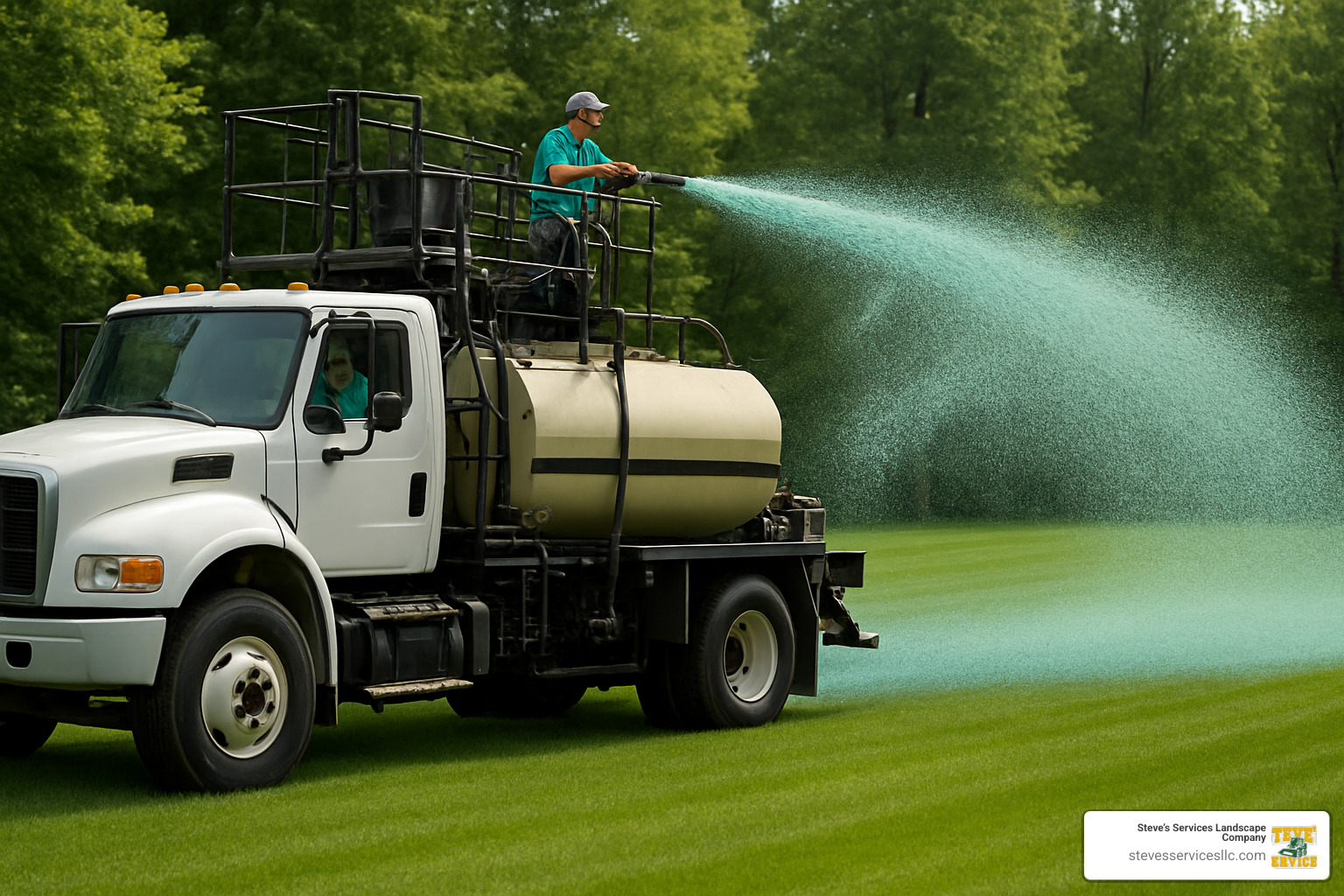
Successful hydroseed for lawns follows a proven process where each step sets up the next for success. We start with thorough project assessment examining water flow and sun exposure patterns, followed by soil testing to reveal pH levels and nutrient content.
Site preparation includes debris removal, proper grading for drainage, and adding quality topsoil mixed with compost. The slurry mixing happens in commercial equipment using precise ratios, followed by calibrated spray application for uniform coverage.
Site Preparation: Soil Testing & Fine Grading
Soil pH needs to fall between 6.5 and 7.0 for optimal grass growth. Massachusetts soils tend to be acidic, so we often incorporate lime when pH falls below 6.5.
Nutrient amendments are customized based on soil test results. Our tilling depth typically runs 3-4 inches deep to break up compaction while creating a loose seedbed. The finish rake step creates that smooth, uniform surface essential for success.
More info about soil prep provides comprehensive guidance for optimal growing conditions.
Mixing the Perfect Slurry
Our commercial hydroseeders hold 300-1,600 gallons of water and we calibrate mixture consistency for optimal spray characteristics. Seed rates typically range from 2-4 pounds per 1,000 square feet, while wood fiber mulch makes up 50-75% of dry ingredients by weight.
Starter fertilizer uses balanced N-P-K formulations like 19-19-19, applied at rates determined by soil test results. Tackifier gets added at 40-60 pounds per acre for erosion protection.
Critical After-Care: First 60 Days

Watering during the first two weeks requires 2-3 daily sessions for 15-20 minutes each, keeping soil consistently moist but not saturated. Weeks 3-4 bring gradual reduction to once daily with increased duration.
Traffic restrictions mean no foot traffic, pets, or equipment for 4-6 weeks. Your first mowing happens when grass reaches 4 inches, using your mower’s highest setting.
More info about post-care provides week-by-week guidance for this critical establishment period.
Costs & Comparisons: Hydroseed vs. Traditional Options
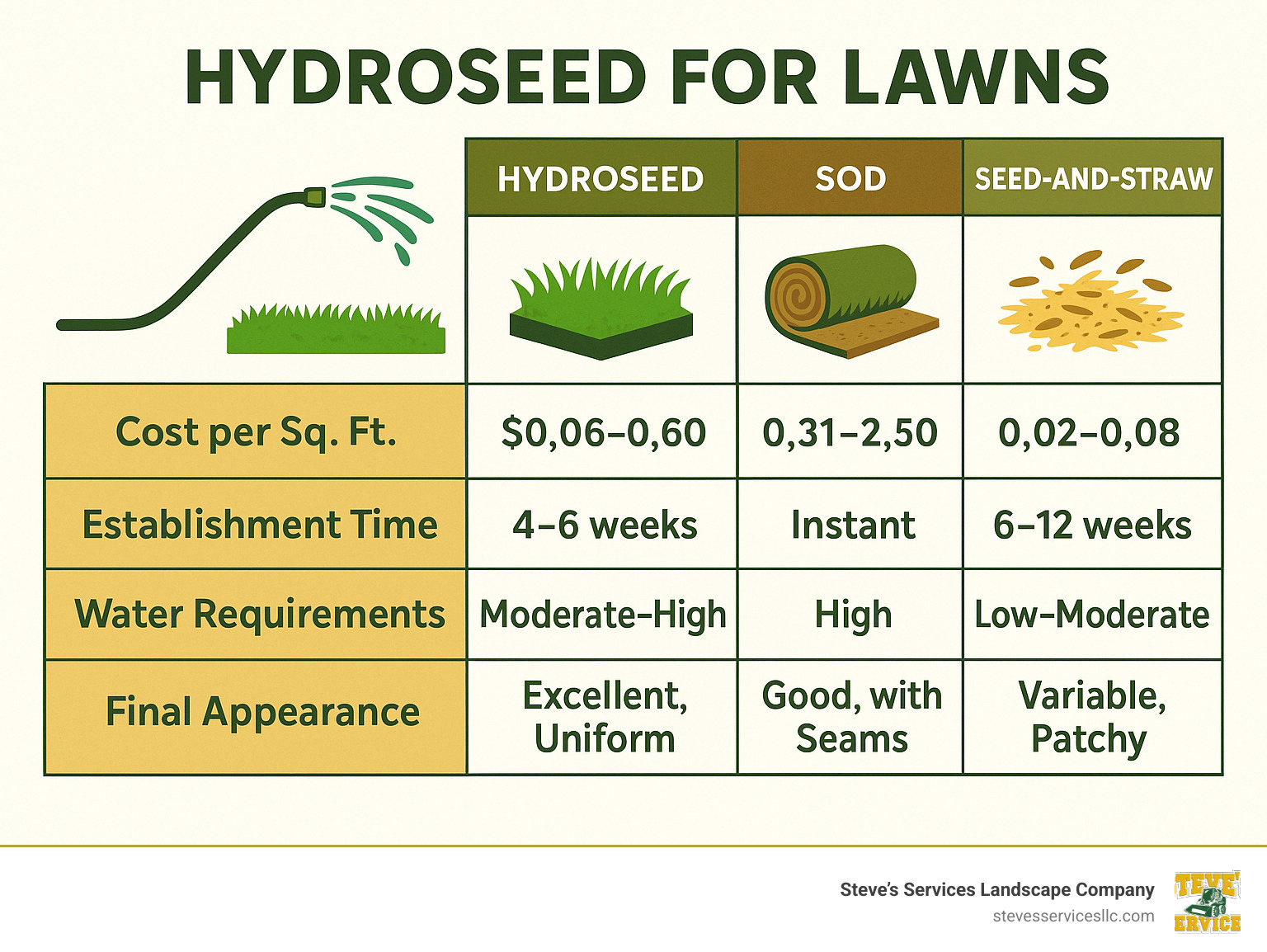
Hydroseed for lawns typically costs between $0.06-$0.60 per square foot based on industry averages, though these are general estimates and not actual costs for Steve’s Services. The wide range reflects differences between basic applications versus complex projects requiring extensive soil work or premium seed blends.
Sod installation runs $0.31-$2.50 per square foot according to industry sources. While sod provides instant results, it requires intensive watering and careful handling during establishment.
Traditional seed-and-straw appears budget-friendly at $0.02-$0.08 per square foot for materials, but often requires multiple applications when wind or rain causes failures.
More on pricing breaks down specific cost factors for Massachusetts projects.
Choosing the Right Grass Blend for Your Climate
After 25 years of hydroseed for lawns projects across Massachusetts, I’ve learned that grass selection must match your specific conditions. Cool-season fescues form the backbone of successful New England lawns.
Tall fescue handles foot traffic and survives drought better than most varieties. Fine fescue tolerates shade and poor soil conditions. Kentucky bluegrass creates premium, dense lawns but requires more maintenance. Perennial ryegrass provides quick results, germinating in just 5-10 days.
Drought-tolerant mixes use water-wise fescue varieties that maintain color during dry periods. Shade-tolerant blends emphasize fine fescue varieties for areas receiving less than six hours of direct sunlight.
Matching Seed to Massachusetts Conditions
Massachusetts’ loamy, acidic soils favor fescue varieties while Kentucky bluegrass often needs pH adjustments. Winter hardiness is essential for surviving brutal freeze-thaw cycles and ice cover.
Our standard Massachusetts blend combines 40-50% tall fescue for durability, 30-40% fine fescue for adaptability, and 10-20% perennial ryegrass for quick establishment. Premium applications add Kentucky bluegrass for improved appearance.
More info about hydroseeding services in MA details our region-specific approach.
Maintenance & Troubleshooting After Spraying

Week 3-8 watering shifts to deeper, less frequent irrigation – water deeply every other day instead of lightly every day. This trains roots to grow deeper rather than staying shallow.
Mowing begins when grass reaches 4 inches, cutting back to 3 inches maximum. Never remove more than one-third of blade height and ensure sharp mower blades for clean cuts.
Fertilization includes a second starter application at week 4-6, then balanced lawn fertilizer at 8-10 weeks. Pre-emergent herbicides can be applied 8-10 weeks after seeding.
More info on watering and mowing provide detailed guidance.
Common Mistakes to Avoid
Walking on the lawn too soon creates permanent damage to fragile seedlings. Underwatering kills more hydroseeded lawns than all other problems combined – soil must stay consistently moist during germination.
Over-fertilizing can burn tender seedlings, while skipping soil tests leads to pH and nutrient imbalances. Late-season seeding in October doesn’t provide enough establishment time before winter.
Frequently Asked Questions about Hydroseeding
How long before I see green shoots?
You’ll start seeing green shoots in 7-10 days after application. Perennial ryegrass appears first at 5-7 days, while Kentucky bluegrass takes 14-21 days. Within 4-6 weeks, you’ll have full coverage.
Can I hydroseed over an existing lawn?
No – hydroseed for lawns needs direct seed-to-soil contact. Existing grass creates a barrier preventing seeds from reaching soil and outcompetes new seedlings. We must completely remove existing grass first.
Is hydroseeding a good DIY project or should I hire a pro?
Hydroseed for lawns requires professional equipment costing $15,000-$50,000 and technical expertise in seed selection, mixing ratios, and application techniques. Professional results, commercial-grade materials, and ongoing support make hiring experts the smart choice.
Conclusion & Next Steps
Hydroseed for lawns offers Massachusetts homeowners the perfect balance between speed and affordability. After 25 years at Steve’s Services Landscape Company, I’ve seen countless bare yards transform into lush green lawns in just weeks.
Our success comes from understanding that every Massachusetts property is unique – from shade patterns to soil conditions across our service area from Burlington to Winchester. We never use cookie-cutter approaches.
Whether you’re starting fresh after construction, fixing winter damage, or tackling slopes that wash away each spring, professional hydroseeding provides the reliable solution. Our personalized approach means you get decades of experience working with Massachusetts conditions.
Ready to transform your property? Contact Steve’s Services Landscape Company today for a consultation where we’ll assess your site, discuss your goals, and create a plan that fits your timeline and budget.
More info about hydroseeding services near you to begin planning your lawn change.