Why Multi-family Property Maintenance Determines the Success of Your Investment
Multi-family property maintenance is the ongoing upkeep of multi-unit residential buildings — covering everything from HVAC and plumbing to landscaping and common areas — to keep properties safe, functional, and attractive to tenants.
Here’s what you need to know at a glance:
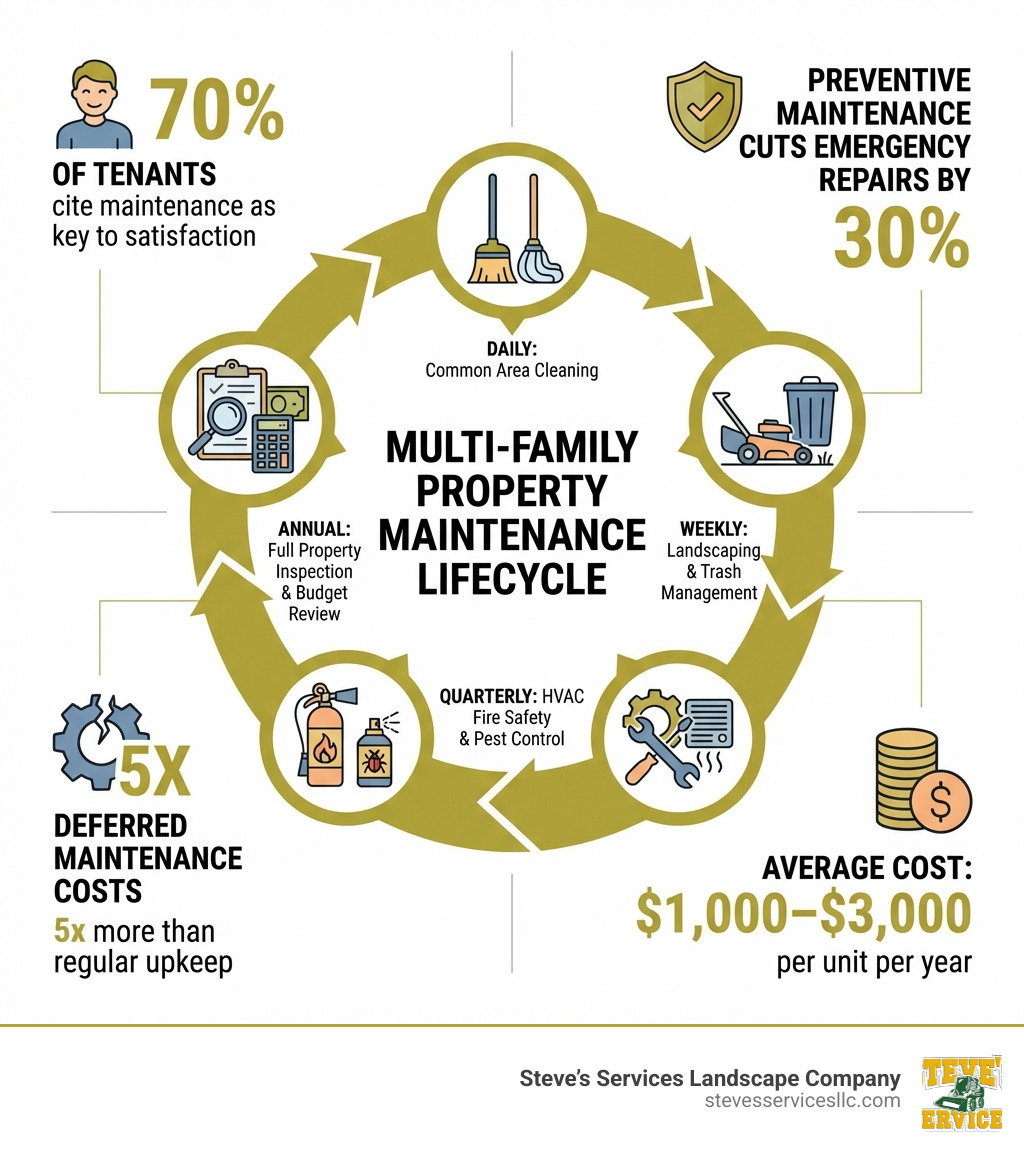
- Preventive maintenance reduces emergency repairs by up to 30%
- Deferred maintenance can cost up to 5x more than regular upkeep
- 70% of tenants cite maintenance as a key factor in their satisfaction
- Average annual cost runs $1,000–$3,000 per unit (varies widely by property age and size)
- Landlords are responsible for structural integrity, habitability, and common areas
- Tenants are responsible for keeping their unit clean and reporting issues promptly
- Technology tools like property management software and IoT devices can save 20+ technician hours per month
Managing a multi-family property is nothing like managing a single-family rental. The challenges multiply fast — one pest problem spreads unit to unit, one ignored leak becomes a flooded floor, and one unhappy tenant becomes a $4,000 turnover cost. With over 135,000 new multi-family units delivered in just the first quarter of 2024, the competition for good tenants has never been fiercer. Staying on top of maintenance isn’t just good practice — it’s the difference between a thriving property and a money pit.
This guide walks you through the core responsibilities, practical schedules, legal requirements, and tools that make multi-family maintenance manageable — without losing your mind.
I’m Steve Sylva, owner of Steve’s Services Landscape Company in Malden, MA, with over 25 years of hands-on experience in multi-family property maintenance, particularly in keeping outdoor common areas, landscaping, and hardscaping in top shape for apartment complexes and condominiums across Greater Boston. I’ll share what actually works in the field, not just theory.
Multi-family property maintenance terms you need:
The Core Pillars of Multi-family property maintenance
To manage a property effectively, we have to categorize tasks. Not all repairs are created equal. If you treat a flickering hallway light with the same urgency as a burst pipe, your team will burn out, and your budget will vanish. We break multi-family property maintenance into four distinct categories:
| Maintenance Type | Goal | Examples |
|---|---|---|
| Preventive | Stop problems before they start | HVAC filter changes, roof inspections, gutter cleaning |
| Routine | Keep the property looking and functioning daily | Lawn mowing, hallway vacuuming, trash removal |
| Reactive | Fix things that break unexpectedly | Repairing a broken dishwasher, patching a drywall hole |
| Emergency | Address immediate threats to life or property | Gas leaks, major floods, total power failure, fire |
Proactive vs. Reactive Multi-family property maintenance
The biggest mistake we see property managers make is falling into the “reactive trap.” Reactive maintenance is stressful and expensive. When you wait for a boiler to die in the middle of a January freeze in Malden or Reading, you aren’t just paying for a repair; you’re paying for emergency labor rates and potentially temporary housing for displaced tenants.
Research shows that preventive maintenance reduces emergency repairs by up to 30%. Furthermore, deferred maintenance—the fancy term for “putting it off until later”—can cost up to five times more than regular upkeep. Think of it like a small roof leak. A $500 patch job today prevents a $5,000 mold remediation and ceiling replacement next year. Proactive care extends the lifespan of your most expensive assets, from your parking lot asphalt to your HVAC systems.
Creating an Effective Maintenance Schedule
Consistency is your best friend. A structured schedule ensures nothing falls through the cracks. Here is how we recommend structuring your team’s workflow:
- Daily: Inspect lobbies, hallways, and mailrooms. Clean high-touch surfaces and pick up litter in the parking lot. Address any “low-hanging fruit” like burnt-out bulbs.
- Weekly: This is where landscape maintenance services come in. Mowing, weeding, and checking irrigation sensors keep the “curb appeal” high. Handle bulk trash removal and check security camera feeds.
- Monthly: Test smoke and carbon monoxide detectors. Inspect HVAC filters (replace every 3 months, but check monthly). Perform pest control perimeter sprays to prevent infestations from moving between units.
- Quarterly: Deep clean common area carpets. Conduct fire safety equipment inspections (extinguishers and pull stations). Review security protocols.
- Biannually: Inspect the roof and gutters (especially after the snow melts in the spring and after the leaves fall in autumn). Check window and door seals to ensure energy efficiency.
- Annual: Perform a comprehensive “top-to-bottom” property inspection. Review your maintenance logs to identify recurring issues and set your budget for the following year.
Navigating Legal Responsibilities and Budgeting
In Massachusetts, property managers and landlords have strict legal obligations. You must provide an “implied warranty of habitability.” This means the unit must be safe and fit for human occupation, including working heat, water, and electricity.
Legal Duties and the Fair Housing Act
Beyond basic habitability, you must comply with local building codes and fire safety standards. One often-overlooked aspect is the Fair Housing Act. If a property manager consistently delays repairs for certain tenants while fast-tracking others, it can be legally interpreted as discrimination or retaliation. Having a digital, timestamped maintenance log isn’t just for organization; it’s your best legal defense to prove you handle requests fairly and timely.
Generally, landlords are responsible for:
- Structural integrity (roof, walls, floors)
- Common areas (hallways, grounds maintenance)
- Vital services (heat, plumbing, electrical)
- Safety equipment (smoke detectors)
Tenants are typically responsible for:
- Keeping their unit clean and sanitary
- Properly using appliances
- Reporting maintenance issues immediately to prevent further damage
Budgeting for Multi-family property maintenance Costs
How much should you set aside? Industry experts often use the 1% Rule (setting aside 1% of the property value annually) or the Square Foot Metric (budgeting roughly $1 per square foot per year).
Based on internet data, average annual maintenance costs typically range from $1,000 to $9,000 per unit (note: these are average costs based on internet data and not actual costs for Steve’s Services). The high end of that range usually applies to older buildings or those undergoing significant “CapEx” (Capital Expenditure) projects like roof replacements or parking lot repaving.
Don’t forget to look into the Inflation Reduction Act (IRA). This federal law provides massive incentives for energy-efficient upgrades. You could see tax credits up to 30% for solar installations or thousands of dollars in rebates for switching to high-efficiency heat pumps.
Metrics for Measuring Maintenance Success
You can’t manage what you don’t measure. We recommend tracking these key performance indicators (KPIs):
- Work Order Turnover: How long does it take from the moment a tenant reports a leak to the moment it’s fixed?
- Tenant Retention: Since 70% of tenants cite maintenance as a key satisfaction factor, a high turnover rate often points to poor maintenance.
- Preventive vs. Reactive Ratio: Aim for at least 70% of your tasks to be planned/preventive.
- Operational Efficiency: Are your technicians spending more time driving for parts than actually fixing things?
Leveraging Technology and Contractor Management
The days of paper work orders and frantic sticky notes are over. If you’re still using them, you’re losing money. Digitizing maintenance requests alone can save up to 10 minutes per ticket. In a 300-unit property, that adds up to 20 technician hours every month.
The Power of Digital Twins and IoT
Modern property managers are now using Digital Twins—photorealistic 3D models of their buildings. This allows you to “walk” through a unit virtually to see exactly where a shut-off valve is or what model of dishwasher is installed before ever sending a technician. Pair this with IoT (Internet of Things) sensors that can detect a water leak or a failing HVAC motor before the tenant even notices, and you’ve moved into the future of property management. Smart home tech doesn’t just impress tenants; it can deliver 10-20% annual energy savings.
Best Practices for Managing Contractors and In-House Teams
Whether you have a full-time staff or rely on outside help, commercial landscape management and general repairs require a vetting process.
- Vetting: Always check licenses, insurance, and references. Don’t just take their word for it; ask for photos of past work.
- Liability Shifting: Hiring specialized contractors for high-risk tasks (like electrical work or snow and ice management) shifts the liability away from the property owner.
- Performance Metrics: Hold your vendors to the same standards as your in-house team. Use contracts that clearly define the scope of work and expected timelines.
Improving Tenant Communication
Communication is the “secret sauce” of tenant retention. A single tenant turnover can cost up to $4,000 per unit when you factor in cleaning, marketing, and lost rent.
Using resident portals for visual documentation—where tenants can upload a photo of the problem—reduces confusion. If you have to shut off the water for a repair, send a blast text or email through your software. Transparency reduces the “frustration factor” and makes tenants feel respected.
Seasonal Checklists and Emergency Preparedness
In areas like Malden, Medford, and Melrose, the weather is our biggest maintenance driver. You need a plan for all four seasons.
- Spring: Focus on landscape maintenance. This includes “spring cleanups,” mulching, and checking the irrigation systems for leaks caused by winter freezes.
- Summer: Keep the grass green and the common areas cool. Ensure AC units are serviced and pools (if applicable) are chemically balanced daily.
- Fall: Leaf removal is critical to prevent clogged drains and gutters. This is also the time to “winterize” pipes and schedule boiler inspections.
- Winter: This is all about safety. Commercial snow management is a non-negotiable. Icy walkways are a massive legal liability. Ensure you have a contract in place long before the first flake falls.
Developing a Robust Emergency Response Plan
When a pipe bursts at 2:00 AM, your staff shouldn’t be guessing what to do. A robust plan includes:
- Clear Evacuation Procedures: Posted in all common areas.
- Emergency Contacts: A digital list accessible to all staff, including plumbers, electricians, and restoration companies.
- Regular Drills: Ensure your team knows how to shut off main water and gas lines.
- Fire Prevention: Annual electrical checks can reduce electrical fire risk by as much as 50%.
Essential Common Area Upgrades
To stay competitive, you need to offer more than just a roof. Modern multi-family renters are looking for:
- Shared Workspaces: With the rise of remote work, small “work pods” in the lobby are highly valued.
- Outdoor Amenities: Think patios and decks with grilling stations or outdoor fire pits.
- Sustainability: Energy-efficient LED lighting in hallways and EV charging stations in the parking lot are no longer “luxury” items—they are becoming expectations. Commercial landscaping for condos that uses native, drought-resistant plants also lowers water bills and appeals to eco-conscious renters.
Frequently Asked Questions about Multi-family Maintenance
What is the difference between routine and preventive maintenance?
Routine maintenance consists of the day-to-day tasks that keep a property looking good and functioning, like mowing the lawn or cleaning the lobby. Preventive maintenance is a strategic approach to servicing equipment (like HVAC systems) to prevent them from breaking down in the first place.
Who is responsible for repairs inside a tenant’s unit?
Generally, the landlord is responsible for all major systems (plumbing, electrical, heat) and appliances provided with the unit. However, if a tenant causes damage through negligence (like throwing a baseball through a window), the tenant is usually responsible for the cost of that repair.
How does proactive maintenance impact property value?
Well-maintained properties can see a 10-20% increase in market value. Appraisers and buyers look closely at the “bones” of a building. If the roof is new, the HVAC is serviced, and the walkways are in perfect condition, the property is worth significantly more than one with a long list of deferred repairs.
Conclusion
Managing multi-family property maintenance is a marathon, not a sprint. By moving from a reactive “fix-it-when-it-breaks” mindset to a proactive, tech-enabled strategy, you protect your investment, your tenants, and your sanity.
At Steve’s Services Landscape Company, we specialize in the “outside-in” approach to property value. From condominium and apartment complex maintenance to large-scale property maintenance, we help owners across Malden, Burlington, Everett, Lynnfield, Medford, Melrose, Reading, Revere, Saugus, Stoneham, Wakefield, Winchester, and Woburn keep their common areas pristine year-round.
Don’t let deferred maintenance eat your profits. Whether you need a commercial landscaping company for the summer or snow management for the winter, we have the local expertise to get the job done right. Ready to level up your property’s curb appeal? Reach out to us today.
