
Land clearing and grading: Top 5 Expert Picks for 2025 Success
Why Land Clearing and Grading Sets Your Project Up for Success
Land clearing and grading forms the foundation of every successful construction and landscaping project. Whether you’re building a new home, installing a commercial parking lot, or preparing land for agricultural use, proper site preparation determines the long-term stability and value of your investment.
Quick Answer: What is Land Clearing and Grading?
- Land Clearing: Removing trees, brush, rocks, debris, and existing structures from a site
- Land Grading: Shaping and leveling the soil to create proper drainage and stable foundations
- Average Cost: $1.18 to $2.00 per square foot for most projects
- Timeline: Professional crews can clear 2-4 acres per day depending on conditions
- Key Benefits: Prevents water damage, ensures structural stability, increases property value
The numbers tell the story clearly. The average homeowner pays between $1,266 and $3,900 for land clearing and grading, with heavily forested areas costing $3,395 to $6,155 per acre. But as one industry expert noted, “Every successful construction project begins with a clean slate.”
Why This Matters for Your Property
Poor site preparation leads to costly problems down the road. Without proper grading, water pools around foundations, causing structural damage and flooding. Organic materials left underground decompose over time, creating unstable ground that can crack foundations and damage structures.
I’m Steve Sylva, owner of Steve’s Services with over 25 years of experience in landscape construction and site preparation throughout Massachusetts. Having completed hundreds of land clearing and grading projects from small residential lots to large commercial developments, I’ve seen how proper site preparation makes the difference between a successful project and costly future repairs.
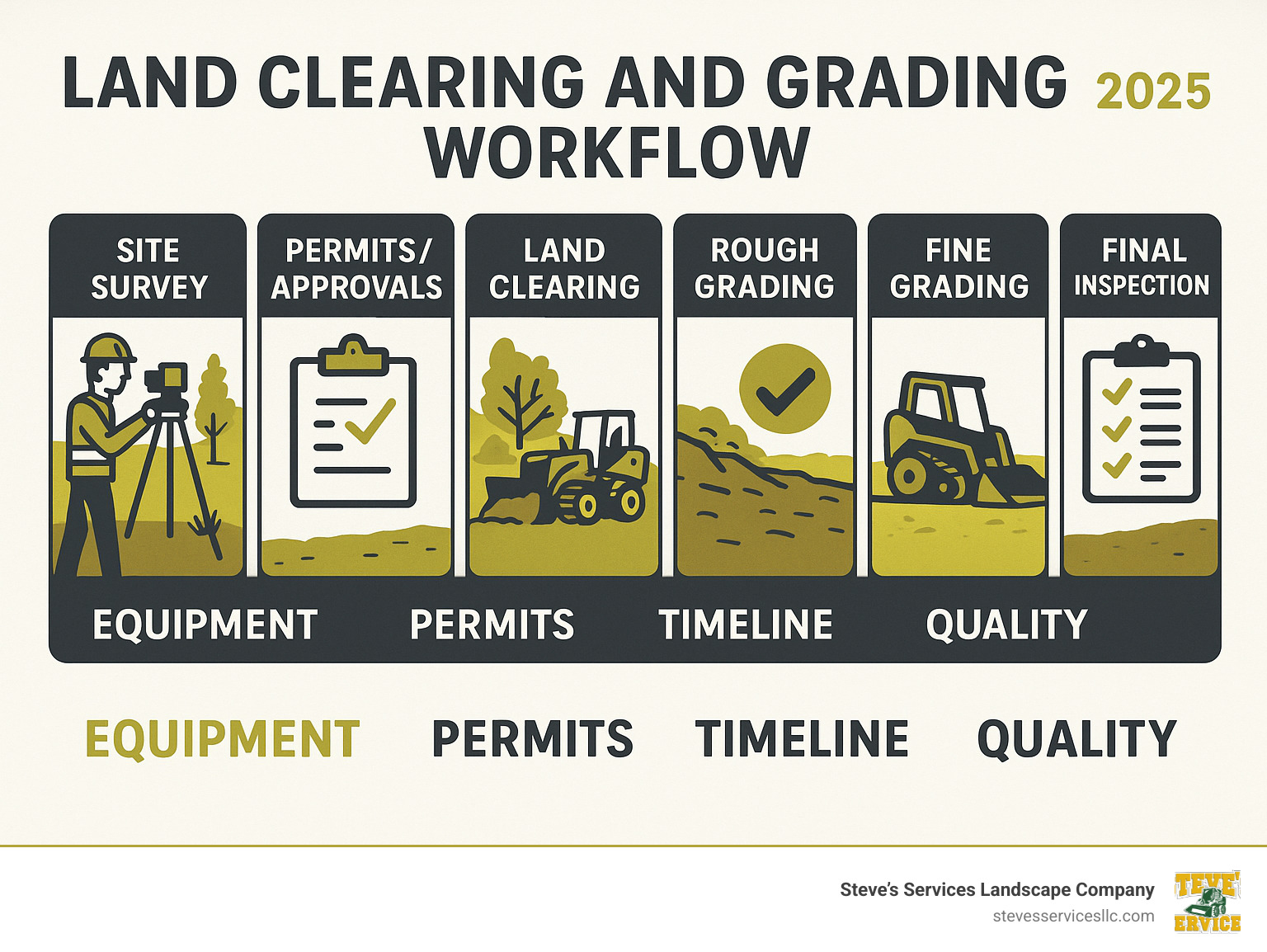
Land clearing and grading glossary:
Land Clearing and Grading Essentials Explained
Understanding land clearing and grading isn’t “just dirt work”—it’s the groundwork every successful build relies on. Skip it and even the finest materials can’t rescue the job later.
These services deliver five long-term benefits: safety, structural integrity, drainage management, construction efficiency, and property value. Clearing removes hazards and buried organics that could later decompose; grading shapes subtle slopes that carry water away, speeds up construction access, and signals quality to future buyers.
Every project starts with a comprehensive site survey that maps boundaries, utilities, soils, and environmental constraints. This data guides equipment choice, permitting, and scheduling while preventing costly surprises mid-project. Research on soil erosion confirms that good grading also protects the surrounding environment.
Land Clearing vs. Land Grading Comparison:
| Aspect | Land Clearing | Land Grading |
|---|---|---|
| Primary Purpose | Remove vegetation & debris | Shape terrain & create drainage |
| Equipment | Bulldozers, mulchers, chainsaws | Graders, scrapers, compactors |
| Typical Timeline | 1-3 days (residential lot) | 2-5 days (complexity dependent) |
| Cost Range | $733-$6,155 per acre | $4+ per sq ft |
| Environmental Impact | Habitat disruption, disposal | Soil compaction, drainage change |
These are average costs based on internet data and not actual costs for Steve’s Services.
Residential Land Clearing and Grading Checklist
- Selective vegetation removal to save valuable trees and future landscaping
- Stump grinding so decaying roots don’t undermine slabs or driveways
- Utility location (811) to avoid damaging buried lines
- Erosion controls such as silt fence to protect neighbors and stay compliant
- Tight-access work handled by our Backyard Excavation specialists
Commercial Land Clearing and Grading Best Practices
Commercial sites scale everything up: heavier equipment, strict storm-water rules, and documented soil compaction. NPDES permits, lab proctor tests, and large-acreage scheduling demand an experienced partner—our Excavating Contractors bring the know-how to keep big projects moving without regulatory hiccups.
Land Clearing: Processes, Equipment & Environmental Stewardship
Modern land clearing balances project goals with environmental responsibility. Smart contractors remove only what’s necessary and often retain healthy shade trees that boost property value.
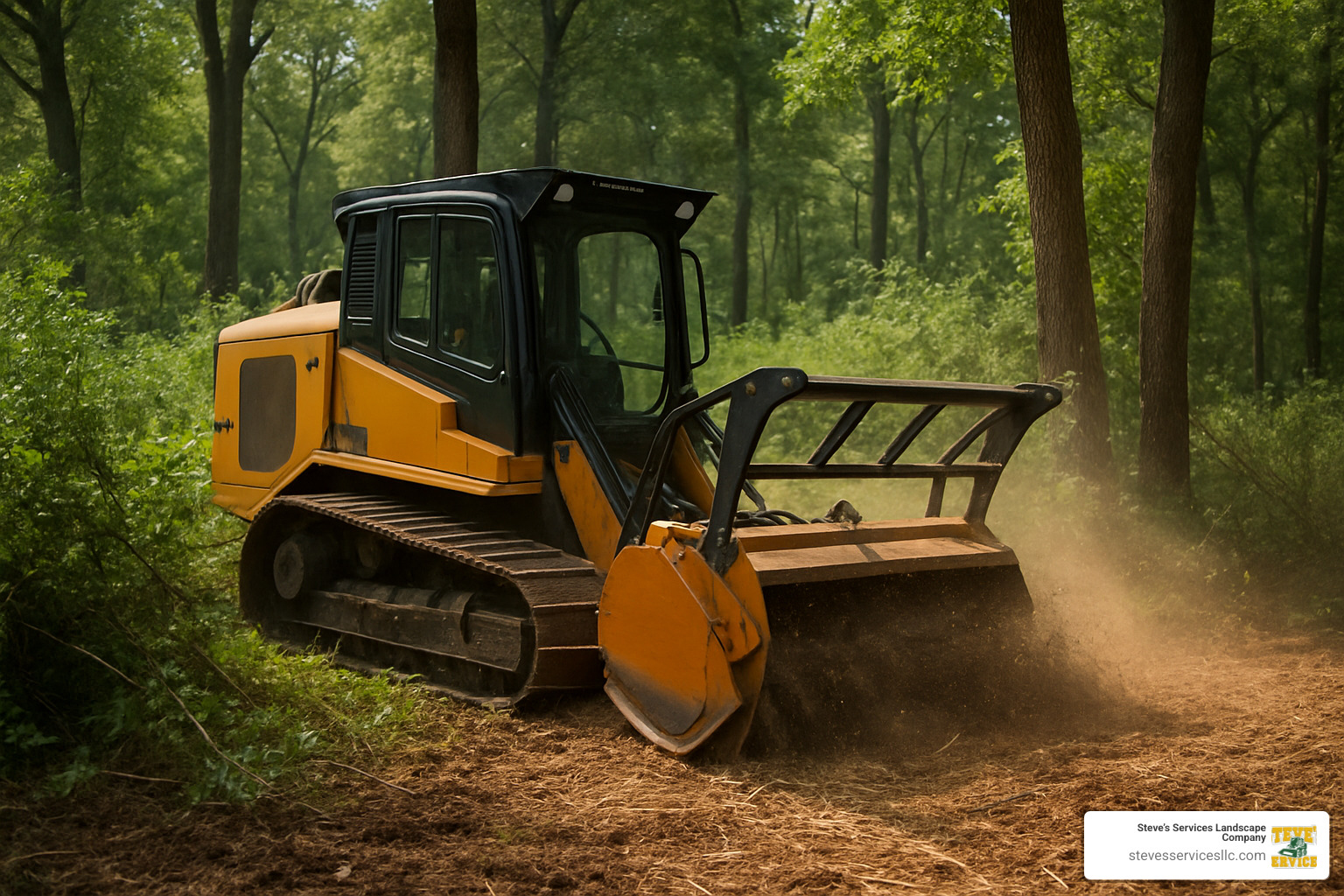
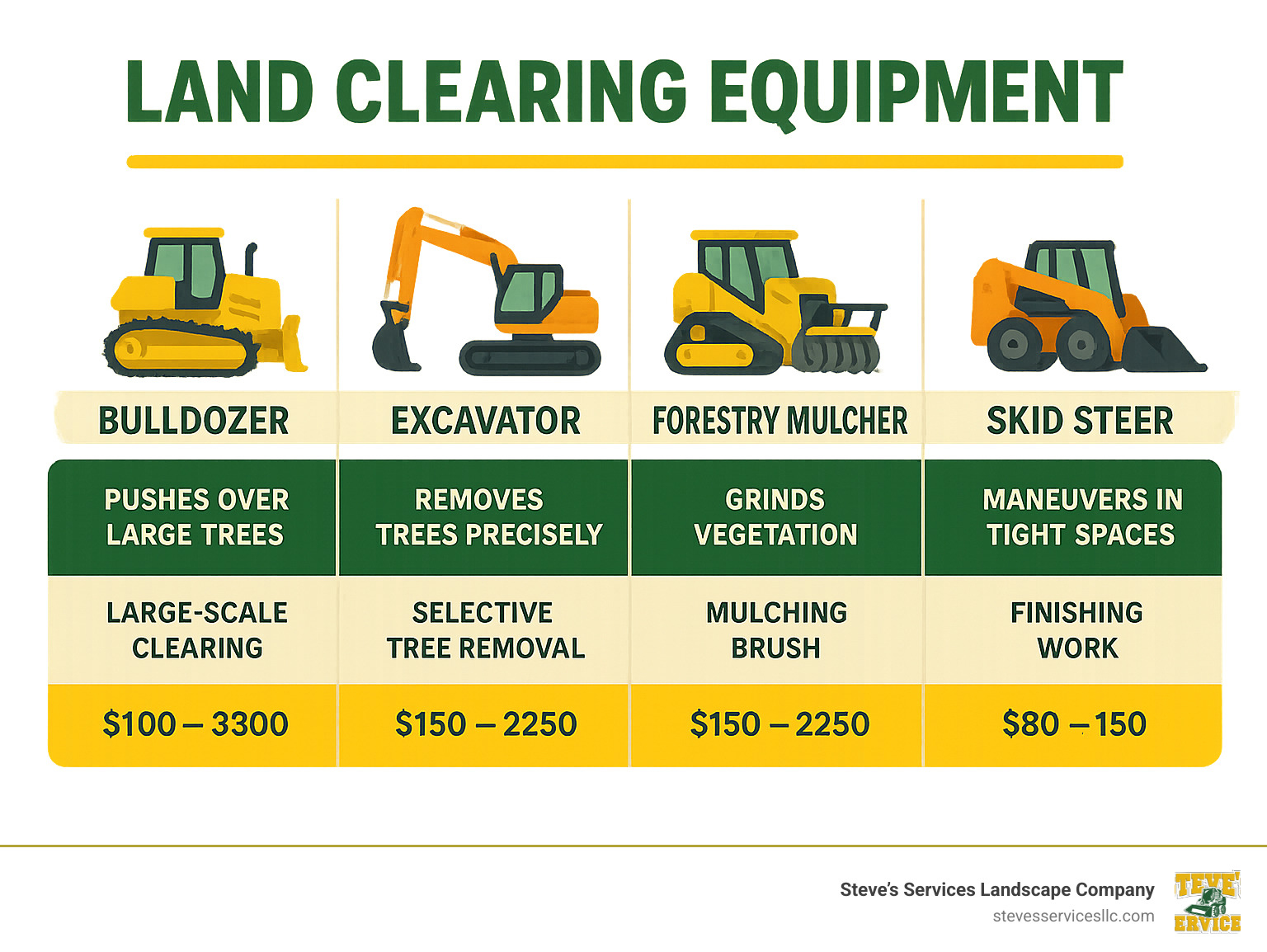
Tree removal may be manual (chainsaws) for precision or mechanical (excavators, bulldozers) for speed. Forestry mulching, often $150-$450 per hour based on internet data, converts brush and small trees into beneficial on-site mulch and eliminates haul-off fees.
Bulldozers remain the workhorses for heavy timber, while recycling timber—selling marketable logs or chipping smaller wood—can offset part of your clearing budget. Grants and cost-share programs found in tree-removal grants may help qualifying landowners.
Step-by-Step Clearing Workflow
- Complete site survey and mark boundaries
- Secure required permits (tree, land-disturbance, environmental)
- Call 811 to mark underground utilities
- Identify trees to preserve and plan debris handling
- Execute clearing with chosen equipment, recycling wood where feasible
- Install temporary erosion controls and perform final cleanup
Eco-Friendly Clearing Approaches
Retaining mulch on site improves soil health, while scheduling work outside nesting seasons protects wildlife. These practices often cost less than traditional clear-cutting because they cut disposal, erosion, and re-landscaping expenses.
Land Grading: From Rough Cut to Fine Finish
Land grading transforms cleared sites into stable, properly drained foundations ready for construction. This precision process requires both technical expertise and specialized equipment to achieve the exacting standards modern construction demands.
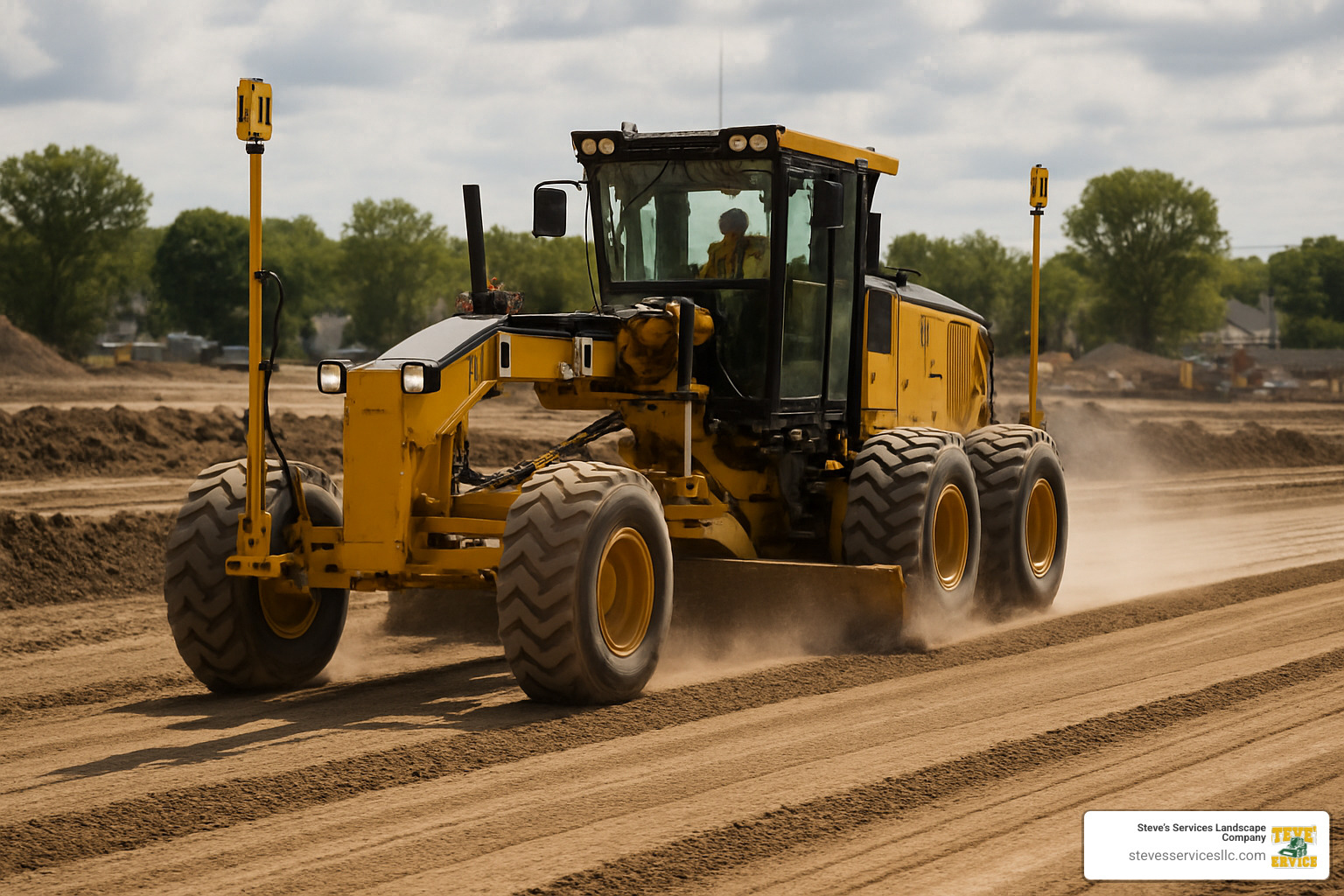
The grading process involves two primary operations that work together like a carefully choreographed dance. Cut and fill operations remove excess soil from high areas and add it to low spots, creating the desired elevation and slope. It’s essentially moving dirt from where you have too much to where you need more.
Modern land grading relies heavily on laser and GPS technology to achieve precision that would have been impossible just a few decades ago. These systems guide equipment operators to exact elevations, ensuring proper drainage and foundation support. The technology is so accurate that grades can be maintained within fractions of an inch across entire sites.
Soil testing forms the backbone of any successful grading project. Professional contractors analyze soil composition, load-bearing capacity, and drainage characteristics before moving a single cubic yard of dirt. These tests typically cost between $7 and $50 per sample, depending on depth and complexity, but they prevent costly foundation problems down the road.
The famous 2% slope rule represents the minimum grade required for proper drainage – that’s approximately 1/4 inch per foot. This seemingly small slope ensures water flows away from structures while preventing erosion from excessive steepness. Too little slope and water pools around foundations. Too much slope and you get erosion problems that wash away your careful work.
Compaction represents the final critical step in professional grading. Loose soil settles over time, creating uneven surfaces and potential foundation problems. Professional contractors use specialized equipment to compact soil to specific density requirements, ensuring long-term stability.
For comprehensive site preparation throughout Massachusetts, our Excavation Services team provides complete grading solutions that meet both residential and commercial needs.
Land Leveling vs. Land Grading
While these terms get tossed around interchangeably at backyard barbecues, land leveling and land grading actually serve different purposes and require different approaches.
Land leveling creates perfectly flat surfaces – think golf courses, agricultural fields, and sports complexes. The goal is eliminating high and low spots to create uniform conditions. Land grading, on the other hand, shapes terrain with controlled slopes designed to direct water flow and provide stable foundations.
Land Leveling vs. Land Grading Comparison:
| Aspect | Land Leveling | Land Grading |
|---|---|---|
| Primary Goal | Create perfectly flat surfaces | Shape terrain with controlled slopes |
| Best Applications | Agriculture, golf courses, large lawns | Construction sites, roads, drainage |
| Equipment Used | Laser-guided scrapers, graders | Bulldozers, graders, backhoes |
| Cost Range | $400-$2,000 per acre | $1,000-$5,000+ per acre |
| Precision Required | High for uniform surfaces | Very high for exact slopes |
Agriculture benefits enormously from precise leveling. Uniform fields ensure consistent irrigation, eliminate wet and dry spots that reduce crop yields, and allow efficient equipment operation. The investment in laser leveling typically pays for itself within 2-3 growing seasons through increased productivity.
Construction sites require grading rather than leveling because proper drainage is essential. Even parking lots need subtle slopes to direct water toward drainage systems. The scheduling for grading projects typically runs 2-5 days for residential sites and 1-3 weeks for commercial developments, depending on complexity and weather conditions.
Budget, Permitting & Timeline: Planning Your Project
Setting a realistic budget for land clearing and grading prevents unpleasant surprises. Note: The following are average costs based on internet data and not actual costs for Steve’s Services.
- Residential: $1.18–$6.00 per sq ft for clearing; heavy forest can reach $3,395–$18,465 per acre. Grading adds roughly $4–$12 per sq ft.
- Commercial: $200–$6,000 per acre for basic prep; complex grading or storm-water systems can push totals to $10–$30 per sq ft plus $5,000–$50,000 for drainage infrastructure.
- Hidden items: surveys ($500–$1,500), permits ($200–$2,000), soil tests ($500–$2,000), erosion control ($1,000–$10,000).
Seasonal timing matters: spring and fall offer workable soils, fewer weather delays, and reduced dust control costs compared with midsummer or frozen-ground winter work.
For local, line-item quotes around Medford, visit our Service Area: Excavating Company Medford MA page.
How Pros Keep Projects Compliant and On Schedule
Expect 2–4 weeks to prepare permit packages and another 4–8 weeks for municipal review. An organized contractor sequences clearing, grading, and inspections so you’re never waiting on paperwork. Our team maintains silt fencing, daily logs, and clear communications to keep regulators—and your project timeline—happy.
Hiring the Right Contractor
Look for up-to-date licensing, insurance, modern equipment, and solid local references. Extremely low bids, vague scopes, or pressure-sales tactics are red flags that usually lead to expensive fixes later on.
Frequently Asked Questions about Land Clearing & Grading
What influences the cost of land clearing and grading?
Key variables are terrain complexity, vegetation density, and weather. Steep, rocky slopes or dense hardwood forest can cost 50–200 % more than open, level ground. Delays from heavy rain or frost also raise labor and equipment bills.
How does proper grading protect my investment?
Correct slopes (about 2 %) and solid compaction keep foundations from cracking, basements from flooding, and landscapes from eroding. Considering that foundation repairs often start at $10,000, preventive grading is inexpensive insurance.
Do I need different permits for clearing vs. grading?
Usually, yes. Tree-removal permits address vegetation, while land-disturbance permits focus on soil movement and erosion control. Projects near wetlands or endangered species may need additional environmental reviews. Working with experienced local contractors streamlines the paperwork so your schedule stays intact.
Conclusion & Next Steps
When you’re ready to transform your property, land clearing and grading isn’t just about moving dirt and cutting trees – it’s about creating a solid foundation for your dreams. Whether you’re building your family’s forever home or developing a commercial space, the work that happens before anyone sees a single brick or board determines everything that follows.
The smart money always goes toward professional site preparation. Think about it: would you rather invest in proper land clearing and grading now, or pay for foundation repairs, drainage problems, and structural issues later? The math is pretty clear when foundation fixes can cost $10,000 to $50,000, while proper grading prevents these headaches from the start.
Your investment in professional site preparation delivers:
Structural peace of mind through stable foundations that won’t shift or crack over time. Water management that works by directing moisture away from your buildings and landscapes. Property value that grows because well-prepared sites command premium prices and sell faster. Maintenance costs that shrink since proper grading eliminates ongoing drainage and erosion problems.
Why Steve’s Services Makes the Difference
After 25 years of serving Massachusetts communities, we’ve learned that every property tells its own story. Some sites need gentle persuasion, others require serious convincing. That’s why our approach starts with listening – to you, and to what your land is telling us.
Our team brings decades of combined experience working with New England’s unique soil conditions and weather patterns. We use modern laser-guided equipment that takes the guesswork out of precise grading. Most importantly, we believe in personalized solutions because cookie-cutter approaches rarely work in real life.
Ready to Break Ground?
Starting your land clearing and grading project doesn’t have to feel overwhelming. We’ve walked hundreds of property owners through this process, and we know exactly how to make it smooth and stress-free.
Your first step is simple: give us a call for a free consultation. We’ll walk your property together, discuss your vision, and explain exactly what needs to happen to make it reality. No pressure, no complicated sales pitch – just honest advice from people who’ve been doing this work for decades.
We’re proud to serve Burlington, Danvers, Everett, Lynnfield, Medford, Melrose, North Reading, Reading, Revere, Saugus, Stoneham, Winchester, Woburn, Malden, and Wakefield with comprehensive site preparation services that get results.
For projects requiring precision work in tight spaces, our Bobcat Services team specializes in detailed site preparation where larger equipment simply won’t fit.
Your Project Journey Starts Here
Once you’re ready to move forward, we’ll schedule a detailed site assessment and provide a clear proposal with no hidden surprises. Our project managers will keep you informed every step of the way, from permits to final cleanup.
Professional land clearing and grading turns your property’s potential into reality while protecting your investment for generations. Let’s start that conversation today and see what your land can become.
