Pool Demolition and Removal: 7 Powerful Steps for Success 2025
Understanding Pool Removal: What to Expect
Taking the plunge to remove your swimming pool is a big decision – one that transforms your property and reclaims valuable outdoor space. Pool demolition and removal isn’t just about breaking concrete; it’s about reimagining possibilities for your yard.
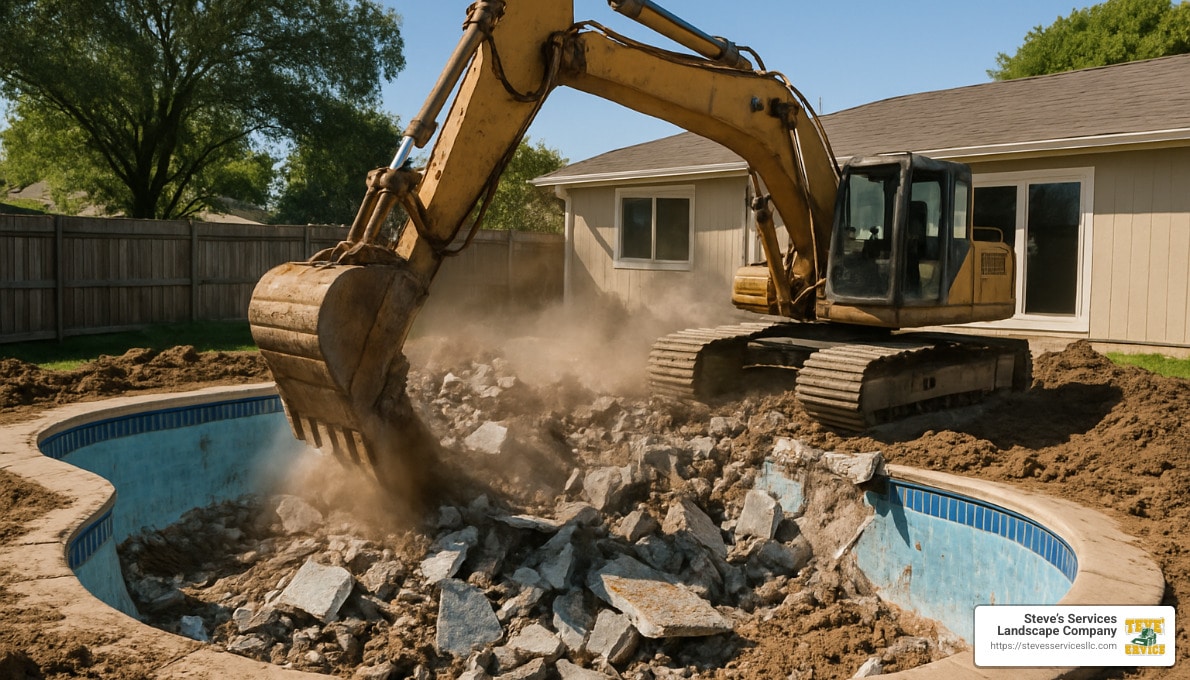
When homeowners call us about removing their pools, they’re often surprised by how straightforward the process can be. A typical pool demolition and removal project includes draining the water, breaking up the structure, hauling away debris, and filling the space with compacted soil to create a blank canvas for your next outdoor vision.
The timeline varies based on your specific situation. A partial removal typically wraps up in just 2-3 days, while a complete removal might take 5-7 days from start to finish. This efficiency means minimal disruption to your daily life.
Budget considerations are naturally top-of-mind for most homeowners. Based on industry averages (not our specific pricing), partial removals generally range from $3,000-$15,000, while complete removals run from $5,000-$19,000. These ranges reflect differences in pool size, accessibility, local regulations, and your chosen removal method.
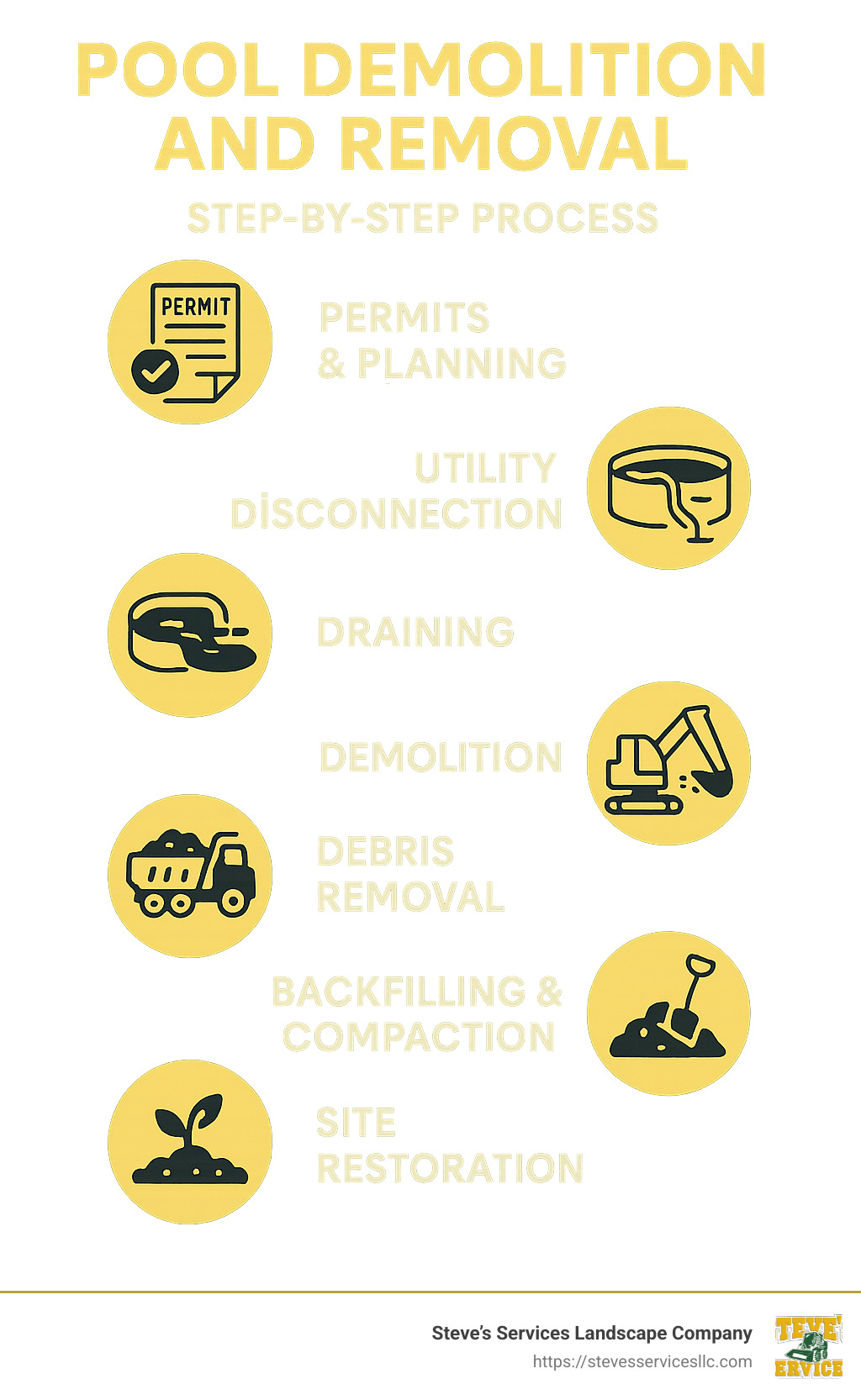
The journey from pool to usable yard space follows a logical progression. First, we handle all the necessary permits – saving you the paperwork headache. Then we carefully drain and dechlorinate the water to protect the environment. The demolition phase comes next, followed by debris removal (we recycle materials whenever possible). Finally, we backfill with quality soil, compact it properly to prevent settling, and finish with grading that prepares your yard for its next chapter.
Many Massachusetts homeowners we’ve worked with chose to remove their pools after realizing maintenance costs were draining their wallets, or safety concerns were keeping them up at night. Others simply wanted to reclaim that space for gardens, patios, or play areas their families would actually use.
Your choice between partial or complete removal has long-term implications. While partial removal costs less upfront, it may limit future construction options. Complete removal provides maximum flexibility but requires a larger initial investment. We’re happy to walk you through the pros and cons based on your specific property and plans.
I’m Steve Sylva, owner of Steve’s Services Landscape Company, and I’ve guided countless Massachusetts homeowners through successful pool demolition and removal projects. Our team specializes in changing outdated pools into beautiful, functional outdoor spaces your family will love for years to come.
Why Homeowners Choose to Remove a Pool
The decision to remove a swimming pool is never taken lightly. After all, pools represent significant investments of both money and memories. But as a company that’s helped countless Massachusetts homeowners through this process, we’ve heard many compelling reasons why pool demolition and removal ultimately becomes the right choice.
High Maintenance Costs
“I was spending over $3,000 a year just to maintain a pool we barely used,” a recent client from Melrose confided to us. This sentiment resonates with many pool owners throughout Massachusetts.
The numbers tell the story: basic pool maintenance averages about $1,400 annually. But when you add utilities, repairs, and seasonal opening/closing services (especially important in our New England climate), many homeowners find themselves spending $3,000-$5,000 every year. For a feature that might only see active use during our brief summer months, that’s a steep price per swim.
Safety Concerns and Liability
Pool safety keeps many homeowners up at night, particularly those with young children or frequent visitors. According to scientific research from the CDC, drowning ranks as the leading cause of injury or death for American children aged 1-4, and third for children 5-19.
Beyond the immeasurable emotional concerns, pools typically increase homeowner liability insurance premiums by 15-25%. Many of our clients report immediate insurance savings after their pool demolition and removal project is complete.
Aging Infrastructure
Many pools across Lynnfield, Winchester, and Stoneham communities date back to the 1970s and 1980s. These aging structures often face serious issues that come with hefty price tags:
Leaking shells need replastering (often $10,000+), outdated equipment requires replacement ($2,000-$5,000), and cracked decking demands repairs ($3,000-$8,000). When faced with these renovation costs, many homeowners realize that removing the pool makes better financial sense than pouring more money into an aging feature.
Reclaiming Valuable Space
A Winchester client recently told us, “We wanted a backyard our grandchildren could actually play in. The pool took up 90% of our usable space.”
In many Massachusetts neighborhoods with modest lot sizes, pools can dominate the entire backyard. Removing one creates exciting opportunities for outdoor living: expanded garden spaces, entertainment areas, children’s play zones, patios with fire pits, or simply low-maintenance landscaping that doesn’t require constant attention.
Drought & Water Bills
With increasing concerns about water conservation and rising utility costs, maintaining a pool has become environmentally and financially challenging for many homeowners. Evaporation alone can cause a pool to lose thousands of gallons annually, leading to significant water bills in addition to the chemicals required to maintain proper balance.
Lifestyle Changes
Life evolves, and so do our needs. Empty nesters often find their once-busy family pool sits unused. New parents may prioritize open play space over swimming. And busy professionals might prefer a low-maintenance yard that doesn’t demand weekend attention.
Improved Property Value and Marketability
Contrary to what many assume, pools don’t always boost home value. In Massachusetts particularly, pools can sometimes deter potential buyers who worry about maintenance responsibilities, safety concerns with young children, prefer usable yard space, or don’t want higher insurance premiums.
A real estate appraiser we frequently work with notes: “In communities like Reading and North Reading, homes with recently removed pools often sell faster than comparable properties with aging pools, especially if the removed pool area has been thoughtfully landscaped.”
For many homeowners, the combination of immediate cost savings, reduced liability, reclaimed space, and potentially improved resale value makes pool demolition and removal a smart investment. If you’re weighing this decision, our detailed guide on How Much Does It Cost to Remove an Inground Pool? can help you understand the financial considerations.

Partial vs. Full Pool Demolition: Pros, Cons & Legalities
When you’re thinking about saying goodbye to your backyard swimming pool, you’ll face an important fork in the road: partial or full pool demolition and removal? This isn’t just about your immediate budget—it’s a decision that affects your property’s future usability and potential value for years to come.
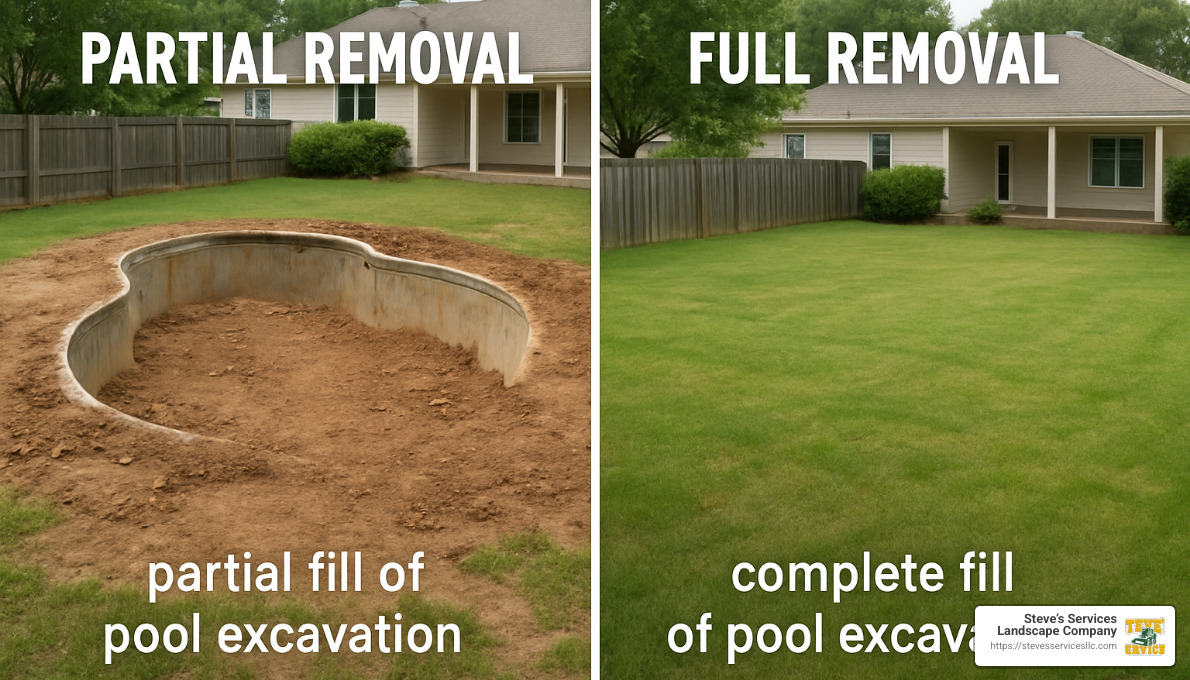
Partial Pool Demolition and Removal Explained
Partial pool removal (sometimes called the “fill-in” method) is exactly what it sounds like—we don’t remove everything. Here’s what typically happens:
We start by draining your pool completely. Then our crew drills multiple drainage holes in the bottom—usually at least 20—to ensure water can always escape downward. We demolish the top 18-36 inches of the pool structure and break up portions of the pool floor for drainage. Interestingly, we often use the broken concrete as part of the fill material, then backfill the remaining cavity with clean fill dirt. This soil gets compacted in layers, and finally, we add topsoil suitable for whatever landscaping you have planned.
This approach tends to be more wallet-friendly, typically ranging between $3,000-$8,000 for an average-sized pool in Massachusetts. Most partial removals wrap up in just 2-3 days.
“I recommend partial demolition for homeowners who simply want their yard back for gardens or open space,” explains our project manager who’s overseen countless pool removals in communities like Danvers and Saugus. “If you’re dreaming of flower beds rather than foundations, this option makes a lot of sense.”
The advantages of partial removal are clear: it costs 40-60% less than full removal, gets done faster, creates less disruption to your property, and works perfectly for garden spaces and light landscaping.
However, there are important drawbacks to consider: the area typically can’t support new construction later, you must disclose the partial removal to future buyers, you might experience some settling over time, and some Massachusetts towns don’t even permit this method.
Full Pool Demolition and Removal Explained
Full pool removal is the comprehensive approach. We completely excavate and remove the entire pool structure—concrete, steel, plumbing, everything. All materials get hauled away and properly recycled when possible. We then fill the excavation with engineered fill material, carefully compacting the soil in monitored layers (typically 8″ lifts). Many projects require compaction testing to verify soil stability before we add topsoil and finish the site.
This thorough approach typically costs between $9,000-$19,000 for an average residential pool in Massachusetts, with the process usually taking 5-7 days.
“When we perform a full removal in places like Winchester or Woburn,” notes our excavation specialist, “we’re essentially turning back time to before the pool existed. The homeowner gets a clean slate with maximum flexibility for whatever they might want to do with that space in the future.”
The full removal approach gives you buildable land that can support structures, eliminates many disclosure requirements when selling your home, maximizes your property value, prevents future settling issues, and meets all municipal requirements. The trade-offs are higher cost, a longer project timeline, and more intensive disruption to your property during the work.
Legal and Regulatory Considerations
Massachusetts towns have varying requirements for pool removals. In communities we serve like Melrose, Medford, and Reading, specific permits are required, and sometimes an engineer must certify the work.
Here’s a critical consideration many homeowners don’t realize: partial pool removal often makes that portion of your land legally non-buildable. This means you cannot construct a house addition, garage, or other structure on that site without first completing a full removal.
Regulations might also dictate the type of fill material used, compaction standards, and final inspection requirements. Some towns require engineered fill with specific compaction rates, while others have strict rules about land-use limitations after partial removals.
“Before making your decision, always check with your local building department,” advises our permitting specialist. “Some towns like Burlington and North Reading have very specific requirements about engineered backfill and compaction testing that can affect your project.”
Professional Pool Demolition and Removal Process
When our team tackles a pool demolition and removal project in Everett, Malden, or anywhere else in our Massachusetts service area, we’re not just breaking up concrete—we’re changing your backyard into a fresh canvas for your outdoor dreams. Having refined our approach over years of experience, we’ve developed a methodical process that ensures safety, efficiency, and minimal disruption to your property.
1. Initial Consultation and Site Assessment
Every successful project begins with a thorough evaluation. We’ll visit your property to assess the pool’s size and construction materials, identify access points for our equipment, note any surrounding structures or landscaping that needs protection, evaluate soil conditions, and mark all utility locations.
This initial assessment is absolutely crucial to proper planning. I remember a challenging project in Wakefield where the only access point was through a narrow side yard barely wider than a wheelbarrow. Instead of telling the homeowner it couldn’t be done, we brought in a specialized compact rubber-track excavator that could steer the tight space without damaging their property. These are the kinds of solutions that come from experience!
2. Permits and Compliance
Before the first piece of equipment rolls onto your property, we handle all the necessary paperwork. This typically includes demolition permits, plumbing and electrical disconnect permits, backfill approvals, and sometimes health department notifications for water drainage.
In Massachusetts communities, permit costs generally range from $150-$500, and our team manages the entire application process for you. We’ve built strong relationships with building departments across our service area, which helps streamline this sometimes confusing step.
3. Utility Disconnection During Pool Demolition and Removal
Safety is our top priority, which starts with properly disconnecting all utilities:
For electrical systems, our licensed electricians disconnect power at the breaker panel, remove all wiring, and cap and seal junction boxes before obtaining final electrical inspection approval.
With gas lines serving pool heaters, we coordinate with the gas company to shut off service, then have licensed plumbers cap the lines with hydraulic cement, followed by proper inspection and tagging.
All plumbing systems must be properly abandoned by cutting and capping supply lines below grade, sealing drainage lines to prevent future water intrusion, and removing or properly sealing skimmer and return lines.
I still remember a project in Stoneham where we finded abandoned gas lines that weren’t on any plans. We immediately called in specialists to properly cap them before proceeding—this attention to detail prevents serious problems down the road.
4. Pool Draining and Environmental Protection
Proper pool draining isn’t just good practice—it’s required by environmental regulations. We test and dechlorinate the water (bringing chlorine levels below 0.1 parts per million), adjust pH to between 6.5 and 8.5, pump water gradually to prevent flooding, and implement erosion control measures around storm drains.
Massachusetts strictly prohibits discharging chlorinated water directly into storm drains or waterways, so we use dechlorination tablets and verify water quality before any discharge. It’s an extra step that protects our local waterways and keeps us in compliance with environmental regulations.
5. Demolition Phase
The actual demolition process varies depending on whether you’ve chosen partial or full removal:
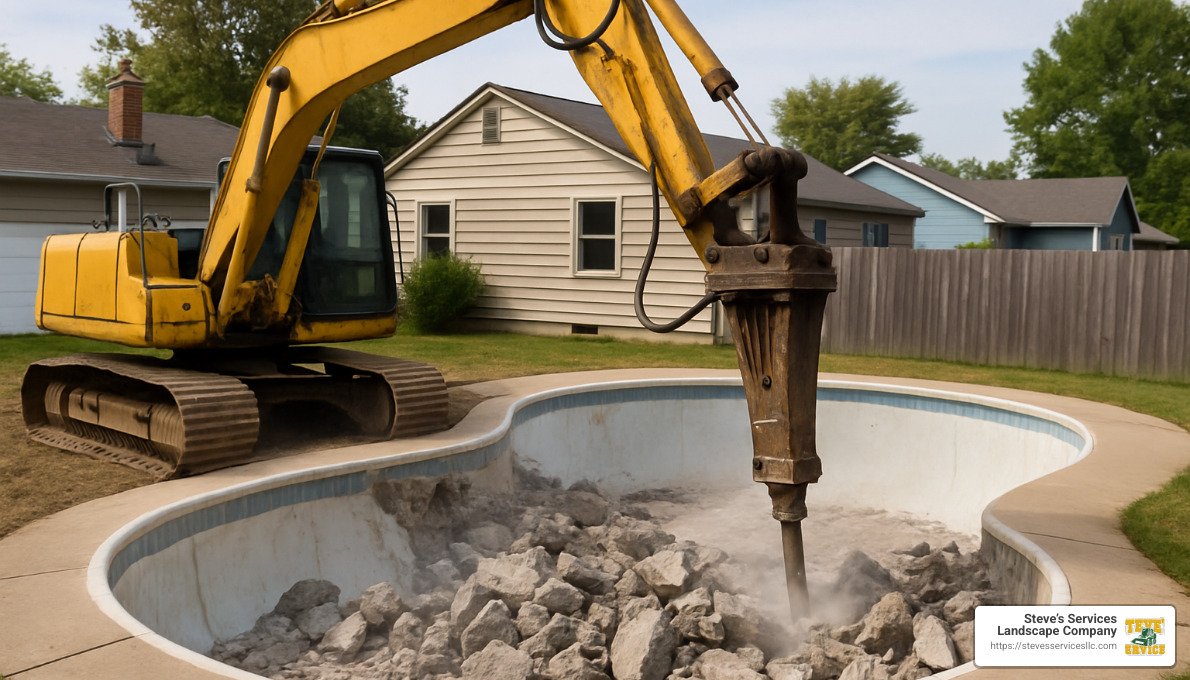
For partial removal, we create large drainage holes in the pool bottom using hydraulic breakers, demolish the top 18-36 inches of the pool walls, break the concrete into manageable pieces, and separate rebar and other metals for recycling.
With full removal, we systematically break up the entire pool structure, completely remove all concrete, gunite, fiberglass, and vinyl materials, clear the excavation of all construction debris, and prepare the site for engineered backfill.
Our crews use specialized equipment including rubber-track excavators that minimize damage to your property while efficiently breaking up even the toughest concrete. According to research on excavator types, these machines offer the perfect balance of power and precision for residential pool removal.
6. Debris Management and Recycling
Environmental responsibility is a core value at Steve’s Services. We typically recycle up to 90% of pool demolition materials—concrete is crushed and repurposed as aggregate, metal components are separated and sent to recycling facilities, and vinyl liners are properly disposed of according to regulations.
Just last month, we removed a concrete pool in Revere where we were able to recycle 100% of the concrete. It was crushed and used as base material for a municipal road project. That’s thousands of pounds of material kept out of landfills and put to good use!
7. Backfilling and Compaction
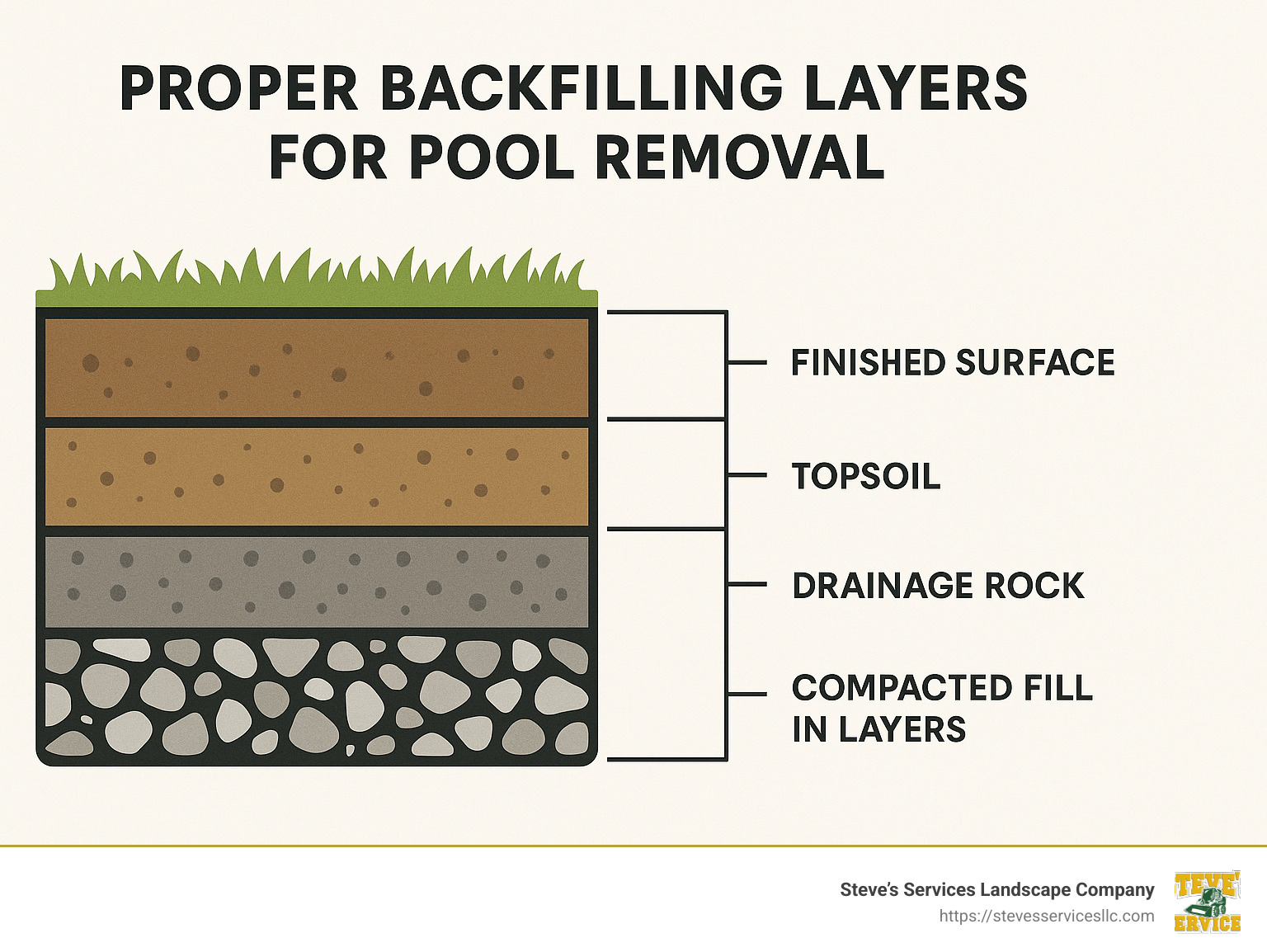
Proper backfilling is critical to prevent future settling issues. We deliver clean, engineered fill material to your site, place a layer of permeable material over drainage holes for partial removals, add fill in carefully measured layers, and compact each layer using mechanical equipment.
Throughout this process, we monitor soil moisture for optimal compaction, and for full removals, we conduct compaction testing to verify at least 90% relative compaction. The difference between properly and improperly compacted fill can be dramatic—we’ve seen properties where poor compaction led to sinkholes forming years later. That’s why we use specialized equipment and follow engineered specifications.
8. Final Grading and Site Restoration
The final phase transforms the former pool area into usable space. We add a generous layer of topsoil (typically 4-6 inches), grade the area for proper drainage, prepare the soil for new landscaping, conduct final inspections, and clean and restore your property.
The change is always rewarding to witness. A recent client in Lynnfield converted their former pool area into a beautiful perennial garden with a stone path and seating area. The space went from being a maintenance headache to their favorite spot in the yard. That’s the kind of result that makes our work so satisfying.
Environmental & Safety Best Practices
Throughout every pool demolition and removal project, we implement strict environmental and safety protocols. We use water sprayers for dust suppression, adhere to local noise ordinance limits, recycle construction debris whenever possible, conduct soil testing when necessary, and use silt fencing and other measures to protect storm drains from sediment.
Our commitment to these best practices isn’t just about following regulations—it’s about being a good neighbor and environmental steward while we help you reclaim your outdoor space.
Environmental & Safety Best Practices
When we tackle a pool demolition and removal project, we’re not just thinking about getting the job done quickly—we’re also focused on protecting the environment and keeping everyone safe. After all, we live and work in these same Massachusetts communities!
Dust Suppression
Breaking up concrete creates dust—there’s no way around it. But there’s a big difference between a contractor who lets dust blow everywhere and our approach at Steve’s Services.
“My neighbor had their pool removed last year by another company, and their white fence turned gray from all the dust!” a Medford client told us recently. “I was worried about the same thing happening, but your crew kept everything so clean.”
We use water misting systems throughout the demolition process, which immediately captures dust particles before they can become airborne. On particularly dry, windy days, we’ll also set up dust barriers around the work area. It takes a little extra time, but your neighbors (and their clean laundry hanging outside) will thank you!
Noise Management
That rhythmic “thump-thump-thump” of concrete breaking isn’t exactly a symphony to the ears. We respect your neighbors by operating our equipment only during permitted hours, typically 8am-5pm on weekdays.
Our fleet includes newer model excavators and breakers that are significantly quieter than older equipment. When possible, we schedule the loudest operations during mid-day, when most neighbors are least likely to be disturbed. It’s amazing how much goodwill a little consideration can generate!
Debris Recycling and Responsible Disposal
“Where does all that concrete go?” is a question we hear often. The answer might surprise you—much of it gets a second life!
Pool demolition and removal generates tons (literally) of concrete, metal, and other materials. Rather than sending it all to a landfill, we carefully separate materials for maximum recycling potential. The concrete from your old pool might become the base material for a new highway or building foundation.
We partner with certified recycling facilities throughout Massachusetts and maintain detailed documentation of all material handling. This isn’t just good for the environment—it also helps keep project costs down since disposal fees for separated recyclables are typically lower than landfill fees.
Stormwater Protection
Rain doesn’t stop for construction, so we need to be prepared to prevent construction debris and sediment from washing into storm drains and local waterways.
Before demolition begins, we install silt fencing where needed and place storm drain guards around nearby drains. For areas where soil will be exposed, we use erosion control blankets to keep the dirt in place. Throughout the project, our team conducts regular inspections to ensure these protection measures remain effective.
A project manager recalled a recent job in Burlington: “We had just finished breaking up the pool shell when a sudden thunderstorm hit. Thanks to our preparation, all the runoff was contained, and we prevented any sediment from reaching a wetland area just 50 feet away.”
These environmental safeguards aren’t just extras we tack on—they’re built into every project we do. Not only do they help us comply with local regulations, but they also reflect our commitment to being responsible members of the communities we serve.
When you choose Steve’s Services for your pool demolition and removal, you’re choosing a company that cares about doing the job right—for you and for the environment.
Budgeting, Timeline & Property Impact
When homeowners call us about pool demolition and removal, one of the first questions is almost always about cost. It’s completely understandable – this is a significant project, and you want to know what you’re getting into before making such a big decision about your property.
Comprehensive Cost Breakdown
The truth is, pool removal costs vary widely based on several key factors that make each project unique. I’ve personally overseen dozens of pool removals across Massachusetts, and no two jobs are exactly alike.
The size and type of your pool play a major role in determining costs. Concrete and gunite pools generally cost more to remove than vinyl or fiberglass ones because they require more intensive demolition work. A small vinyl pool might be on the lower end of the price spectrum, while a large concrete pool with extensive decking could push toward the higher end.
Accessibility is another major factor that many homeowners don’t initially consider. If your pool is tucked behind your home with a narrow access point, we may need specialized compact equipment to reach it. I remember a project in Winchester where we had to bring in our smallest rubber-track excavator and carefully steer between two mature oak trees – situations like this require extra planning and sometimes additional labor.
Based on our research and experience in the Massachusetts market, partial removal typically ranges from $3,000-$15,000, while full removal generally costs between $9,000-$19,000. The average cost works out to approximately $13.50 per square foot, but this can vary significantly.
Beyond the core demolition work, there are several additional cost factors to consider:
– Permit fees ($150-$500)
– Utility disconnections ($300-$1,500)
– Engineered backfill, if required ($1,000-$3,000)
– Compaction testing ($300-$800)
– Landscape restoration (varies widely based on your design choices)
Just last month, we completed a full removal of a standard 16′ x 32′ concrete pool in Woburn for $11,500. However, a similar-sized pool in Winchester with limited access and required engineered backfill cost $14,800. Every property presents its own unique challenges and opportunities.
Realistic Project Timeline
I’ve found that helping homeowners understand the timeline upfront creates much smoother projects. While the active demolition phase is relatively quick, the overall process includes important preparation work.
The pre-project phase typically takes 1-3 weeks, which includes our initial consultation and estimate (usually 1-2 days), permit application and approval (5-15 business days), and scheduling utility disconnections (3-10 business days). This preparation is crucial for a smooth demolition phase.
Once we’re on site, the actual work moves quickly. Partial removals typically take just 2-3 days, while full removals usually require 5-7 days to complete properly. Of course, Mother Nature occasionally has other plans – heavy rain can delay excavation work, and unexpected findies underground sometimes require additional attention.
“We had planned a straightforward removal in Melrose last spring,” our project coordinator often shares with new clients, “but we encountered an unexpected underground spring that required additional drainage solutions. We adapted quickly, but it added a day to the timeline. That’s why we always build a small buffer into our schedules.”
How Pool Demolition and Removal Affects Home Value
Many homeowners worry about how removing a pool might impact their property value. The good news is that in most Massachusetts communities we serve, properly executed pool removals often have a positive effect.
Eliminating an aging, deteriorated pool can significantly increase your home’s marketability. Converting pool space to usable yard area appeals to many buyers, especially families with young children who value play space more than pool maintenance. The reduced ongoing maintenance costs and lower insurance premiums make the property more attractive financially as well.
A real estate appraiser who works throughout our service area has shared with us: “In communities like Reading and Wakefield, I’ve seen properly executed pool removals increase property values by 3-5% compared to homes with aging, poorly maintained pools. The key is quality restoration of the space afterward.”
Market context matters too. In neighborhoods where pools are common features, removal might slightly decrease value. However, in most Massachusetts communities where pools are less common, removal typically has a neutral or positive impact. Full removals generally create more positive value impact than partial removals because they provide more flexibility for future use.
Massachusetts law requires sellers to disclose the previous existence of a pool, the method of removal used, any known issues with the filled area, and documentation of permits and inspections. That’s why we provide our clients with complete documentation packages that include permits, inspection records, compaction test results, and before/after photos. This transparency protects both you and any future buyers of your property.
By understanding these budgeting, timeline, and property value considerations, you’ll be well-equipped to make an informed decision about your pool removal project. And remember, we’re always available to answer any specific questions about your unique situation.
Hiring the Right Pool Demolition Contractor & Next Steps
Finding the right partner for your pool demolition and removal project isn’t just about getting a good price—it’s about ensuring your property is treated with care and expertise. I’ve seen how choosing the right contractor makes all the difference between a smooth change and a costly headache.
Essential Qualifications
When you’re evaluating contractors for your pool removal, start by checking their credentials. Any reputable company should have proper licensing specific to excavation work and comprehensive insurance coverage (look for at least $1 million in liability coverage). They should also carry workers’ compensation for all employees—this protects you from liability if anyone gets injured on your property.
Experience matters tremendously in this specialized field. A contractor who’s removed two pools isn’t the same as one who’s removed two hundred. Ask specifically about their experience with pool removals in your community, whether it’s Everett, Lynnfield, or Winchester. Local knowledge is invaluable when navigating permits and regulations that can vary significantly between Massachusetts communities.
“I met with a homeowner in Reading last year who had hired a general contractor for their pool removal,” shares Steve Sylva. “They’d ended up with significant settling issues because the contractor didn’t understand proper compaction techniques. Unfortunately, that’s not uncommon when working with companies that don’t specialize in pool removal.”
The right contractor will own or have reliable access to specialized equipment like rubber-track excavators and proper compaction tools. They’ll also have established relationships with quality fill material suppliers and proper disposal and recycling channels for the removed materials.
The Evaluation Process
When you sit down with potential contractors, the questions you ask can reveal volumes about their expertise and reliability. Here are the conversations worth having:
Ask about their recent experience: “How many pool removals have you completed in the past year?” A company that does this work regularly will have specific answers and examples.
Discuss permit handling: The best contractors will manage the entire permitting process for you, saving you significant time and hassle navigating municipal requirements.
Get details on their backfilling approach: They should explain a systematic method that includes proper drainage provisions, layered fill application, and mechanical compaction. Vague answers here are a major red flag.
Inquire about compaction testing: For full removals, professional testing should be standard practice. This ensures the site won’t settle unexpectedly months or years later.
Request information about documentation: Upon completion, you should receive a comprehensive package including permits, inspection records, compaction reports (when applicable), and before/after photos.
Understand their warranty: A quality contractor should stand behind their work with at least a 1-year warranty against significant settling.
When evaluating estimates, be wary of prices that seem too good to be true—they usually are. A suspiciously low bid often indicates corners being cut, particularly in backfilling and compaction procedures. Similarly, be cautious of contractors who can’t provide references, suggest working without permits, or request full payment upfront.
Next Steps After Selecting a Contractor
Once you’ve found your pool removal partner, expect a detailed written proposal that clearly outlines the scope of work, materials specifications, timeline, payment schedule, and warranty terms. This document is your roadmap for the project and should answer most of your questions before work begins.
Before the excavators arrive, a good contractor will conduct thorough pre-project planning. This typically includes a site visit to mark utilities, access planning for equipment, and sometimes neighbor notification if the work might cause temporary disruptions.
“We always hold a project kickoff meeting with homeowners,” explains our operations manager. “This gives us a chance to review the timeline, establish communication protocols, and address any last-minute questions. It sets the stage for a smooth process and helps prevent surprises.”
Frequently Asked Questions about Pool Demolition and Removal
What permits are required and who obtains them?
In Massachusetts communities, you’ll typically need several permits for pool removal, including demolition, plumbing disconnect, and electrical disconnect permits. Some municipalities also require specific backfill/compaction permits.
At Steve’s Services, we handle the entire permitting process as part of our comprehensive service. Our established relationships with building departments throughout our service area help streamline approvals, saving you time and potential headaches.
How long before I can build on the site?
If you’ve opted for a full removal with engineered backfill and compaction testing, you can typically begin new construction as soon as final inspections are complete—usually within 1-2 weeks of project completion.
For partial removals, however, the area generally isn’t suitable for supporting structures. If you later decide you want to build on that spot, you’d need to excavate everything and perform a proper full removal with engineered backfill.
This is why we always discuss future plans with homeowners before deciding on a removal method. If there’s even a possibility you might want to build on the site someday, full removal is usually the most cost-effective choice in the long run.
Can partial removal ever be upgraded to full later?
Yes, but it’s significantly more expensive than choosing full removal initially. You’d essentially be paying twice—once for the partial removal and again to excavate all that fill material, remove the remaining pool structure, and start fresh with proper engineered backfill.
“I had a client in Winchester who initially chose partial removal to save money,” recalls our project manager. “Three years later, they wanted to build an addition that extended over that area. The cost to properly prepare the site ended up being more than if they’d done a full removal from the start.”
When you work with experienced professionals who take the time to understand your property goals, you’ll get the guidance needed to make the right choice the first time—saving you money and hassle in the long run.
Conclusion
Starting on a pool demolition and removal project is more than just eliminating an unused feature—it’s about reimagining your outdoor space and freeing yourself from the ongoing demands of pool ownership. When done right, this change can be truly liberating for homeowners.
I’ve seen the relief on countless faces throughout Massachusetts communities like Everett, Lynnfield, and Melrose when that final layer of topsoil goes down. There’s something deeply satisfying about watching a space that was once a source of stress become a blank canvas full of possibilities.
The beauty of professional pool removal lies in the details. From the initial permit applications to the final grading, every step matters in creating a seamless transition. That’s why our team at Steve’s Services Landscape Company approaches each project with meticulous care—whether you choose partial removal for a simple garden space or full removal for future building options.
Many of our clients are surprised by how quickly they adapt to their new yard. A family in Winchester recently told me, “We were worried we’d miss the pool, but honestly, we use our new patio area ten times more than we ever used the pool.” That’s the common thread we hear: less maintenance, more enjoyment.
The peace of mind that comes from eliminating safety concerns, reducing insurance costs, and reclaiming valuable outdoor space is truly priceless. Add in the potential increase in property value (especially in communities where pools aren’t the norm), and it’s easy to see why pool removal continues to be a popular choice for Massachusetts homeowners.
What matters most is that your project is handled with expertise and integrity. The right contractor makes all the difference between a smooth, successful change and years of headaches from improper work. That’s why we invest so heavily in proper equipment, extensive training, and relationships with local building departments throughout our service area.
Whether you’re in Burlington, Danvers, Everett, or any of the other Massachusetts communities we serve, our commitment remains the same: to deliver a seamless transition that gives you back valuable outdoor space without the hassle and expense of pool maintenance.
Ready to explore your pool removal options? Our team is here to help with a personalized consultation custom to your specific property and needs. We serve communities throughout Massachusetts, including Burlington, Danvers, Everett, Lynnfield, Medford, Melrose, North Reading, Reading, Revere, Saugus, Stoneham, Winchester, Woburn, Malden, and Wakefield.
More info about swimming pool demolition services