
Pruning Box Bushes: 4 Key Tips for Health
The ‘Why’ and ‘When’: Understanding the Boxwood Pruning Calendar
For healthy, shapely boxwoods, professional pruning box bushes follows several key principles:
- Major Pruning: The best time is late winter to early spring, while the plant is dormant. This is ideal for reshaping or significant size reduction before new growth starts.
- Light Pruning: This is best done in early summer, after the first flush of new growth has hardened. This is for general tidying and shape maintenance.
- Key Technique: Professionals prioritize thinning over shearing. Thinning removes select branches to allow light and air into the plant’s center, promoting dense, healthy growth from the inside out.
- Amount to Remove: A critical rule is to never remove more than one-third of the plant’s total mass at one time. Severely overgrown shrubs may require pruning over two to three seasons.
- Essential Tools: Professionals rely on sharp, high-quality bypass hand pruners, loppers for larger branches, and hedge shears (used judiciously) for formal shapes. All tools must be clean and sharp.
Boxwood shrubs add timeless elegance and structure to any garden. However, for many homeowners, the thought of pruning box bushes can feel daunting, with a common worry about making a wrong cut on an evergreen. Understanding professional practices can help homeowners appreciate the art and science behind maintaining vibrant, healthy boxwoods for years to come.
For over 25 years, we’ve been helping homeowners and property managers achieve stunning landscapes. Our team at Steve’s Services understands the nuances of pruning box bushes, ensuring your shrubs look their best year-round.
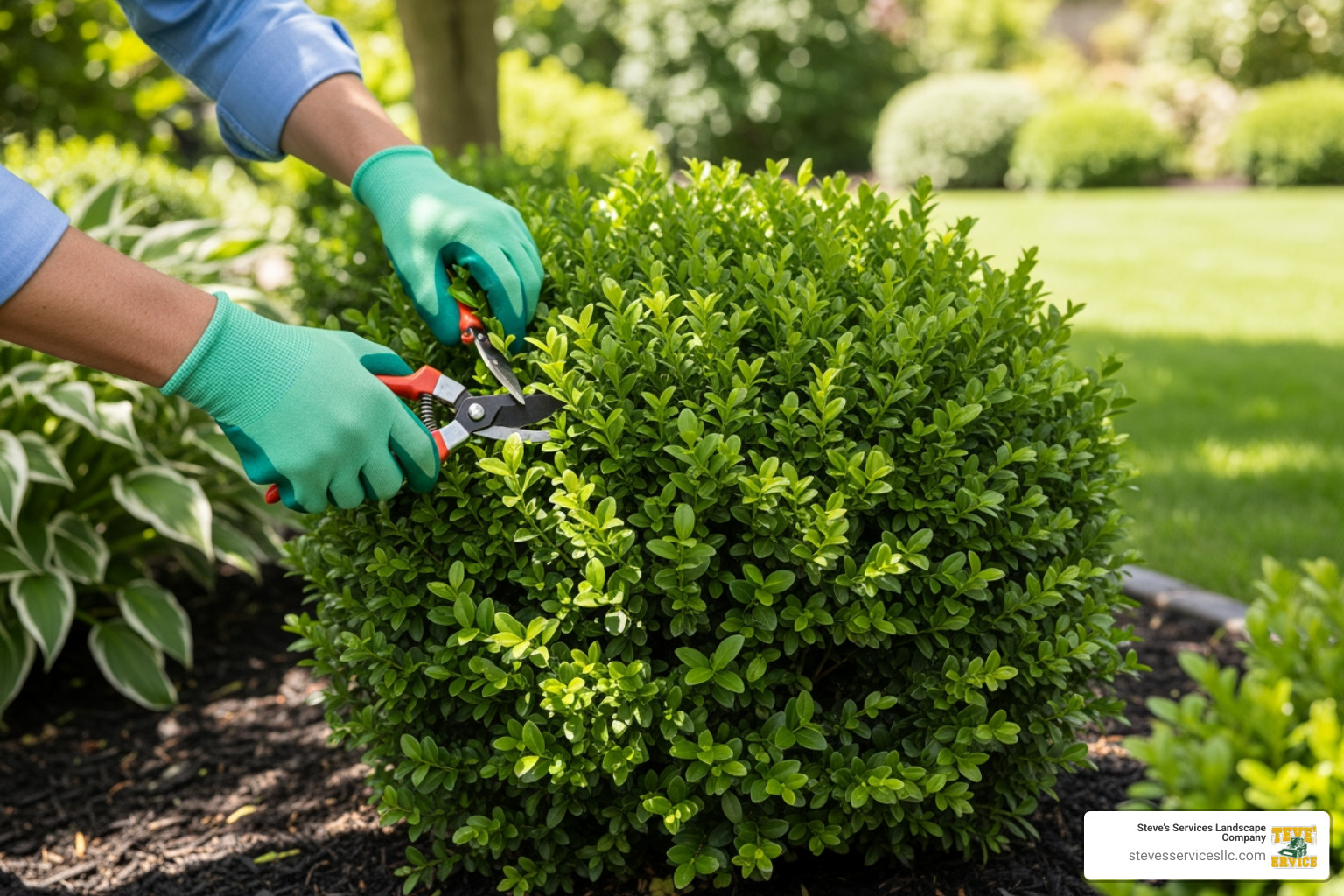
Pruning is a vital practice that contributes significantly to the health, vigor, and aesthetic appeal of boxwood shrubs. Boxwoods, in particular, benefit from annual pruning to encourage healthy growth, maintain a clean profile, and control their size. Strategically removing parts of the plant encourages new growth, which naturally occurs in the spring, with new stems and leaves emerging about four weeks after pruning. This process not only keeps boxwoods looking neat but also increases light and air penetration within the canopy, which is crucial for reducing disease.
The timing of pruning is just as important as the technique. Pruning during dormancy invigorates plants, channeling their energy into robust new growth when spring arrives. Conversely, pruning when a plant is actively leafed out in summer and fall can reduce the next season’s growth. Proper pruning, as highlighted by experts like those at NC State Extension Publications, is essential maintenance for keeping shrubs healthy and vibrant.
The Ideal Pruning Seasons for Boxwoods
Knowing when to prune is key to boxwood success. For major reshaping or hard pruning (significant size reduction), the ideal time is late winter to early spring, while the plant is still dormant. This allows the boxwood to heal from the cuts and direct its energy into a strong flush of new growth once warmer weather arrives. This dormant season pruning is particularly effective for resetting the shape of an overgrown shrub.
Once the initial burst of spring growth has settled, usually around early June in our Massachusetts communities, lighter trimming can be performed. This early summer pruning is perfect for tidying up and maintaining the desired shape after the first flush of new shoots has emerged. For formal shapes like topiaries, spring, before new growth, is also an excellent time to establish precise lines.
The Risks of Pruning at the Wrong Time
While boxwoods are generally resilient, pruning them at the wrong time can lead to significant problems. The biggest risk comes from late summer or fall pruning, as this stimulates new growth. If this new growth emerges too late in the season, it won’t have enough time to harden off before frost arrives. This tender growth is highly susceptible to frost damage, which can lead to weakened plant health, increased susceptibility to diseases, and unsightly winter dieback. It is much safer to allow the plant to conserve its energy for winter survival. We always advise our clients in Burlington, Everett, Lynnfield, and surrounding areas to avoid late-season pruning to protect their boxwoods from unnecessary stress.
Professional Techniques: Shearing vs. Thinning for Optimal Health
When it comes to pruning box bushes, professionals use two primary techniques: shearing and thinning. While both have their place, understanding their different impacts on plant health is crucial for long-term success.
Shearing involves cutting back all the branches to a uniform length, typically using hedge shears or electric trimmers. It creates the crisp, formal surface seen on traditional hedges and topiaries. Thinning, on the other hand, is a more selective method. It involves removing individual branches, cutting them back to a lateral branch or the main trunk. This method opens up the plant’s interior, allowing sunlight to penetrate deep inside and encouraging air to flow freely through the branches.
While shearing may seem efficient for formal hedges, thinning delivers superior results for plant health. When a boxwood is thinned, sunlight can reach the center of the plant, not just the outer edges. This improved light penetration and air circulation promote dense, leafy growth throughout the entire shrub, creating a fuller and healthier plant from the inside out. For additional insights on maintaining healthy bushes, resources like Bush Pruning Tips for Healthier Bushes offer helpful guidance.
| Technique | Health Impact | Best For | Long-Term Results |
|---|---|---|---|
| Shearing | Can create dense outer growth, potentially leading to sparse interior foliage and dead zones. | Formal hedges, geometric shapes (requires careful application). | Can lead to an “outer shell” of growth, reduced vigor, and increased susceptibility to pests/diseases if not combined with thinning. |
| Thinning | Promotes sunlight penetration and air circulation throughout the plant, encouraging dense, leafy branches from the interior out. | Natural forms, rejuvenating overgrown shrubs, improving overall plant health. | Healthier, more vigorous plants with dense foliage throughout, less prone to disease and pests. |
Why Thinning is the Professional’s Choice for Healthy Boxwoods
A common issue we see on new properties is boxwood shrubs that look green on the outside but are bare and brown underneath. This happens when boxwoods are repeatedly sheared without any thinning. The dense outer shell of foliage blocks all light and air from reaching the interior. These interior dead zones create a “hollow” shrub, where the center essentially dies off from lack of sunlight. This stagnant environment also becomes a breeding ground for problems, as poor air circulation invites fungal diseases and makes the plant more vulnerable to pest infestations.
Thinning prevents these issues by selectively removing branches throughout the plant. Light and air can circulate freely, encouraging dense, leafy branches to grow from deep within the shrub. The result is a much healthier, more robust plant that can naturally resist pests and diseases. While thinning takes more time and skill than shearing, it creates a more natural appearance and ensures boxwoods will thrive for decades. This approach is fundamental to our Shrub Pruning philosophy—we’re not just maintaining your landscape; we’re helping it flourish.
The ‘Four D’s’: The Foundation of Healthy Pruning Box Bushes
A professional’s first step is always to address the plant’s health before any aesthetic shaping begins. This process is guided by the “Four D’s”—a framework for prioritizing which branches to remove when pruning box bushes.
First, any dead branches are removed. These brittle, discolored limbs no longer contribute to the plant and can be entry points for disease. Next are damaged branches—anything broken, cracked, or injured from storms or other mishaps. Removing them prevents the damage from spreading.
The third category is diseased branches, which might show signs of fungal infections or other illnesses. Prompt removal and proper disposal of this wood (never in a compost pile) are critical to stop the spread to healthy parts of the plant. Finally, deformed or deranged branches are addressed. This includes branches that are growing in the wrong direction, crossing and rubbing against others, or disrupting the plant’s natural form.
By systematically working through these Four D’s, a professional ensures the boxwood is structurally sound and healthy before any aesthetic shaping begins. This health-first approach promotes stronger growth and creates a more resilient plant.
A Guide to Professional Pruning for Box Bushes: Shaping and Restoration
Boxwoods are wonderfully versatile, capable of being shaped into crisp, formal hedges and intricate topiaries, or allowed to express their natural, flowing form. Achieving any look successfully depends on proper technique and a patient, long-term approach.
When it comes to pruning box bushes, especially those that have become overgrown, professionals adhere to the “one-third rule.” This principle dictates that no more than one-third of a plant’s total mass should be removed in a single season. A plant needs sufficient foliage to produce the energy required to recover and thrive. Taking too much at once can send it into shock and seriously weaken it.
This gradual approach is especially important when tackling an overgrown shrub or making significant changes to its shape. It may require patience, but the boxwood will respond with healthy, vigorous growth.
Pruning for Formal Shapes: Hedges and Topiaries
Creating a perfectly manicured hedge or an intricate topiary requires a clear plan and regular maintenance. For young boxwood plants destined for formal shapes, frequent light shearing during their first few years helps create a dense, compact branching structure. This early training sets the foundation for a crisp, defined look.
When shaping hedges, precision is everything. Professionals use guides like string lines stretched between stakes to ensure straight lines and uniform heights. A key professional technique is to create hedges with a slightly pyramidal shape—narrower at the top and wider at the base. This allows sunlight to reach all the way down to the lower branches, preventing them from becoming sparse and leggy and resulting in a hedge that’s full and lush from top to bottom.
For topiaries, maintenance is more frequent. During the growing season, light trimming every six to eight weeks keeps intricate forms looking sharp. It’s detailed work, but the results are stunning. Our Bush and Shrub Trimming services handle all these precise details, so your formal gardens stay immaculate throughout the year.
Tackling Overgrown Boxwoods: The Rejuvenation Process
An overgrown boxwood that has become a sprawling giant is a common sight, but it’s not a lost cause. Bringing it back to a reasonable size requires a thoughtful, multi-year approach rather than one dramatic haircut.
Following the one-third rule, a severely overgrown boxwood requires a rejuvenation process spread over two to three seasons. The hard pruning is performed in late winter while the plant is still dormant. This timing is crucial—it minimizes stress and gives the plant the best chance to bounce back with strong new growth in the spring.
Boxwoods can produce fresh growth from old, bare wood, but this process takes time. It can take a few years for a heavily pruned boxwood to fully recover and fill back in. The goal is to gradually reduce the overall size while stimulating new growth from the older wood. Each season, another portion is removed, allowing the plant to adjust and maintain enough foliage to produce the energy it needs.
This careful, staged approach ensures the boxwood doesn’t just survive the process—it thrives afterward, coming back fuller and healthier. It’s the same thoughtful planning we bring to our Tree Pruning services, where long-term plant health always comes first.
Advanced Considerations: Disease Prevention and Variety Selection
Beyond basic shaping, advanced considerations like disease prevention and proper variety selection are vital for the long-term health of your boxwood shrubs. A healthy boxwood is more resilient and often requires less corrective work over time.
Managing Boxwood Blight Through Smart Pruning
Boxwood blight is a serious fungal disease that can cause significant harm. While pruning cannot cure an infected plant, smart pruning methods are essential for preventing its spread and lessening its impact.
One of the best preventative measures is to thin out boxwoods to improve air circulation. Blight thrives in damp, still conditions, so good airflow helps dry the leaves, making it much harder for the fungus to establish.
If boxwood blight is suspected or confirmed, our team acts quickly. We carefully remove and properly dispose of any infected branches immediately to stop the disease from spreading. A critical step in this process is to disinfect pruning tools between each cut, especially when moving from a potentially diseased plant to a healthy one. We use a 70% alcohol solution, allowing the tools to soak for at least 30 seconds to kill any spores. Pruning is also scheduled for dry days, as wet leaves can facilitate the spread of blight spores. These proactive measures are a key part of how we maintain landscape health through our comprehensive Landscape Maintenance approach.
Choosing the Right Boxwood to Minimize Pruning
A key strategy for minimizing future pruning box bushes is selecting the right variety from the start. Some types of boxwoods are naturally slower-growing or more compact, meaning they won’t need as much trimming to maintain their desired size and shape.
Planting a boxwood that is genetically programmed to grow very large into a small area will necessitate constant, heavy pruning. Instead, it’s better to look for dwarf varieties or those known for slow growth. Consulting with landscape professionals can help you choose the perfect boxwood that fits your specific needs and aesthetic goals.
There are some fantastic, low-pruning boxwood varieties that perform wonderfully in our Massachusetts climate:
- ‘Green Velvet’ is a popular choice that grows into a dense, rounded shape and requires minimal shaping.
- ‘Green Mountain’ is known for its naturally upright, cone-like form, often used for formal hedges or topiaries that need less frequent trimming.
- ‘North Star’ is a compact, globe-shaped variety that grows slowly, perfect for smaller spaces or a tidy look with little effort.
- ‘Sprinter’ grows a bit faster than some dwarf varieties but maintains a compact, upright shape, making it a good choice for quicker establishment without becoming unruly.
- ‘Winter Gem’ is a tough variety that holds its color through winter, and its manageable growth rate makes it another excellent low-maintenance option.
Choosing one of these varieties can significantly reduce the need for intensive pruning box bushes, allowing you to enjoy their beauty with less upkeep.
Frequently Asked Questions about Pruning Box Bushes
Over the years, we’ve answered countless questions from homeowners in Everett, Burlington, Lynnfield, and throughout Massachusetts about their boxwoods. Here are the most common concerns we hear, along with professional insights.
How much can you prune from a boxwood at once?
The guiding principle for all professional pruning box bushes is the “one-third rule.” It’s critical not to remove more than one-third of the plant’s total mass in a single pruning session. A boxwood’s leaves are essential for capturing sunlight and converting it into energy. Removing too many at once can prevent the plant from producing enough energy to heal, grow, and stay healthy.
For severely overgrown boxwoods, this means a patient, gradual approach is necessary. The rejuvenation work may need to be spread over two or even three growing seasons. While it requires patience, this staged approach gives a boxwood the best chance to recover fully and thrive. Light maintenance trimming can happen more frequently, but any significant size reduction must respect this fundamental principle.
Can you kill a boxwood by pruning it too hard?
Yes, it is possible to kill a boxwood by pruning it too aggressively. Boxwoods are resilient but recover slowly from severe pruning. Removing more than half of the foliage in one session puts the plant’s survival at serious risk.
Some shrubs respond well to “renewal pruning”—cutting them nearly to the ground to stimulate fresh growth. Boxwoods are not in that category. While they can produce new growth from older, bare wood, the process takes years, not months. During that long recovery period, the plant is vulnerable to stress, disease, and environmental challenges, with a significant chance it may not survive.
This is why professionals advocate for a staged approach when dealing with drastically overgrown boxwoods. It ensures the plant always retains enough foliage to support itself, leading to a healthy, attractive shrub for decades to come, rather than a bare skeleton that may not recover.
What tools do professionals use for pruning box bushes?
Using the right tools for pruning box bushes is essential for making clean, healthy cuts and avoiding ragged wounds that invite disease. Keeping those tools sharp and clean is just as crucial.
- Sharp bypass hand pruners are the workhorses for most tasks, handling branches up to about half an inch in diameter. They make clean, scissor-like cuts that heal quickly, unlike anvil pruners which can crush stems.
- For branches between half an inch and 1.5 inches, loppers provide the necessary leverage for a clean cut while maintaining precision. Their long handles also help reach into the interior of larger shrubs.
- For branches larger than 1.5 inches, a pruning saw is used. These saws typically cut on the pull stroke, making them efficient and effective.
- For formal hedges and topiaries, high-quality hand shears or electric hedge trimmers are indispensable for maintaining crisp, uniform lines.
Tool sharpness is non-negotiable. Dull blades tear and damage plant tissue rather than making clean cuts, creating wounds that are slow to heal and invite disease. Professionals sharpen their tools regularly.
Furthermore, tools are carefully cleaned and disinfected between uses, especially when moving between plants or working on shrubs showing signs of disease. A quick dip in a 70% alcohol solution can prevent the spread of boxwood blight or other pathogens throughout a landscape. This small step makes a tremendous difference in keeping an entire garden healthy.
Conclusion
As we’ve explored, pruning box bushes is a nuanced task that goes far beyond a simple trim. The keys to success lie in proper timing, using the right technique (especially prioritizing thinning), and always putting the plant’s health first. This health-first approach ensures your boxwoods won’t just look good for a season; they’ll thrive, adding lasting beauty and value to your landscape for many years to come.
If all this talk of dormant seasons and the “one-third rule” seems complex, or if you simply prefer to leave the detailed work to the experts, we understand. For impeccable care of your boxwoods and your entire landscape in the Everett, MA area, look no further than the skilled team at Steve’s Services. We’re here to provide professional and reliable solutions that bring out the best in your garden. Our team proudly serves communities including Burlington, Danvers, Lynnfield, Medford, Melrose, North Reading, Reading, Revere, Saugus, Stoneham, Winchester, Woburn, Malden, and Wakefield. To ensure your hedges and shrubs are perfectly maintained and looking their absolute best, we invite you to learn more about our Hedge Trimming Services.
