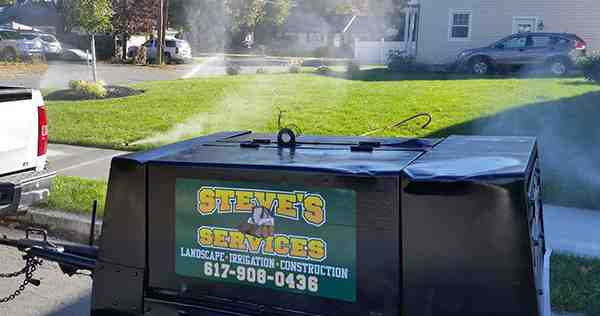
Anatomy of an Automatic Sprinkler Irrigation System
An automatic sprinkler irrigation system is a network of pipes, valves, sprinkler heads, and a controller that waters your lawn and garden on a set schedule — without you lifting a finger.
Here’s what you need to know at a glance:
| Feature | What It Means for You |
|---|---|
| Automated scheduling | Watering happens on a timer, even when you’re away |
| Zone control | Different areas get the right amount of water |
| Water efficiency | Smart systems can cut water use by up to 50% |
| Backflow protection | Keeps irrigation water out of your drinking supply |
| Professional or DIY install | Options range from simple hose-based kits to full in-ground systems |
Whether you’re tired of dragging a hose around on weekends or your lawn is showing dry patches from inconsistent watering, an automatic system solves both problems — and saves you time and money in the long run.
Keeping a lawn healthy in Massachusetts takes more than just occasional watering. Between hot summers, unpredictable rain, and busy schedules, it’s easy for a yard to suffer. An automatic sprinkler system takes the guesswork out of lawn care entirely. It waters at the right time, in the right places, with the right amount of water — consistently, season after season.
I’m Steve Sylva, owner of Steve’s Services Landscape Company in Malden, MA, and over my 25+ years in the landscaping business I’ve designed and overseen the installation of countless automatic sprinkler irrigation systems for homeowners and commercial properties across Greater Boston. In this guide, I’ll walk you through everything you need to know — from components and costs to maintenance and smart features — so you can make the best decision for your property.
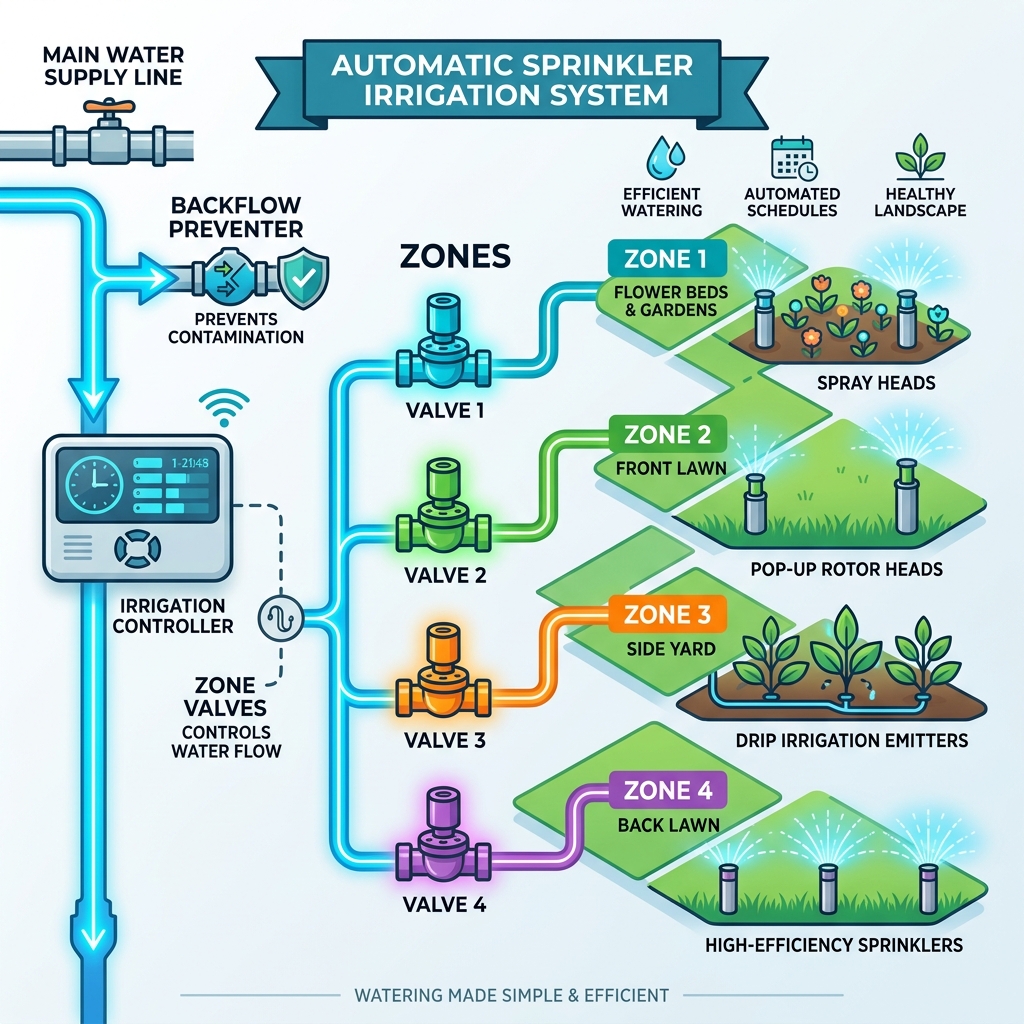
Automatic sprinkler irrigation system terminology:
To understand how your lawn stays so green, you first need to look under the hood—or rather, under the grass. A professional irrigation system is a complex assembly of mechanical and electronic parts working in harmony.
The system begins at your home’s water supply. A main line carries water to the various components that regulate its pressure, direction, and timing. Most systems use a combination of PVC pipe (which can typically handle up to 200 PSI) for main lines and “funny pipe” or poly tubing for the final connection to the heads. Funny pipe is particularly useful in our Massachusetts climate because its flexibility helps it withstand the ground shifting during our freeze-thaw cycles.
According to Rain Bird’s anatomy of a system, the journey of water involves moving through a shut-off valve, a backflow preventer, and then into a manifold of valves that act as the “gatekeepers” for each watering zone.
The Brain: Smart Controllers and Timers
If the pipes are the veins, the controller is the brain. Modern automatic sprinkler irrigation system technology has evolved far beyond simple mechanical dials. Today, we primarily install smart WiFi-enabled controllers that offer unprecedented control.
These “smart” brains can sequence zones automatically, ensuring that only one area of your yard draws water at a time to maintain proper pressure. Many homeowners are now opting for smart sprinkler controllers because they offer:
- Weather Awareness: They use local weather data to skip watering if rain is in the forecast.
- App Control: You can start or stop your sprinklers from your smartphone whether you’re in the living room or on vacation in Cape Cod.
- Wind Skip: Advanced units like OtO can detect high winds and pause watering to prevent the water from blowing onto your house or driveway.
- Soil Sensors: Some systems integrate moisture sensors that tell the controller exactly when the soil is dry enough to need a drink.
The Heart: Valves and Backflow Preventers
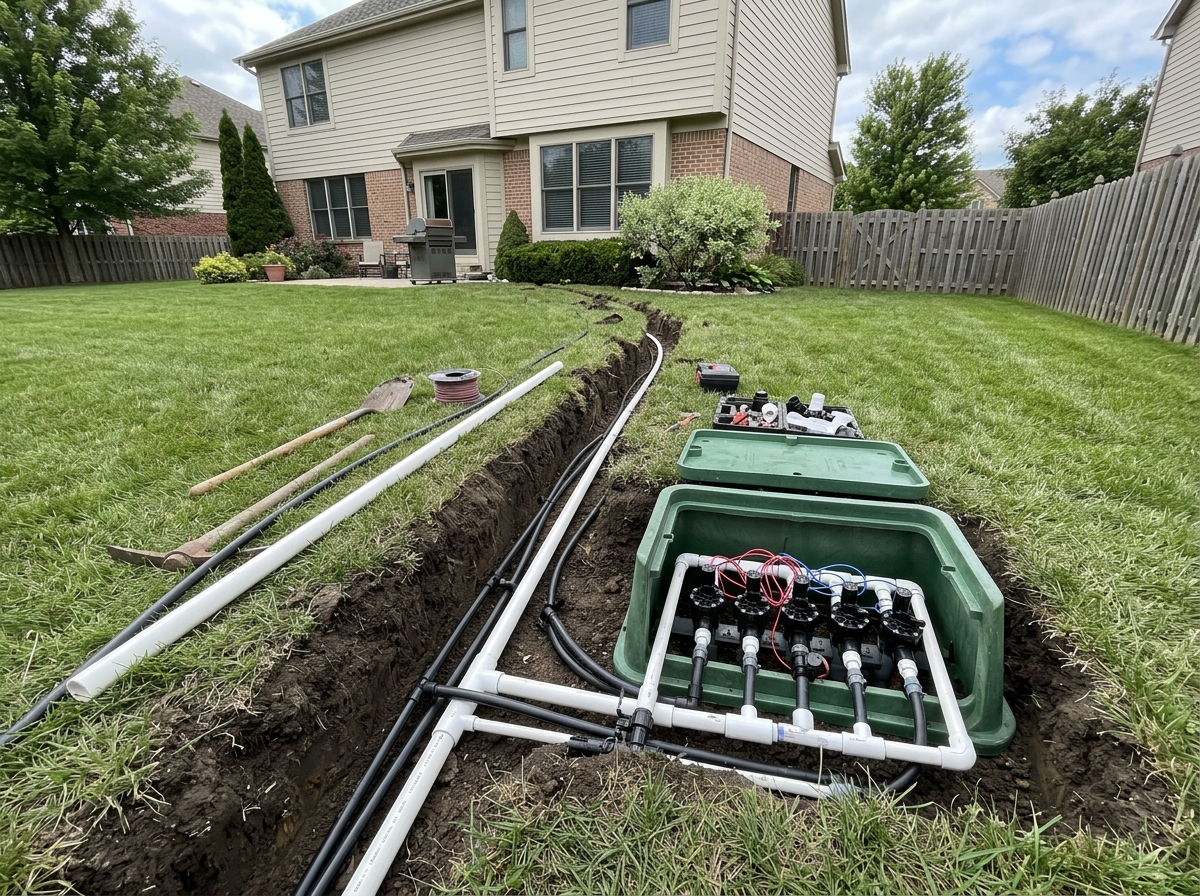
The valves are the mechanical muscles of the system. Located in a protective valve box, these components receive an electrical signal from the controller to open or close, allowing water to flow to a specific zone.
Equally important is the backflow preventer. This is a safety device required by building codes in towns like Melrose and Burlington. Its sole job is to ensure that “gray” irrigation water—which might contain lawn chemicals or fertilizers—never flows backward into your home’s clean drinking water. Because this is a critical safety component, replacing a backflow preventer should always be handled by a professional to ensure your home remains compliant with local health regulations.
How Professional Irrigation Systems Work
An automatic sprinkler irrigation system works through a calculated balance of water pressure and flow. When the timer hits the programmed start time, it sends a low-voltage electrical signal to the valve. The valve opens, and water rushes through the lateral pipes to the sprinkler heads.
To keep the system running efficiently, we must account for:
- Static Pressure: The pressure in the pipes when no water is moving (measured in PSI).
- Flow Rate: The amount of water available, measured in Gallons Per Minute (GPM).
- Friction Loss: As water moves through pipes and around corners, it loses energy.
Understanding how these systems work is essential for a design that doesn’t leave dry spots or “geysers” caused by broken heads.
Zoning and Water Pressure Requirements
You can’t water a whole yard at once because most residential water lines don’t have enough “oomph” (pressure and flow) to pop up 50 heads at the same time. This is why we design “zones.”
A typical yard might have one zone for the sunny front lawn, another for the shaded side yard, and a third for the flower beds. This allows us to achieve “head-to-head coverage,” meaning the spray from one head reaches the base of the next. This ensures 100% coverage without dry gaps. We often utilize professional design services to map out these zones, accounting for elevation changes (which shouldn’t exceed 6 feet for many DIY kits) and the specific needs of different plant types.
Selecting the Right Sprinkler Heads for Your Automatic Sprinkler Irrigation System
Not all sprinkler heads are created equal. Choosing the right one is the difference between a lush lawn and a swampy mess.
- Pop-up Spray Heads: These stay flush with the ground when off (safe for mowers!) and are great for smaller areas or flower beds.
- Rotors: These shoot a single stream of water and rotate back and forth. They are perfect for large, open lawn areas.
- Rotary Nozzles: These are high-efficiency heads that deliver multiple streams of water slowly, reducing runoff on slopes.
- Impact Sprinklers: The classic “chk-chk-chk” sprinklers, often used in larger agricultural or very large residential settings.
If a head gets cracked by a snowplow or mower, replacing it quickly is vital to maintain the pressure balance of the entire zone.
Key Benefits of an Automatic Sprinkler Irrigation System
The most obvious benefit is convenience—no more dragging hoses at 6:00 AM. But the advantages go much deeper than just saving you a Saturday morning chore.
A well-designed system provides consistent hydration. Unlike manual watering, which is often “all or nothing,” an automatic system delivers precise amounts of water. This leads to deeper root growth and better nutrient retention in the soil. It also helps with erosion reduction, as the controlled spray prevents the “washout” effect often caused by heavy manual hosing.
By using water-efficient sprinkler systems, you are also doing your part for the environment. Systems like Irrigreen claim to use up to 50% less water than traditional setups by using digital mapping to avoid spraying sidewalks and fences.
Precision Watering and Lawn Health
Precision is the secret to a golf-course-quality lawn. When you water manually, you often over-water some spots and under-water others. This leads to weed suppression issues, as weeds love the stressed patches of a lawn.
Professional installation ensures that your system is programmed for “evaporation control”—watering in the early morning hours when the sun is low and the wind is calm. This ensures the water actually reaches the roots rather than evaporating into the Massachusetts air.
Professional Installation and Cost Factors
Installing an automatic sprinkler irrigation system is a significant home improvement. While some “all-in-one” kits exist for small yards (covering roughly 1,000 to 3,000 sq. ft.), a full-scale in-ground system requires trenching, plumbing, and electrical work.
Several factors influence the final price:
- Yard Size and Shape: Oddly shaped yards require more heads and complex piping.
- Soil Type: Rocky or heavy clay soil in areas like Winchester or Woburn can increase labor time for trenching.
- Number of Zones: More zones mean more valves, wire, and piping.
- Smart Features: Upgrading to WiFi controllers or high-efficiency nozzles adds to the initial equipment cost.
Understanding the Investment in an Automatic Sprinkler Irrigation System
When looking at the complete guide to sprinkler costs, it’s important to differentiate between internet averages and reality.
Based on general internet data, the average cost to install a professional system can range from $2,500 to $18,000+.
- Small, simple systems: $2,500 – $4,500
- Average residential systems: $5,000 – $9,000
- Large or complex estate systems: $12,000 – $18,000+
Note: These are average costs based on internet research and do not represent actual quotes from Steve’s Services.
While the home sprinkler system cost may seem high upfront, the long-term ROI is found in increased property value and significantly lower water bills. For example, some smart systems pay for themselves in 3 to 5 years through water savings alone.
Essential Maintenance and Winterization
A sprinkler system isn’t “set it and forget it” forever. It needs a little TLC to stay in peak condition. Regular maintenance includes a “Spring Start-up,” where we check every head for clogs, adjust the spray patterns, and ensure the controller is programmed for the current season.
Throughout the summer, you should keep an eye out for:
- Leaking Heads: Water pooling around a head when the system is off.
- Clogged Nozzles: Uneven spray patterns or heads that don’t pop up fully.
- Dry Spots: Indicating a head might be out of alignment.
Protecting Your System from Freezing Temperatures
In Malden, Reading, and the surrounding areas, winterization is not optional. If water stays in your pipes when the ground freezes, the expanding ice will crack the PVC, shatter the valves, and ruin the backflow preventer.
The most effective method is a “blowout.” We use a high-volume air compressor to force all water out of the lines. Knowing how to blow out an irrigation system properly is a skill that saves homeowners thousands in repair costs. The cost to winterize is a small price to pay compared to the cost of repairing a frozen manifold or burst main line.
Frequently Asked Questions about Sprinkler Systems
How much water does an automatic system save?
A lot! Traditional manual watering is often incredibly wasteful. Smart systems can reduce water waste by up to 50% by using weather-based adjustments, soil sensors, and precision mapping that ensures you aren’t “watering” your driveway or the neighbor’s fence.
Why is a backflow preventer required?
It is a vital safety device required by law. It prevents “back-siphonage,” which occurs when a drop in municipal water pressure could suck stagnant, fertilizer-laden water from your sprinkler lines back into your kitchen tap. Keeping this device in good repair is essential for your family’s health.
How many zones does my yard need?
There is no “one size fits all” answer. The number of zones depends on your water pressure (PSI) and the GPM your home can provide. We also look at the “micro-climates” of your yard—for instance, a shaded area under a large oak tree needs far less water than a wide-open lawn facing the afternoon sun.
Conclusion
Investing in an automatic sprinkler irrigation system is one of the best ways to protect your landscaping investment and reclaim your free time. From the “brain” of the smart controller to the “heart” of the valves and backflow preventer, every piece plays a role in keeping your Greater Boston home looking its best.
At Steve’s Services Landscape Company, we pride ourselves on designing systems that are as efficient as they are effective. Whether you are in Malden, Lynnfield, or Saugus, we have the local expertise to handle the unique soil and climate challenges of our region.
Ready to stop dragging the hose and start enjoying a greener lawn? Request an irrigation system installation from us today and let our team of professionals design the perfect solution for your home.