Why Choosing the Best Fertilizer for Newly Laid Sod Makes or Breaks Your Lawn
The best fertilizer for newly laid sod is a phosphorus-rich starter fertilizer with a balanced NPK ratio — here are the top options to know:
| Fertilizer | NPK Ratio | Best For |
|---|---|---|
| Scotts Turf Builder Starter | 24-25-4 | Fast root establishment, all grass types |
| The Andersons Premium New Lawn Starter | 20-27-5 | Deep greening, includes iron |
| Jonathan Green Veri-Green Starter | 12-18-8 | Cool-season grasses, Northeast lawns |
| Balanced All-Purpose Starter | 16-16-16 | Pre-installation soil prep |
| Fall/Root Builder Formula | 10-20-20 | Deep roots, winter hardiness |
New sod looks great on day one. But without the right nutrients at the right time, it can yellow, fail to root, or die off within weeks.
Most homeowners don’t realize that fertilizing too early — or with the wrong formula — can do more harm than good. New sod needs phosphorus to build roots first, not a high-nitrogen boost that pushes top growth before the roots can support it. Getting this wrong is one of the most common (and costly) mistakes we see in Massachusetts lawns.
I’m Steve Sylva, owner of Steve’s Services Landscape Company, with over 25 years of hands-on experience helping Massachusetts homeowners choose the best fertilizer for newly laid sod and get their new lawns off to a strong start. In the sections below, I’ll walk you through exactly what to use, when to apply it, and how to avoid the mistakes that set new sod back.
Basic best fertilizer for newly laid sod vocab:
Understanding the Best Fertilizer for Newly Laid Sod
When we talk about the best fertilizer for newly laid sod, we aren’t just talking about your run-of-the-mill lawn food. New sod is essentially a plant in recovery. It has been sliced away from its original home, had its roots severed, and is now trying to “knit” into your soil in Medford or Reading.
The primary goal during the first few weeks isn’t to make the grass grow tall so you can mow it; it’s to encourage those tiny white roots to dive deep into the ground. This is why we prioritize “Starter Fertilizers.” These formulas are specifically engineered to reduce transplant shock and accelerate establishment. According to industry statistics, using a high-quality starter fertilizer can help new grass grow up to 70% thicker and 35% quicker compared to unfed lawns.
If you are looking for professional help to ensure your lawn gets the best start possible, you can find more info about sod installation services on our site. Choosing the right product involves looking at the Best Fertilizers to Promote Healthy Growth for New Sod 2025 to ensure your local soil conditions are met.
Ideal NPK Ratios for the Best Fertilizer for Newly Laid Sod
You’ve probably seen those three numbers on the front of fertilizer bags—that’s the NPK ratio (Nitrogen, Phosphorus, and Potassium). For new sod in our Massachusetts climate, the middle number (Phosphorus) is the MVP.
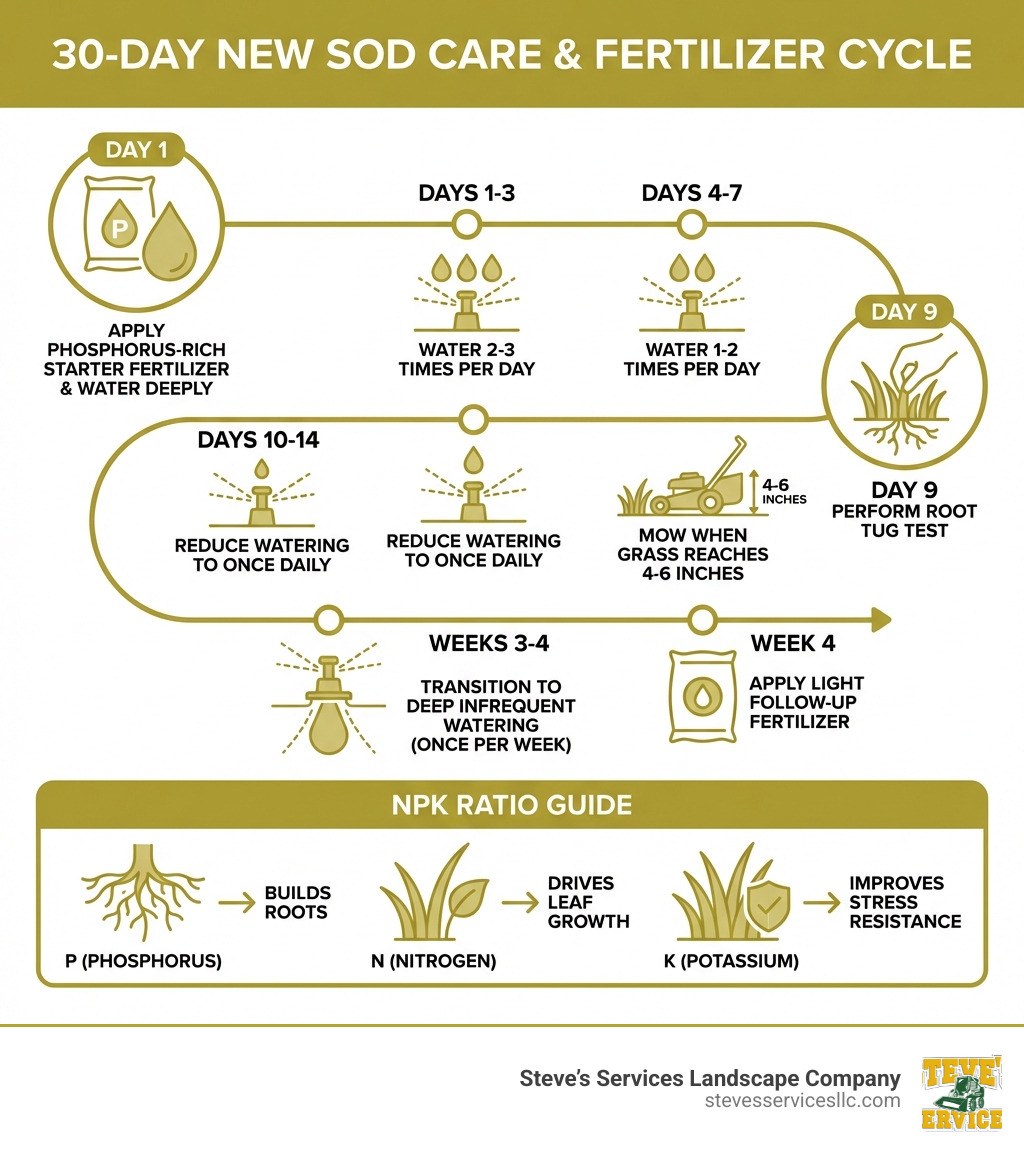
- Nitrogen (N): Promotes top growth and that deep green color.
- Phosphorus (P): The “root builder.” This is critical for energy transfer and root development.
- Potassium (K): Enhances overall plant health and stress resistance.
Commonly recommended ratios for new sod include:
- 16-16-16: A balanced “triple sixteen” often used as a pre-installation soil prep. It provides an even dose of everything.
- 10-20-20: Excellent for fall installations or areas needing a massive root boost.
- 24-25-4: A high-phosphorus starter like Scotts Turf Builder Starter Fertilizer, which is widely considered one of the best fertilizers for newly laid sod because it balances quick greening with intense root support.
Starter Fertilizer vs. Regular Lawn Food
A common mistake we see in places like Malden and Melrose is homeowners grabbing a bag of “standard” lawn fertilizer for their brand-new sod. Here is why that is a bad idea:
| Feature | Starter Fertilizer | Regular Lawn Fertilizer |
|---|---|---|
| Phosphorus Levels | High (to build roots) | Low to None (maintenance only) |
| Nitrogen Release | Controlled/Slow (prevents burn) | Often Quick (for fast greening) |
| Primary Goal | Root Establishment | Leaf Growth & Color |
| Transplant Shock | Reduces it significantly | Can increase it if too high in N |
Using regular fertilizer on new sod is like giving a marathon runner a giant steak right in the middle of a race—it’s too much of the wrong thing at the wrong time. New sod needs the nutrient density of a starter formula to overcome the stress of being moved. You can learn more about caring for new sod to see how these nutrients interact with your soil.
When and How to Apply Fertilizer to New Sod
Timing is everything. If you apply the best fertilizer for newly laid sod at the wrong time, you risk “burning” the tender new roots or simply wasting your money as the nutrients wash away.
In our experience serving communities from Burlington to Saugus, there are two primary schools of thought: applying to the bare soil before the sod goes down, or applying immediately after installation. Both work, but if you apply it to the bare ground, you can actually till the nutrients into the top few inches of soil, making them even more accessible to the roots.
For those applying after the sod is laid, products like The Andersons Premium New Lawn Starter are fantastic because they include micronutrients like iron for deep greening without over-stimulating the grass. For a deeper dive, check out our guide to how to fertilize new sod.
The First 30 Days: A Fertilization Timeline
To get that magazine-cover lawn in Winchester or Woburn, follow this 30-day timeline:
- Day 0 (Pre-Installation): Apply a balanced starter (like 16-16-16) to the prepared bare soil.
- Day 1 (Installation Day): If you didn’t do pre-install fertilization, apply your starter fertilizer now. Water it in immediately.
- Day 9 (The Tug Test): Gently pull on a corner of the sod. If you feel resistance, those white roots are grabbing hold!
- Day 10-14: If using a liquid system, this is often when a second light application occurs.
- Week 4: Apply a follow-up light application of starter fertilizer to keep the momentum going. We often recommend Jonathan Green Veri-Green Starter Fertilizer for this stage, as it is specifically formulated for the cool-season grasses we love in the Northeast.
How to Apply the Best Fertilizer for Newly Laid Sod Safely
Applying fertilizer isn’t just about throwing it like chicken feed. You need even distribution to avoid “striping”—those annoying dark green and light green lines.
- Use a Spreader: Never apply by hand. Use a broadcast or drop spreader.
- Check Settings: Every bag has a recommended setting. Start a little lighter if you’re nervous; you can always add more, but you can’t take it back.
- The “Perpendicular” Method: Apply half the dose walking North-South, and the other half walking East-West. This ensures total coverage.
- Water it In: This is non-negotiable. Fertilizer needs water to move from the surface down to the roots. Without water, the granules just sit there and can actually chemically burn the grass blades. For more on this, see our detailed new sod watering guide.
Essential Nutrients for Healthy Sod Growth
Beyond the big three (NPK), there are other elements that make a fertilizer the best fertilizer for newly laid sod.
The Importance of Phosphorus and Potassium
We’ve hammered home that phosphorus is for roots, but let’s talk about why. Phosphorus helps with energy transfer within the plant. Think of it as the battery that allows the sod to grow.
Potassium, on the other hand, is like the plant’s immune system. It helps with water uptake and makes the grass more resistant to the wild Massachusetts weather—from humid summer heatwaves in Lynnfield to early frosts in North Reading. A product like Southland Sod Farms Sod and Seed Starter is designed to reduce this specific type of environmental stress. For more information on how these work together, visit our page on sodding and landscaping.
Liquid vs. Granular Fertilizers for New Lawns
This is a hot debate among lawn enthusiasts.
- Granular Fertilizers: These are the most common. They are easy to see as you apply them and usually offer a “slow-release” technology. This means they feed the lawn over several weeks. Scotts Turf Builder Starter Fertilizer 14,000 sq. ft. uses All-in-One particles to ensure every inch of your lawn gets the same nutrient mix.
- Liquid Fertilizers: These provide almost instant absorption. They are great for a quick “green-up” and often contain humates (which improve soil health) and micronutrients. However, they don’t last as long as granular options and require more frequent applications.
In the Northeast, we generally recommend a granular starter for the heavy lifting and liquid supplements only if you’re dealing with specific nutrient deficiencies.
Common Mistakes and Professional Maintenance Tips
Even with the best fertilizer for newly laid sod, things can go sideways if you aren’t careful. One of the biggest risks is over-fertilization. Too much nitrogen too early can cause “nitrogen burn,” which turns your expensive new sod yellow or brown.
Avoiding Fertilizer Burn and Yellowing
Yellowing sod is a cry for help. It usually means one of three things:
- Underwatered: The edges of the sod pieces are drying out.
- Over-fertilized: You used a quick-release nitrogen fertilizer that “fried” the roots.
- Transplant Shock: The grass is still adjusting to its new home.
To avoid these issues, always perform a soil test before you even buy your sod. This tells you exactly what your soil is missing. Also, pay close attention to the when to mow new sod guidelines—mowing too early can stress the grass further. If you’re worried about the initial investment, you can check sod installation costs to plan your budget accordingly.
Professional Installation and Fertilization Costs
If the thought of NPK ratios and spreader settings makes your head spin, you aren’t alone. Many homeowners in Danvers and Wakefield prefer to leave the first 30 days to the pros.
Average professional sod installation and fertilization costs range from $0.60 to $5.50 per square foot. These are average costs based on internet data and not actual costs for Steve’s Services. Factors that influence this price include the size of your yard, the type of grass (like Kentucky Bluegrass or Fescue), and the amount of soil prep required. On the high end, complex projects with significant grading or premium organic fertilizers can exceed $5.50 per square foot.
Frequently Asked Questions about New Sod Fertilization
When should I first fertilize my new sod?
Ideally, you should apply a starter fertilizer either to the bare soil right before laying the sod or on the very same day you install it. If you missed that window, wait until the roots have started to knit (usually about 10-14 days) before applying a light dose of the best fertilizer for newly laid sod.
Do I need to water in the fertilizer after application?
Yes, absolutely! Water is the vehicle that carries the nutrients from the surface down to the root zone. Without watering it in, the fertilizer can sit on the blades and cause chemical burns, especially in the summer sun. Aim for about 1/2 inch of water immediately after fertilizing.
Can I use “weed and feed” products on new sod?
No! This is a major “no-no.” Most “weed and feed” products contain pre-emergent or post-emergent herbicides that are too harsh for young, establishing roots. We recommend waiting at least 3 to 4 mows (usually about 6-8 weeks) before applying any weed control products to your new lawn.
Conclusion
At Steve’s Services Landscape Company, we know that a beautiful lawn is the heart of a great home. Whether you are in Everett, Stoneham, or Medford, the secret to a lush, green yard starts with the best fertilizer for newly laid sod. By focusing on phosphorus for root growth, sticking to a strict 30-day watering and feeding schedule, and avoiding high-nitrogen “quick fixes,” you’ll have a lawn that doesn’t just look good today, but stays healthy for years to come.
If you’re ready to transform your yard without the guesswork, our team is here to help with everything from soil prep to professional installation. Contact Steve’s Services for expert sod installation today and let’s get your new lawn growing!