
Why the Right Fertilizer is Crucial for Your New Sod

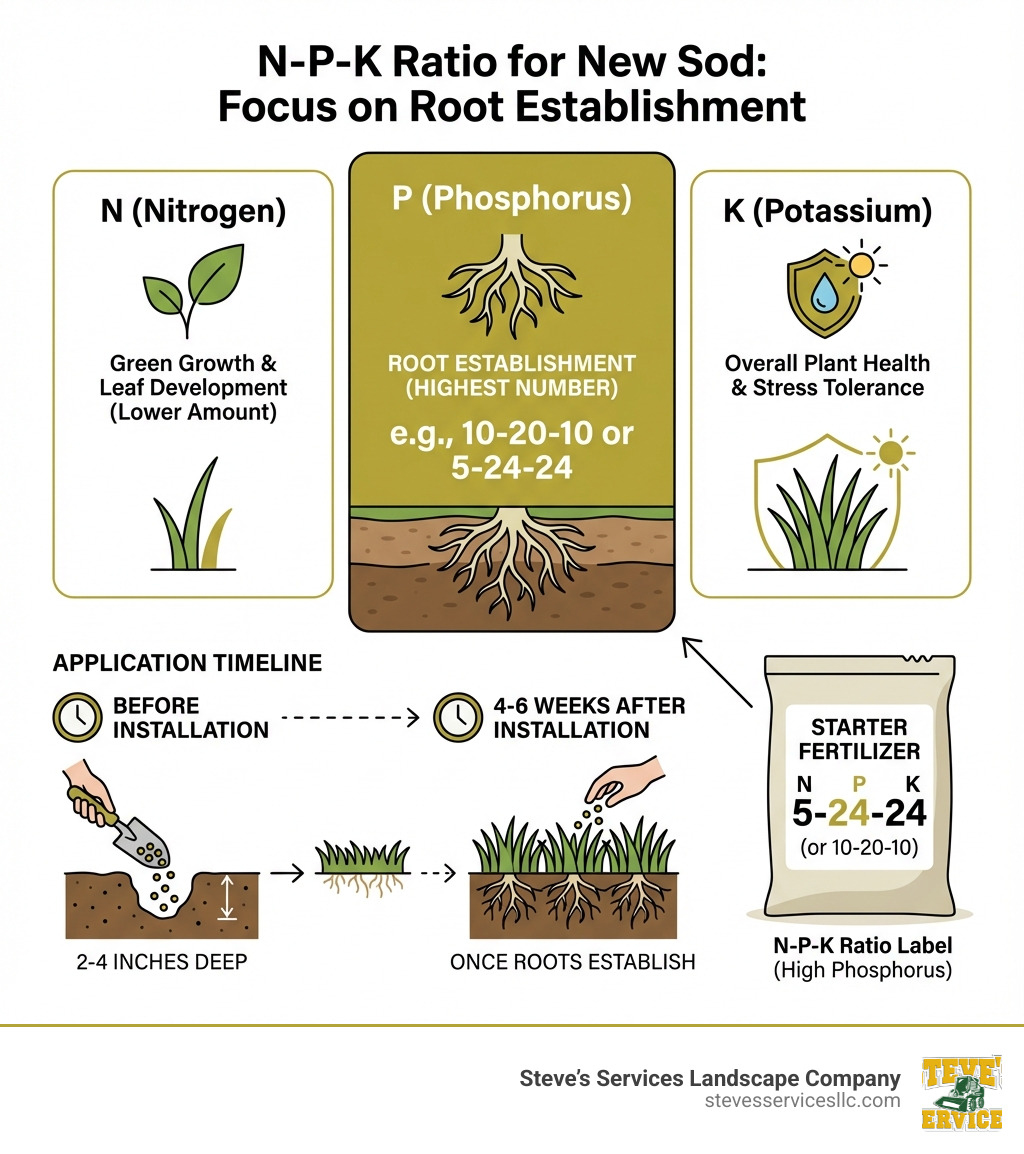
The best fertilizer for laying sod is a starter fertilizer with high phosphorus content, typically featuring an N-P-K ratio like 10-20-10, 5-24-24, or 16-20-0. Apply it before installation by incorporating it 2-4 inches deep into the soil, or wait 4-6 weeks after laying sod to allow roots to establish before the first application.
Quick Answer for New Sod Success:
- Best N-P-K Ratio: 10-20-10, 5-24-24, or 16-20-0 (high phosphorus)
- Application Rate: 1 pound of phosphorus (P) per 1,000 sq ft
- Timing: Before installation (incorporated 2-4 inches deep) OR 4-6 weeks after laying sod
- Why Phosphorus Matters: Promotes strong root development over top growth
- Avoid: High-nitrogen fertilizers like 40-0-0 immediately after installation
Laying fresh sod is a significant investment in your property. You’ve cleared the area, graded the soil, and carefully rolled out each piece of turf. But without the right nutrients at the right time, even premium sod can struggle to establish deep roots and develop into the lush, resilient lawn you’re envisioning.
The difference between a lawn that thrives and one that merely survives often comes down to phosphorus. This nutrient is essential for root development, which is exactly what new sod needs most during its first few weeks. While nitrogen promotes leafy green growth and potassium builds stress tolerance, phosphorus is the foundation that allows your sod to anchor itself into the soil below.
Timing matters just as much as the fertilizer you choose. Apply too early, and you risk burning tender new roots. Apply too late, and you miss the critical window when your sod is working hardest to establish itself. The research is clear: starter fertilizers should contain at least 1 pound of phosphorus per 1,000 square feet, with application either incorporated into the soil before installation or applied 4-6 weeks after laying sod once roots have begun to establish.
Water plays an equally critical role. Even the best fertilizer won’t help your sod if nutrients can’t reach the root zone. Deep, thorough watering after fertilizer application ensures nutrients penetrate the soil where they’re needed most, while frequent shallow watering can actually prevent proper root development.
I’m Steve Sylva, owner of Steve’s Services Landscape Company, and over my 25+ years in the landscaping industry, I’ve helped countless Massachusetts homeowners establish beautiful lawns from sod. Choosing the best fertilizer for laying sod and applying it correctly has been a cornerstone of every successful installation we’ve completed, ensuring our clients’ investments result in lawns that look great and stand up to New England’s challenging climate.
Must-know best fertilizer for laying sod terms:
Decoding Fertilizer Labels: Understanding N-P-K for New Sod
Understanding what those three numbers on a fertilizer bag mean is the first step to choosing the best fertilizer for laying sod. These numbers represent the N-P-K ratio, indicating the percentage by weight of Nitrogen (N), Phosphorus (P), and Potassium (K) in the fertilizer. Each of these essential macronutrients plays a distinct and vital role in the healthy growth and establishment of your new lawn.
- Nitrogen (N): The Growth Booster
Nitrogen is primarily responsible for vegetative growth, density, and that vibrant green color we all love. It’s a key component of chlorophyll, the pigment essential for photosynthesis, which is how plants convert sunlight into energy. While crucial for overall plant health, new sod doesn’t need an abundance of nitrogen right away. Too much nitrogen too soon can encourage lush top growth at the expense of root development, which is the opposite of what we want for newly laid sod. - Phosphorus (P): The Root Builder
For new sod, phosphorus is arguably the most critical nutrient. It’s essential for DNA formation, seedling development, and, most importantly, robust root growth. Phosphorus helps new roots dig deep and hold strong, providing the structural strength your sod needs to establish itself firmly in the soil. Without sufficient phosphorus, your new sod might struggle to take root, appearing discolored and weak. Starter fertilizers are specifically formulated with a higher phosphorus content to prioritize this crucial root development. - Potassium (K): The Protector
Potassium acts as your lawn’s immune system booster. It’s involved in vital biochemical reactions, aids in sugar and starch production, and helps maintain turgor pressure (cell rigidity). This nutrient improves disease resistance, strengthens cell walls, and increases your sod’s tolerance to stress, including drought and cold, which is particularly beneficial for preparing your lawn for New England winters.
The Ideal N-P-K Ratio for Starter Fertilizer
When selecting the best fertilizer for laying sod, we look for what’s known as a “starter fertilizer.” These formulations are specifically designed to promote strong root development in new turf. The key characteristic of a starter fertilizer is its higher phosphorus content (the middle number in the N-P-K ratio).
While a balanced ratio is generally essential for overall lawn health, for new sod, the emphasis shifts to phosphorus. Our research and experience show that starter fertilizers high in phosphorus are ideal for new sod, ensuring those roots dig deep and hold strong.
Common N-P-K ratios recommended for new sod include:
- 10-20-10: This is a classic starter fertilizer ratio, offering a good balance with a significant boost in phosphorus.
- 5-24-24: This ratio provides a very high phosphorus content, along with a good amount of potassium to help with overall plant health and stress tolerance.
- 16-20-0: Another excellent choice, this ratio provides phosphorus for roots and a moderate amount of nitrogen for initial green-up without overstimulating top growth.
- 15-15-15 or 8-8-8: These balanced ratios can also be suitable, providing an even supply of all three macronutrients, with enough phosphorus to support root development.
It is generally recommended that no more than 1 pound of Nitrogen (N) and at least 1 pound of Phosphorus (P) per 1,000 square feet be applied to the root zone at the time of planting. This ensures that the nascent root system has ample resources to establish itself without being overwhelmed by excessive nitrogen.
The Best Fertilizer for Laying Sod: A Professional’s Guide
Choosing the best fertilizer for laying sod isn’t just about picking a bag off the shelf; it’s about understanding your soil, your grass type, and the unique needs of a brand-new lawn. At Steve’s Services Landscape Company, we emphasize a custom approach to ensure your sod gets the best possible start.
Before we even consider fertilizer, we always recommend a thorough soil test. A professional analysis, like those from the UMass Extension Soil & Plant Nutrient Testing Laboratory, provides invaluable information about your soil’s current pH levels and existing nutrient deficiencies. Knowing precisely what your soil lacks allows us to select a fertilizer that truly addresses your lawn’s needs, preventing unnecessary applications and ensuring optimal health. For instance, if a soil test reveals high phosphorus levels, a professional would adjust the fertilizer blend to avoid over-fertilization.
Our expert recommendations at Steve’s Services Landscape Company are always guided by science and years of practical experience in Massachusetts. We consider the type of fertilizer (granular vs. liquid), its release rate (slow-release vs. quick-release), and whether an organic or synthetic option is best for your specific project.
- Granular vs. Liquid Fertilizer:
- Granular fertilizers are typically slow-release, providing a steady supply of nutrients over time. They are easy to apply with a spreader and reduce the risk of burning.
- Liquid fertilizers are absorbed quickly by the grass, offering immediate nutrient availability. They can be particularly useful for ensuring rapid uptake, especially for newly installed sod that needs a quick boost. For new sod, a staggered liquid application (e.g., once a week for the first three weeks) can ensure a steady nutrient supply.
- Slow-Release vs. Quick-Release:
- Slow-release fertilizers are generally preferred for new sod. They provide nutrients gradually, minimizing the risk of nutrient burn and promoting more consistent growth. This controlled feeding is better for the environment and reduces the frequency of application.
- Quick-release fertilizers provide an immediate surge of nutrients. While they can offer a rapid green-up, they carry a higher risk of burning tender new sod if not applied carefully, especially with high nitrogen content.
Organic vs. Synthetic: What to Know When Choosing Fertilizer
The choice between organic and synthetic fertilizers is another important consideration when seeking the best fertilizer for laying sod. Each type has its advantages:
- Organic Fertilizers: These are derived from natural sources like compost, manure, and bone meal. They improve soil health by adding organic matter, which improves soil structure, water retention, and microbial activity. Organic fertilizers release nutrients slowly, reducing the risk of burning and providing a sustained feeding for your new sod. They are an excellent choice for sustainable lawn care practices.
- Synthetic Fertilizers: These are chemically manufactured and provide nutrients in a readily available form. They are fast-acting, offering a quicker response in terms of greening and growth. However, synthetic fertilizers can have a higher salt content and pose a greater risk of burning your new sod if over-applied or not watered in properly. They don’t contribute to long-term soil health in the same way organic options do.
The best choice depends on your priorities. For new sod, we often lean towards slow-release options, whether organic or synthetic, to provide gentle, consistent nourishment.
Does the Best Fertilizer for Laying Sod Change Based on Grass Type?
Yes, the specific needs of your sod can vary depending on the grass type, especially considering Massachusetts’ climate. Most lawns in our service areas of Burlington, Danvers, Everett, Medford, Melrose, Reading, Revere, Saugus, Stoneham, Winchester, Woburn, Malden, Wakefield, and Lynnfield typically feature cool-season grasses, but understanding both types is helpful:
- Cool-Season Grasses (e.g., Fescue, Kentucky Bluegrass): These grasses thrive in cooler temperatures, typically in spring and fall. For new sod of these types, a starter fertilizer is still crucial. Once established, they benefit most from fertilization in early spring and fall to support active growth and prepare for winter dormancy.
- Warm-Season Grasses (e.g., Bermuda, St. Augustine, Zoysia): While less common in Massachusetts, some homeowners might opt for specific warm-season varieties in protected microclimates. These grasses flourish in warmer weather, and their active growth period is typically in late spring and summer. If you have warm-season sod, your fertilization schedule would shift to align with these warmer months, with nitrogen being more important during these times to promote lush growth. Bermudagrass, for instance, is known to have higher nutrient demands than some other sod types and may require more frequent feeding.
Regardless of the grass type, the initial focus for new sod remains consistent: providing ample phosphorus for root development. Once your sod is established, we can then tailor a long-term fertilization plan that perfectly matches your grass type and local climate conditions.
Fertilizing New Sod: Professional Timing and Application
Proper fertilization is a delicate dance between timing, product choice, and application technique. When it comes to new sod, getting this right can be the difference between a struggling patch of green and a vibrant, flourishing lawn. At Steve’s Services Landscape Company, we follow meticulous practices to ensure your new sod receives the ideal start.
When to Apply the First Fertilizer
The timing of the first fertilizer application is critical, and professionals employ two primary, effective strategies:
- Before Laying Sod (Pre-Installation):
This method involves applying a starter fertilizer directly to the prepared soil bed before the sod is laid. The fertilizer is incorporated into the top 2 to 4 inches of soil, placing essential nutrients directly in the root zone. This strategy provides phosphorus from day one, encouraging immediate root growth into the native soil. - After Installation (Post-Installation):
The alternative approach is to wait until after the sod has been laid. Professionals typically wait 4-6 weeks, allowing the sod’s initial roots to establish and knit with the soil. Applying fertilizer too soon can risk burning the tender, newly forming roots. A professional can determine the right moment for the first feeding by assessing root establishment, ensuring the sod is ready to absorb and use the nutrients effectively.
Whichever method is chosen, the goal is to provide phosphorus for root development without overwhelming the young grass. For the post-installation method, a balanced NPK ratio like 15-15-15 or 8-8-8, or a starter fertilizer with a higher P value, like 5-24-24, is often used.
- Professional Application Techniques:
- Using Professional Equipment: A calibrated mechanical spreader (either broadcast or drop style) is essential for ensuring precise and uniform coverage. This avoids the inconsistent results of hand-spreading.
- Calibrated Application Rates: Professionals calculate the exact amount of fertilizer needed for a given area and calibrate their spreaders accordingly. For new sod, a cautious approach is often taken, sometimes using a lower rate than recommended for established lawns to completely eliminate the risk of nutrient burn on delicate new grass.
- Systematic Coverage: Applying the fertilizer in a systematic pattern with slightly overlapping passes ensures every square foot of the new lawn receives the necessary nutrients.
- Watering-In for Activation: Immediately after application, the lawn must be watered thoroughly. This crucial step washes the fertilizer granules off the grass blades and into the soil, activating the nutrients and making them available to the roots while preventing leaf burn.
The Critical Role of a Professional Watering Schedule
Watering is intrinsically linked to effective fertilization and the overall success of new sod. A professional watering strategy goes beyond simply keeping the grass alive; it’s designed to facilitate nutrient absorption and encourage deep, resilient root growth.
- Fertilizer Activation and Nutrient Uptake: Water is the vehicle that moves nutrients from the fertilizer into the soil and makes them available to the plant’s roots. Without proper watering after application, fertilizer is ineffective and can even damage the lawn.
- Encouraging Deep Roots: A key professional strategy involves transitioning from frequent, shallow watering (necessary for the first week or two) to deep, infrequent watering. Watering less often but for longer durations encourages roots to grow deeper in search of moisture. This creates a more robust, drought-tolerant lawn, a stark contrast to the shallow-rooted, stress-prone lawns that result from consistently light watering.
- Initial Saturation: The process begins with thoroughly saturating the sod and the top 3-4 inches of soil immediately after installation. This initial watering is crucial for eliminating air pockets and kick-starting the rooting process.
Common Mistakes and Long-Term Fertilization Strategy
Even with the best fertilizer for laying sod, missteps in application or timing can undermine your efforts. We’ve seen many beautiful lawns in Massachusetts suffer from common mistakes that are easily avoidable with proper knowledge and care.
- Over-fertilizing: This is perhaps the most common and damaging mistake. Applying too much fertilizer, especially high-nitrogen varieties, can “burn” your new sod, leading to yellowing, browning, and even death of the grass. The high salt content in concentrated fertilizer can draw moisture out of the plant cells, causing dehydration. This is why professionals are so cautious with application rates on new sod.
- High Nitrogen Burn (Wrong Product Choice): Using a fertilizer meant for an established, actively growing lawn (often high in nitrogen, like a 40-0-0) on new sod is a recipe for disaster. New sod needs phosphorus for roots, not excessive nitrogen for top growth. This can lead to rapid, weak growth that’s prone to disease and stress, while starving the roots of what they truly need.
- Wrong Timing: Applying fertilizer too soon after installation (before roots establish) or too late (missing critical growth windows) can hinder development. Similarly, fertilizing during the hottest part of the day, especially with granular products, can increase the risk of leaf burn.
- Uneven Application: Manually scattering fertilizer (“chicken feeding”) almost always results in uneven distribution. This leads to a patchy lawn with some areas burned or over-fertilized, and others under-nourished. This is why professionals always use a mechanical spreader for consistent coverage.
- Neglecting Watering After Application: Failing to water in fertilizer immediately after application can leave granules sitting on grass blades, leading to burn spots, and prevents the nutrients from reaching the root zone.
Long-Term Fertilization Strategy
Once your sod is established, a long-term fertilization strategy is needed to maintain its health and vibrancy. This isn’t a one-size-fits-all approach; a professional plan is custom to your specific grass type and local conditions. For most lawns in Massachusetts, this means several targeted applications per year.
- Growing Season Schedule: A consistent supply of nutrients is typically provided every 6-8 weeks during the active growing season to support healthy growth.
- Seasonal Needs:
- Spring: An application in early spring helps the lawn recover from winter dormancy and prepares it for vigorous growth.
- Summer: Depending on the grass type and weather conditions, a light feeding can help maintain color and health.
- Fall (Winter Preparation): A late-fall application is one of the most important of the year. This “winterizer” fertilizer, often higher in potassium, helps the lawn build strong roots and increase its hardiness, making it more resilient to cold and disease.
- Ongoing Soil Health: A long-term professional strategy includes periodic soil testing (every 2-3 years) to monitor nutrient levels and pH. This allows for adjustments to the fertilization plan, ensuring the lawn receives exactly what it needs to thrive for years to come.
Frequently Asked Questions about Fertilizing New Sod
We often get questions from homeowners in our service areas about how to best care for their new sod. Here are some of the most common inquiries we receive regarding fertilizer:
What is the ideal NPK ratio for new sod?
The ideal NPK ratio for new sod emphasizes phosphorus (P) to promote strong root development, which is crucial for establishment. We recommend a starter fertilizer with a higher middle number, such as 10-20-10, 5-24-24, or 16-20-0. A balanced ratio like 15-15-15 or 8-8-8 can also be effective. The key is to avoid high-nitrogen fertilizers (e.g., 40-0-0) immediately after installation, as these encourage top growth at the expense of vital root establishment. Our goal is to ensure those roots dig deep and hold strong.
Should I fertilize before or after laying sod?
Professionals use two primary methods, with the choice depending on the specific installation plan:
- Before Laying Sod: Fertilizer can be incorporated 2-4 inches deep into the prepared topsoil before the sod is laid. This method places nutrients directly in the root zone, making them immediately available to encourage root growth.
- After Laying Sod: The other strategy is to wait 4-6 weeks after installation. This allows the sod’s initial roots to establish without the risk of fertilizer burn. A professional assessment can determine when the sod is ready to effectively absorb nutrients.
How soon can I use a regular lawn fertilizer on my new sod?
Transitioning to a regular, nitrogen-rich lawn fertilizer should only happen once the sod is fully established and has a dense, strong root system. This is typically several months after installation, often after the lawn has required 3-4 mowings. At this stage, the lawn’s primary need shifts from root development to sustaining lush, green top growth. This transition is a key milestone in a long-term professional lawn care program.
Conclusion: Nurturing Your Investment for a Lasting Green Lawn
Establishing a vibrant, resilient lawn from sod in Massachusetts requires more than just laying down turf; it demands a thoughtful approach to fertilization. As we’ve explored, the best fertilizer for laying sod is one that prioritizes phosphorus for robust root development, applied with precision and at the right time.
Remember these key takeaways:
- Focus on Phosphorus: Look for starter fertilizers with a high middle number (P) in their N-P-K ratio, such as 10-20-10 or 5-24-24, to encourage deep root growth.
- Timing is Everything: Apply fertilizer either by incorporating it 2-4 inches into the soil before laying sod, or wait 4-6 weeks after installation to allow roots to establish before the first feeding.
- Water Wisely: Always water thoroughly immediately after installation and after applying fertilizer. Transition to deep, infrequent watering as your sod roots to promote a strong, resilient lawn.
- Avoid Common Mistakes: Steer clear of over-fertilization, using high-nitrogen products too soon, and uneven application.
- Plan for the Long-Term: After initial establishment, transition to a seasonal fertilization program custom to your grass type and the New England climate to maintain optimal health.
A beautiful, thriving lawn is a significant asset to your home, enhancing curb appeal and providing a lush space for enjoyment. By understanding the science behind nutrients and applying these best practices, you’re not just fertilizing; you’re nurturing your investment for lasting green success.
For expert guidance and professional results with your new lawn, we invite you to explore our new lawn installation services. At Steve’s Services Landscape Company, we’re dedicated to helping homeowners across Massachusetts achieve the lawns of their dreams.
