Understanding What is a Contractor in Today’s Economy

What is a contractor? A contractor is an independent business owner who provides specific services to clients through contractual agreements. They control how work gets done and are responsible for their own taxes, tools, and insurance.
Key characteristics include:
- Status: Self-employed, not an employee.
- Work Style: Project-based with defined timelines.
- Control: Decides how, when, and where work is completed.
- Payment: Invoices clients and handles their own taxes.
- Tools: Provides their own equipment.
The contractor economy is growing. A RBC report found that 13% of Canadian workers are self-employed, highlighting the popularity of this flexible work style.
Contractors are specialists who offer expertise for specific projects across industries like construction, technology, and landscaping. Unlike employees, they don’t receive company benefits or paid vacation, trading job security for the flexibility to run their own business, choose clients, and set rates.
As the owner of Steve’s Services, I’ve seen how understanding the contractor role helps clients make better decisions for their property improvement projects, whether it’s for General Contracting Services or finding the right commercial building contractor.
What is a Contractor? A Clear Definition
What is a contractor exactly? According to Cornell Law School, a contractor is “a business or entity that agrees to perform work under the terms of a contract.” In short, you’re hiring an independent business, not an employee.
When you partner with Steve’s Services for Hardscaping Services or Bobcat Services, you’re engaging a business that brings its own crew, expertise, and equipment. The work is governed by a contractual agreement where you define the desired outcome—like a new patio or professional Excavation Services—and we determine the best way to achieve it. This project-based approach gives you specialized expertise with full autonomy over the process, ensuring quality results without micromanagement.
The Core Characteristics of What is a Contractor
Understanding what defines a contractor clarifies why this model is effective for specialized projects:
- Operates as a Business: Contractors are entrepreneurs who manage their own operations. Our business mindset drives quality, as our reputation is built on every project.
- Hired for a Specific Outcome: We focus on delivering a defined result, such as providing professional General Contracting Services, rather than performing ongoing, varied tasks.
- Controls How Work is Done: We use our expertise to choose the best methods and schedules to complete the job. You specify the result; we handle the process.
- Not an Employee: Contractors don’t receive benefits or paid leave from clients, trading job security for the flexibility to choose projects and build their own business.
- Responsible for Taxes and Insurance: We manage our own business insurance and tax obligations, simplifying the administrative burden for you.
Contractor vs. Employee: Understanding the Key Differences
The line between what is a contractor and an employee can be blurry, but the distinction is critical. The IRS and labor departments enforce worker classification strictly, and misclassification can lead to significant penalties for businesses.

The primary difference is control and independence. An employer directs an employee’s tasks, schedule, and methods. In contrast, a client tells a contractor what outcome they want, and the contractor determines how to achieve it. For example, when you hire Steve’s Services for Commercial Landscaping Services, you’re engaging an independent business that manages the entire process, from planning to execution.
[TABLE] Comparing Contractor vs. Employee
| Feature | Contractor (Independent) | Employee (Traditional) |
|---|---|---|
| Control over Work | Controls methods, hours, and location of work. Client dictates the outcome. | Employer dictates methods, hours, and location of work. |
| Payment Structure | Paid by project, hourly rate, or fixed fee. Invoices client directly. | Paid salary or hourly wages. |
| Benefits & Paid Leave | No employer-provided benefits (e.g., health insurance, paid time off, retirement). | Receives employer-provided benefits (e.g., health insurance, paid time off, 401(k)). |
| Tax Withholding | Responsible for own self-employment taxes and estimated quarterly payments. Client does not withhold. | Employer withholds income, Social Security, and Medicare taxes from paychecks. |
| Tools & Equipment | Typically provides own tools, equipment, and supplies. | Employer typically provides necessary tools and equipment. |
| Job Security | Project-based; no expectation of ongoing work after contract completion. | Ongoing employment relationship; greater job security. |
| Training | Self-trained; responsible for own professional development. | Employer often provides training and development. |
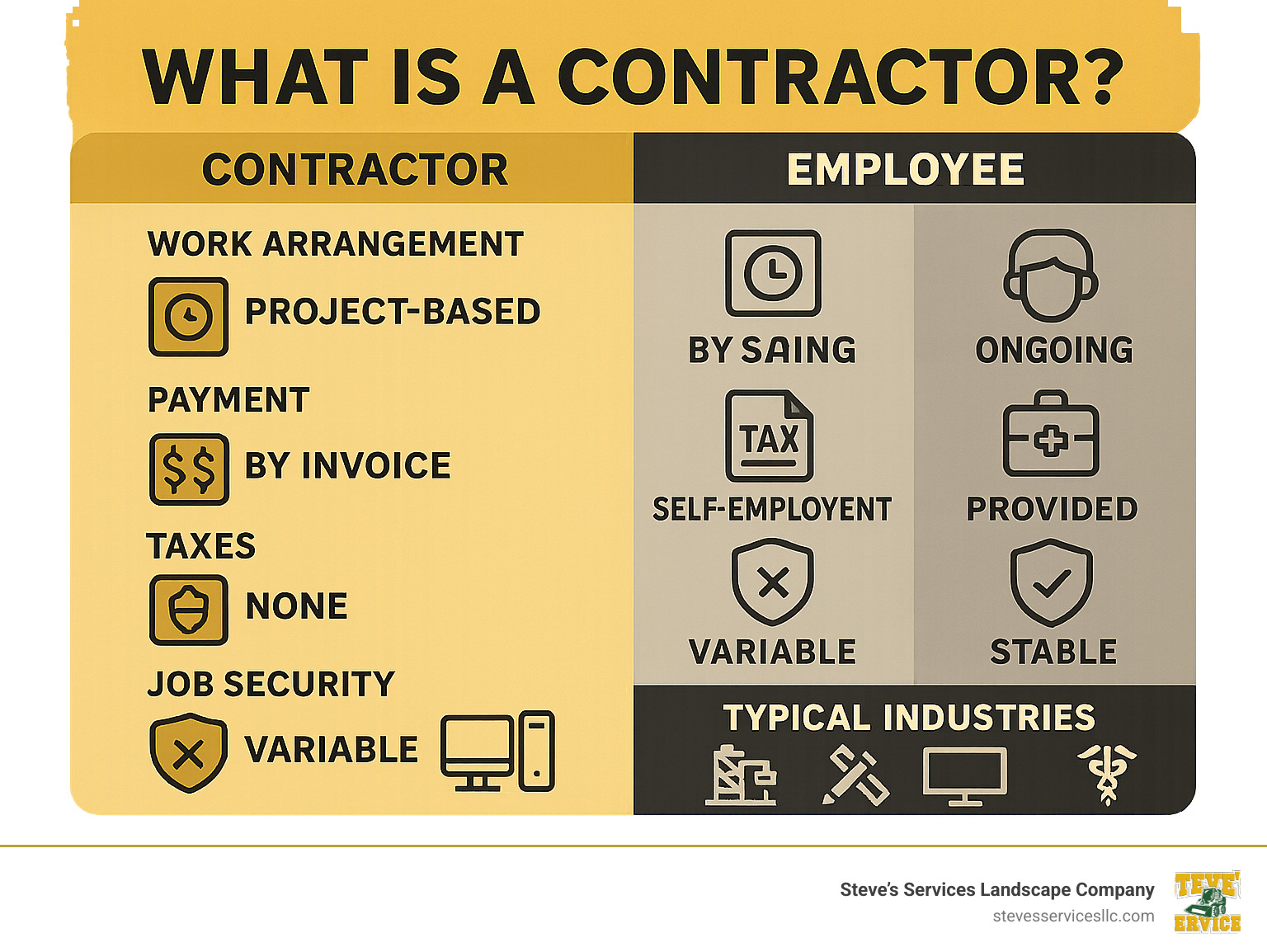
As the table shows, contractors handle their own payments, taxes, benefits, and tools. This independence is a key trade-off for the project-based nature of their work. Understanding these differences helps you decide whether a contractor or an employee is the right fit for your needs. For specialized or seasonal tasks, a contractor is often the ideal choice.
Types of Contractors and Their Roles
The term “what is a contractor” covers several distinct roles, especially in industries like construction and landscaping. This structure allows property owners to access specialized expertise efficiently. For example, Steve’s Services may act as a general contractor for a full landscape redesign or as a subcontractor for specific tasks like Excavation Services.
General Contractor: The Project Overseer
A general contractor (GC) takes overall project responsibility. They are the client’s single point of contact, managing the entire project from start to finish. Key duties include:
- Hiring and managing subcontractors
- Overseeing schedules and budgets
- Securing necessary permits
- Ensuring quality control
For outdoor projects, we offer General Contracting Services, coordinating all trades to bring your vision to life.
Subcontractor: The Specialist
A subcontractor is a contractor hired by the GC to perform a specific part of the project. As Cornell Law School notes, they are awarded a portion of an existing contract. This system leverages specialized skills, as it’s impossible for one company to excel at everything. A GC might hire specialists for electrical work, plumbing, or our expert Hardscaping Services.
Independent Contractor or Freelancer
Independent contractors and freelancers are self-employed professionals who work directly with clients. This is common in IT, marketing, and design. For property owners, this could mean hiring a landscape designer for a custom plan or engaging us directly for Commercial Landscaping Services. This direct relationship often leads to better communication and a more personal touch.
The Business of Contracting: Responsibilities, Payments, and Legalities
What is a contractor from a business perspective? They are entrepreneurs managing project execution, finances, and legal compliance. Success in contracting requires mastering both the skilled trade and the business operations behind it.

Key Responsibilities of a Contractor
A contractor’s duties extend beyond the physical work. Key responsibilities include:
- Client Communication: Keeping clients informed about progress, such as potential weather delays for Snow Removal Services.
- Project Management: Adhering to timelines and budgets.
- Quality Assurance: Ensuring work meets high standards and matches the client’s vision.
- Site Safety: Maintaining a safe work environment, especially when using heavy equipment for Bobcat Services.
- Vendor Management: Coordinating with suppliers and other partners.
You can learn more about how we handle these responsibilities through our process at Steve’s Services.
How Contractors Get Paid
Contractors invoice clients directly rather than receiving a regular paycheck. Common payment models include:
- Structures: Per-project pricing for defined jobs, hourly rates for ongoing work, or retainers for continuous services.
- Terms: A deposit to cover initial costs, milestone payments for large projects, and a final payment upon completion and inspection.
This approach helps manage cash flow for both the contractor and the client.
Legal and Tax Considerations
Contractors are small business owners responsible for their own legal and tax obligations.
- Taxes: They pay self-employment tax (Social Security and Medicare) and make estimated quarterly tax payments on their income.
- Business Structure: Many form an LLC for liability protection, separating personal assets from business risks.
- Insurance: General liability insurance is essential to cover property damage or injuries. For example, it protects a client if equipment damages property during Excavation Services. Workers’ compensation is required for contractors with employees.
Essential Elements in a Contractor Agreement
A clear contract is the foundation of a successful project. It should always include:
- Scope of Work: A detailed description of services to be provided.
- Payment Schedule: The total cost and when payments are due.
- Project Timeline: Clear start and end dates.
- Termination Clause: Conditions under which either party can end the agreement.
- Proof of Insurance: Verification of the contractor’s liability coverage.
- Dispute Resolution: A process for handling disagreements.
Pros and Cons of Hiring a Contractor
Deciding between hiring a contractor and an employee affects your budget, timeline, and level of involvement. As experienced contractors providing Landscaping Services, we believe in being transparent about the advantages and potential challenges.

Advantages for Businesses
Hiring a contractor often makes sense for specific projects. Here’s why:
- Access to Specialized Expertise: Contractors bring focused experience to a specific project, which is more efficient than hiring a full-time specialist.
- Cost Savings: You avoid costs associated with employees, such as benefits, payroll taxes, and paid time off, potentially saving 20-30%.
- Flexibility and Scalability: Easily scale your workforce up or down based on project needs without the commitment of a full-time salary.
- Reduced Administrative Burden: Hiring a contractor eliminates HR tasks like payroll processing and benefits management.
Potential Risks and Disadvantages
It’s also important to consider the potential downsides:
- Less Direct Control: Clients define the outcome, but contractors control the work methods and schedule, which requires trust.
- Risk of Misclassification: Incorrectly classifying an employee as a contractor can lead to IRS penalties. The relationship must be structured carefully.
- Availability Challenges: Good contractors are often busy and may be booked in advance, requiring you to plan ahead.
- Lack of Cultural Integration: Contractors are external partners, not internal team members, which may not be ideal for long-term, integrated roles.
- Communication Gaps: Since contractors are not always on-site, intentional and clear communication is essential to avoid misunderstandings.
Frequently Asked Questions about Contractors
Here are answers to common questions about what is a contractor and how to work with them.
How do I find a reliable contractor?
Finding a good contractor involves a few key steps:
- Get Recommendations: Ask for personal recommendations from friends, neighbors, or colleagues.
- Do Online Research: Use reputable platforms to find contractors, but look for consistent patterns in reviews.
- Review Their Work: Ask to see a portfolio of past projects and request references from recent clients.
- Verify Credentials: Always confirm they have the proper licenses for your area and ask for proof of current insurance.
Do contractors need to be licensed and insured?
Yes. Licensing requirements vary by location and trade. In Massachusetts, general contractors and many specialized trades must be licensed. Insurance is non-negotiable. General liability insurance protects your property, and workers’ compensation covers injuries on site. Always ask for proof of insurance before work begins. A reputable contractor will provide it without hesitation.
What is the difference between a contractor and a freelancer?
Though often used interchangeably, there’s a subtle distinction. Both are self-employed, but the key difference is often scale and formality.
- Freelancers typically handle smaller, more varied tasks, often for multiple clients at once (e.g., a graphic designer or writer).
- Contractors usually take on larger, more structured projects with formal agreements, such as in construction or landscaping. At Steve’s Services, we operate as contractors, taking comprehensive responsibility for your outdoor projects.
Conclusion
Understanding what is a contractor is key to leveraging their value. A contractor is a specialized business owner hired for a specific outcome. They operate independently, bringing their own tools, expertise, and business processes to your project. This model provides access to specialized skills on demand, offering flexibility and cost-effectiveness compared to hiring full-time employees.
The foundation of a good contractor relationship is a clear agreement that outlines the scope, timeline, and payment terms, ensuring a smooth process for both parties.
At Steve’s Services, we are professional and reliable contractors serving communities throughout Massachusetts, including Danvers and Reading. For over 25 years, we’ve delivered exceptional results in landscaping, hardscaping, and property maintenance. We are committed to changing your outdoor spaces with quality craftsmanship and excellent service.
Ready to see how a professional contractor can benefit your property? Learn more about our Contracting Services or Contact Us for a consultation to discuss your vision.