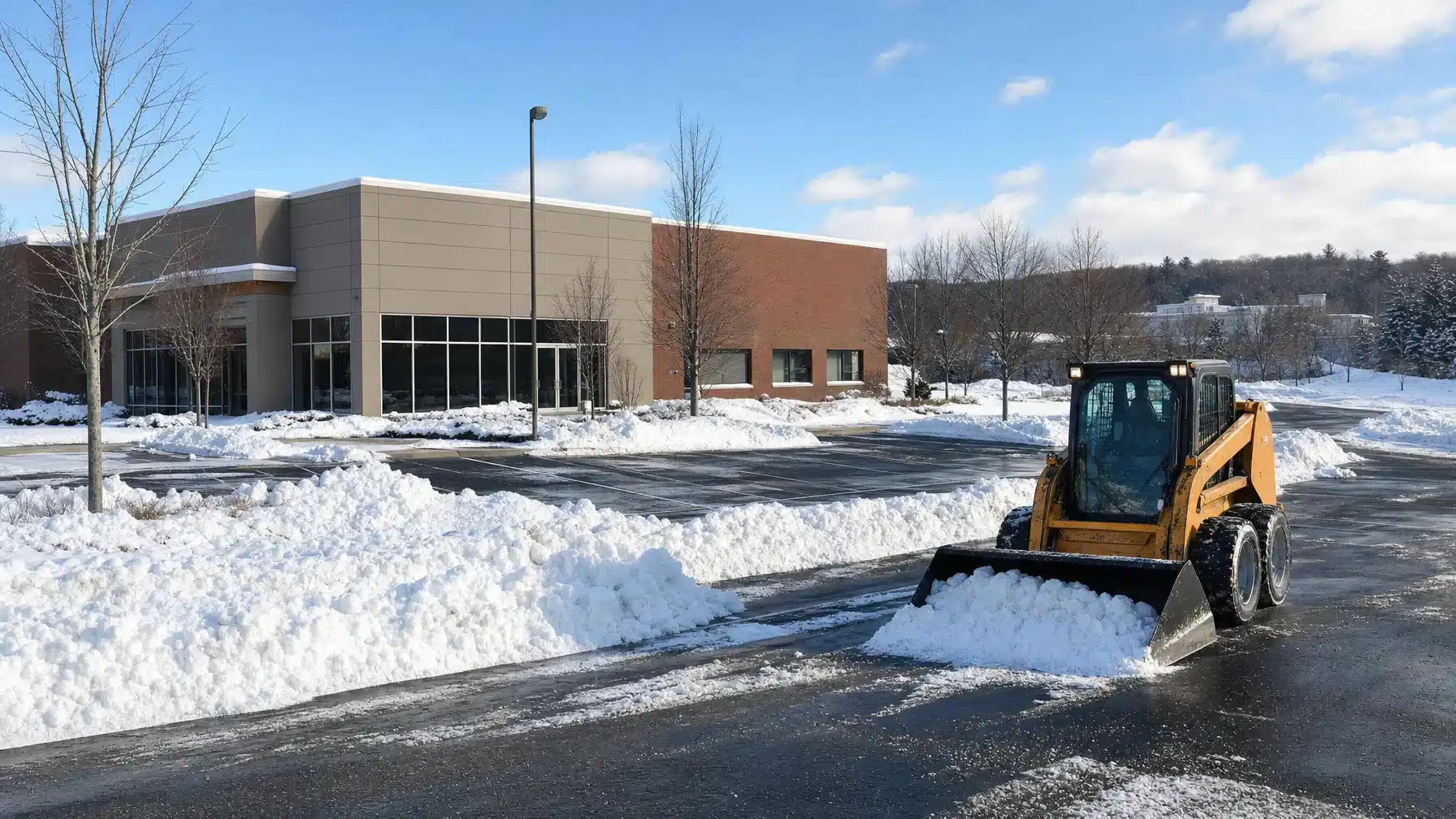
Commercial Snow Removal Site Map: A Property Manager’s Checklist
Before discussing commercial snow removal with a contractor, mark the areas you want cleared, the access your property needs, visible obstacles, possible snow-storage areas and anything you cannot yet confirm. Keep known site information separate from requested service and proposed arrangements.
Use the checklist and legend below to assemble a briefing map. Treat that map as a discussion aid, not an agreed service plan: shading a parking area does not establish coverage, and drawing a possible snow pile does not approve its placement.
Start with a current property drawing
Use an existing property plan, aerial image or clear sketch as your starting point. Compare it with the current site and flag outdated or unclear details. Include the property name, street address, map preparation date and the name of the person maintaining the annotations.
- Label buildings and entrances using names that match signs or tenant references.
- Outline parking areas, driveways, drive lanes, sidewalks, steps and loading areas.
- Identify adjacent streets and distinguish your property from neighboring or shared areas. Flag uncertain boundaries for confirmation.
- Give each area a short, distinct label so discussion notes can refer to the same location without relying on phrases such as “the back lot.”
Add a reusable annotation legend
Copy this legend onto the map. Use letters and outlines as well as any colors, so the labels remain understandable in a printed copy. Add a status to each annotation: Known, Requested, Proposed or Unresolved.
- C, Clearing request: outline the area you want included in the service discussion. Status: Requested.
- K, Keep-clear need: identify an access point or area you need to remain usable, with a note explaining its function. Separate the known use from the requested service.
- O, Obstacle or sensitive feature: mark its location and description. Status: Known if verified; Unresolved if its location or extent needs checking.
- S, Possible snow storage: outline a candidate area for review. Status: Proposed, not approved.
- Q, Open question: place a question mark at the relevant location and connect it to a question in the map notes. Status: Unresolved.
Mark clearing requests and business access needs
Outline requested clearing areas individually rather than shading the entire property. Label any area you believe is handled by a tenant, neighboring owner or another vendor, and mark that responsibility as unresolved until confirmed.
- Vehicle access: mark driveway entrances, exits, parking sections and connections between lots.
- Pedestrian access: trace the walking connections between parking, sidewalks and building entrances. Identify designated accessible spaces and routes as site information for review.
- Business operations: label delivery doors, loading docks, waste pickup areas and employee or customer entrances.
- Operating constraints: attach notes about business hours, delivery windows, overnight parking, gates and temporary closures to the affected areas.
- Emergency-related features: identify marked fire lanes, emergency exits and hydrants for discussion without treating the map as a compliance assessment.
Record desired access priorities as requests, not promised completion times. If parked vehicles or deliveries affect an area, note who can clarify those arrangements rather than drawing an assumed equipment route.
Identify obstacles and sensitive features
Mark visible curbs, islands, bollards, signs, gates, utility structures, drain covers and landscape edges. Include known irrigation components near the areas under discussion, but keep these as location annotations rather than instructions for protection or equipment operation.
Do not present an old drawing or remembered location as verified. Use Q wherever a feature needs checking. If you attach photographs, label each photo to match its map location and note when it was taken.
Show possible snow storage as a proposal
Outline any candidate storage areas with S and write “Proposed, requires review” beside them. Keep nearby entrances, walking routes, drains, landscape features, public ways and emergency-related features visible on the map so the discussion includes those relationships.
Ask whether each candidate area is suitable and what remains to be checked. If no location has been identified, write “Snow storage unresolved” instead of selecting an empty-looking space. Do not use the drawing to prescribe pile dimensions, push directions or equipment movements.
Review the map and track unresolved items
Walk through the labeled areas with the contractor. Record changes beside the relevant labels, and distinguish discussion notes from arrangements both parties have actually confirmed. Reconcile the map with the separately agreed service scope before relying on it.
For each open question, use this note format: Map label | Question | Person responsible for resolving it | Resolution | Status. Keep the updated map’s version date, property contact and change notes together, and identify who will circulate later updates.
Map-completion checklist
- Does the base drawing reflect the current property, with uncertain boundaries or outdated details flagged?
- Are requested clearing areas distinct from known site features and areas handled by others?
- Are entrances, walking connections, deliveries, parking constraints and access needs labeled?
- Are obstacles and sensitive features marked without presenting uncertain locations as verified?
- Are candidate snow-storage areas explicitly proposed, with unresolved placement questions recorded?
- Does each remaining question have a responsible contact, and does the shared map show its current version date?
Steve’s Services provides commercial snow removal services for property owners in the greater Everett, MA area. For a service discussion, bring your annotated map, access notes and unresolved questions so you can explain the property’s needs without presenting proposals as settled arrangements.