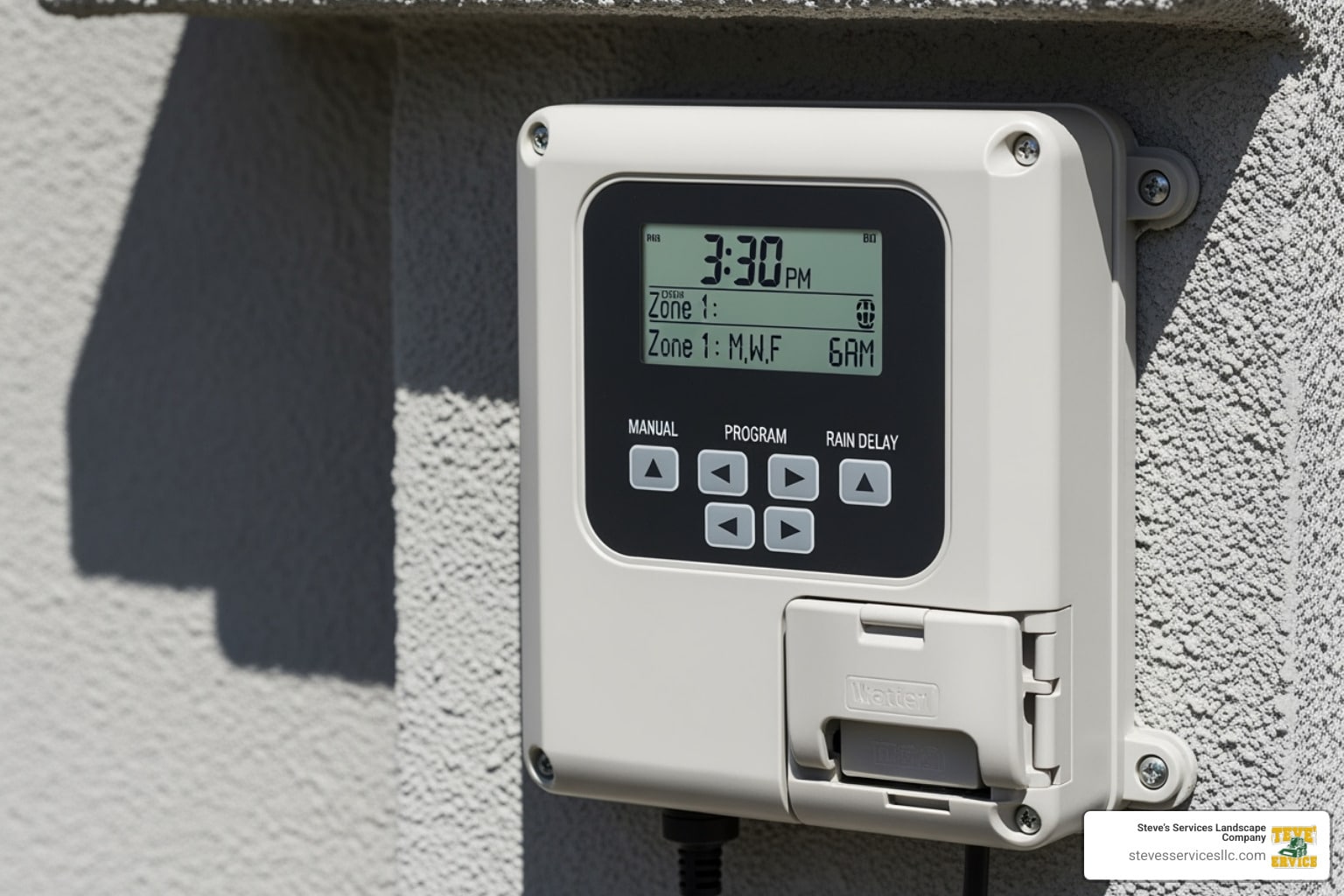
Cost of sprinkler system control box: 2025 Smart Guide
Why Understanding Sprinkler Controller Costs Matters for Your Property
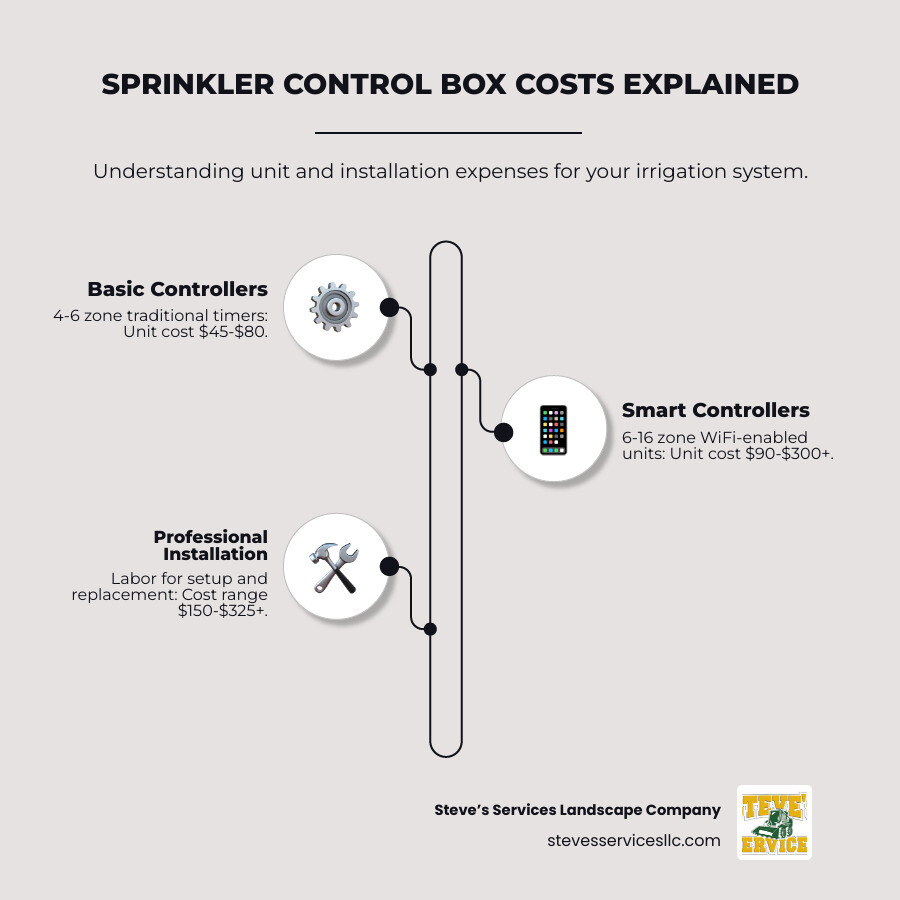
The cost of sprinkler system control box replacement includes the unit and professional installation. Prices vary widely based on technology and the complexity of the job. Here’s a general breakdown:
Basic Controllers (4-6 zones):
- Traditional timers: $45-$150
- Installation: $150-$450
Smart Controllers (6-16 zones):
- WiFi-enabled units: $90-$300+
- Installation with setup: $200-$600+
Total Project Cost Range: $195-$900+
Note: These are average costs based on internet research and not actual pricing for Steve’s Services.
When a sprinkler system malfunctions—watering at odd hours, skipping zones, or failing to turn on—the controller is a common culprit. As the electronic brain of your irrigation system, it eventually requires replacement. Understanding the potential costs helps you budget for this essential repair and avoid surprises.
The price range reflects differences in technology, zone capacity, and installation complexity. While smart controllers with WiFi and weather-based adjustments have a higher upfront cost than basic timers, they often generate long-term savings through reduced water consumption.
As the owner of Steve’s Services in Malden, MA, I’ve spent over 25 years helping homeowners make informed controller upgrade and replacement decisions. A professional assessment is key to determining if you need a simple controller swap or more extensive system repairs.
Simple glossary of related topics:
- how much does a water sprinkler system cost
- average cost to install sprinkler system per square foot
- water efficient sprinkler system
What is the Average Cost of a Sprinkler System Control Box?
When replacing a sprinkler controller, you must account for two main expenses: the controller unit and professional installation. This is not a simple DIY project, as it involves electrical work and irrigation system expertise to ensure safety and proper function.
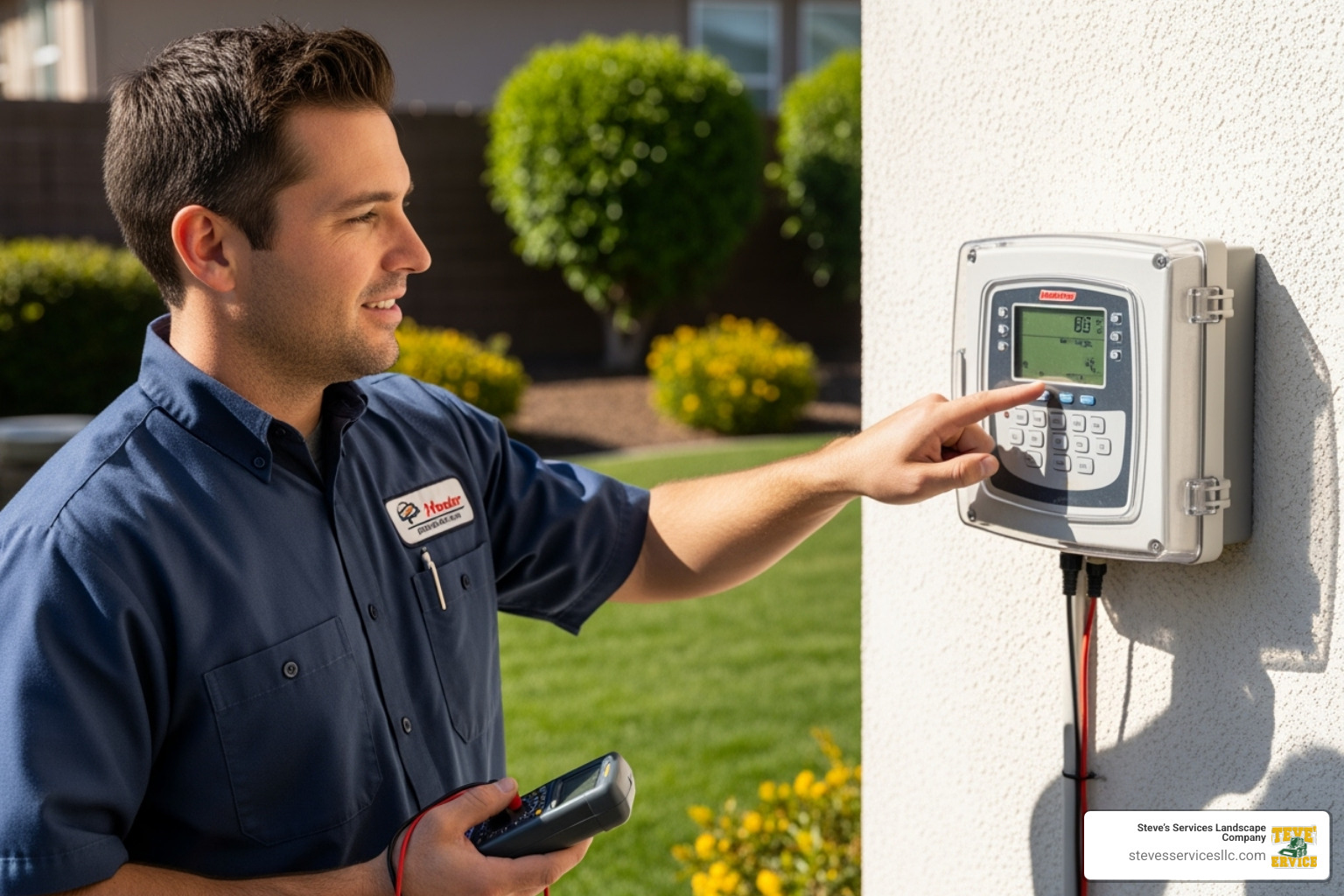
A low online price for a controller is only part of the total investment, which can range from $195 for a basic replacement to over $900 for a premium smart system with installation.
The unit cost varies dramatically. A no-frills timer that simply turns zones on and off will run $45-$150. These basic models are reliable for simple scheduling. For the advanced features of a smart controller with WiFi, weather adjustments, and smartphone control, expect to pay $90-$300+.
Note: These are average costs based on internet research and not actual pricing for Steve’s Services.
Price Ranges for Controller Units
Basic controllers are ideal for straightforward needs. These 4-6 station timers use traditional dial-based or button controls that you set manually. They are reliable workhorses for smaller properties, typically costing $45-$150. They offer simple, effective scheduling without apps or weather data.
Smart WiFi-enabled controllers represent modern irrigation technology. They provide app-based control from anywhere, automatically adjust watering based on weather forecasts, and often carry EPA WaterSense certification for proven water efficiency. The $90-$300+ price reflects their sophisticated features, including automatic rain delays and freeze protection. The water savings alone often justify the higher upfront cost.
Understanding Professional Installation Costs
Professional installation typically adds $150-$450 to your project cost. This service includes safe electrical work, precise wiring, zone testing, and system programming. Proper installation is crucial for safety, preventing damage to the new controller, and ensuring your warranty remains valid.
The installation cost depends on several factors. Job complexity is a major component; replacing an old, outdated system may require more rewiring and mounting modifications than a simple swap. Smart controllers require additional time for WiFi setup and app configuration. Indoor versus outdoor installations also affect labor, as outdoor units need weatherproofing and may require extra hardware. The accessibility of existing wiring can also influence the final price.
When budgeting, always consider the total project cost, which includes both the technology and the expertise needed for a lasting, reliable solution.
Key Factors That Influence the Final Price
Beyond the base price, several elements impact the final project cost. These include the controller’s technology, the size of your irrigation system, and any premium features.
Smart vs. Traditional: How Technology Impacts Price
The choice between a smart and a traditional controller is the biggest factor in determining your cost.
Traditional controllers are classic timers that require you to manually set watering times and durations. They offer reliable, basic functionality but lack the adaptability to changing weather conditions. Their simplicity keeps them affordable, typically in the $45-$150 range.
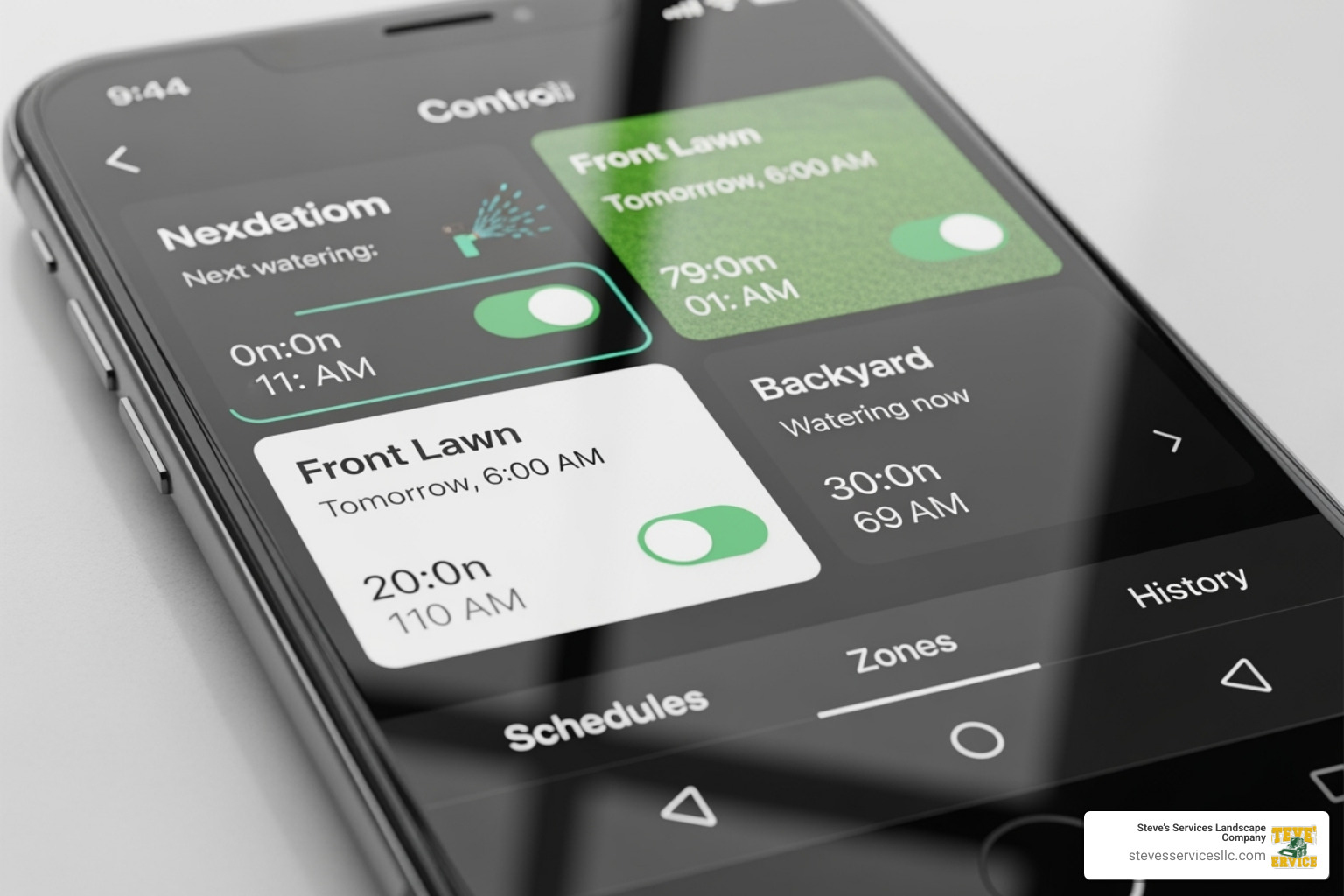
Smart controllers leverage WiFi connectivity for remote control via smartphone apps, allowing you to manage your system from anywhere. Their key feature is “weather intelligence,” which uses local forecasts to automatically adjust watering based on rain, temperature, or wind. This can lead to significant water savings and lower utility bills. Many also integrate with smart home systems like Amazon Alexa or Google Assistant. While the upfront cost is higher at $90-$300+, the long-term savings and convenience often make them a worthwhile investment. The EPA WaterSense certification on many smart models further guarantees their water-saving potential.
Number of Zones, Brand, and Other Features
Other specifications also play a crucial role in the final price.
- Number of Zones: A “zone” is a distinct area of your landscape watered by a specific valve. Controllers are priced based on their zone capacity. A basic 4-zone model is cheaper than a 12-zone or 24-zone model designed for larger, more complex properties.
- Brand and Quality: Professional-grade units from major manufacturers use more robust components and offer better diagnostics and longer lifespans than consumer-grade alternatives. This higher quality improves reliability and reduces future issues.
- Premium Features: Optional features add value and increase cost. Touchscreens can simplify programming, while flow meter support allows high-end controllers to detect leaks and shut off water to prevent damage. Expandability through add-on modules lets you increase zone capacity as your landscape evolves, offering long-term flexibility.
We help clients in Everett and surrounding Massachusetts communities weigh these factors to find the best controller for their specific irrigation needs and budget.
Beyond the Box: Associated Costs and Repairs
When a sprinkler system acts up, the controller isn’t always the sole cause. A thorough system diagnosis is essential because the initial controller replacement investment can be compounded by related issues.
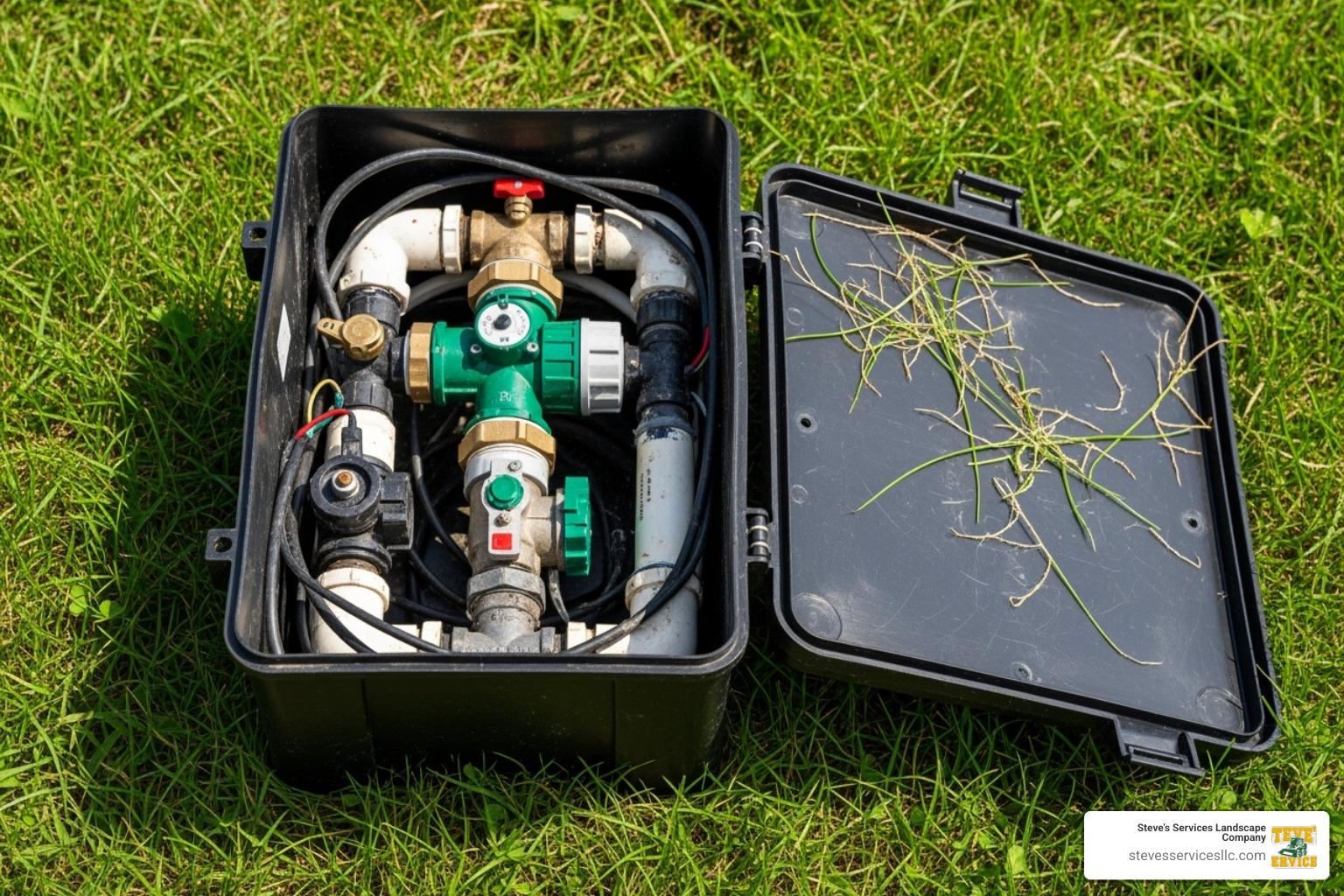
A controller that won’t power on might be due to a failed transformer, not faulty electronics. A zone that won’t activate could be a wiring problem or a stuck valve. We always perform a full system check to identify the root cause, preventing unnecessary expenses.
The Hidden Cost of a Sprinkler System Control Box: Related Repairs
Several components work with your controller and can be the real source of problems:
- Wiring Issues: Underground wires can degrade from moisture or be damaged by pests, leading to breaks or shorts. This prevents the controller’s signals from reaching the valves.
- Faulty Transformers: These components convert your home’s power to the low voltage your system uses. A failed transformer will render your controller useless. Replacement units typically cost $25-$80, plus professional installation.
- Damaged Surge Protectors: Electrical surges from storms can fry the components that protect your controller, leaving it vulnerable.
- Valve Replacement: This is a common additional cost. Each zone has an underground valve that can stick, leak, or fail, mimicking controller problems. Replacing a standard electric valve typically runs $100-$350, depending on accessibility. If only the solenoid (the electrical component) needs replacement, costs are often in the $50-$150 range. Difficult-to-access valves may incur additional excavation fees of $50-$200. For more details, you can research how much sprinkler valves cost.
Note: These are average costs based on internet research and not actual pricing for Steve’s Services.
When to Repair vs. Replace Your Controller
Deciding whether to repair or replace depends on an accurate diagnosis. A controller that won’t power on might only need a new fuse, a very inexpensive fix. Similarly, replacing a faulty transformer is much cheaper than buying a new controller.
However, clear signs of complete failure—such as a blank display, unresponsive buttons, or erratic watering despite correct programming—usually indicate internal electronic failure, making replacement the more cost-effective option. The age of the unit is also a key factor. Most controllers last 5-15 years. If your unit is approaching the end of its expected lifespan, investing in repairs is often not financially sound.
This is an excellent opportunity to upgrade for efficiency. Moving to a smart controller can reduce water usage by 20-50% through weather-based adjustments. In Massachusetts, these savings can be substantial, and the convenience of remote monitoring adds significant value.
Maximizing Value and Lifespan
Choosing a sprinkler controller is an investment in your property’s health and efficiency. The goal is to select a unit that provides years of reliable, water-saving irrigation. The best decisions balance immediate budget with long-term performance.
The Typical Lifespan of a Sprinkler Controller
Most sprinkler controllers last 5 to 15 years. This range is heavily influenced by several factors:
- Quality: Professional-grade controllers from reputable brands use superior components and more robust construction. While their initial cost is higher, they often outlast budget models, making them more cost-effective in the long run.
- Weather Protection: Controllers installed outdoors are exposed to harsh elements. A proper weatherproof enclosure is critical to extending a unit’s life. Indoor units are naturally more protected and tend to last longer.
- Electrical Stability: Power surges from fluctuations or lightning can shorten a controller’s lifespan. Investing in quality surge protection is a wise precaution.
We advise clients to consider replacement when a controller reaches the 10-year mark, especially if it shows signs of glitches. Proactive replacement prevents system failure during the peak summer watering season.
Cost-Saving Tip: Choose the Right Size and Features
To manage your budget effectively, match the controller to your actual needs. Avoid the “bigger is better” trap; there’s no need to pay for a 24-zone controller if your landscape only has six zones. We assess each property to recommend the correct capacity.
Carefully consider which smart features you will actually use. While WiFi connectivity and weather-based adjustments offer real convenience and savings, you may not need every available integration. The long-term water savings from smart controllers, however, often justify their higher initial cost by significantly lowering utility bills.
EPA WaterSense certified models provide third-party verification of a controller’s efficiency. Choosing one of these models ensures your investment will contribute to a healthier landscape and lower water consumption for years to come.
Frequently Asked Questions about Sprinkler Controller Costs
Here are answers to common questions homeowners have about controller pricing and related issues.
How do I know if my sprinkler control box is bad?
Common signs of a failing controller include:
- No Power: The unit is completely dead with no lights or display.
- Unresponsive Screen or Dials: The display is frozen or garbled, or buttons and dials do not work.
- Specific Zones Not Working: One or more zones fail to turn on or shut off, which could point to the controller’s output.
- Erratic Watering Schedules: The system waters at incorrect times or runs continuously, ignoring its programming.
If you notice these symptoms, a professional diagnosis is needed to confirm the cause.
Is it cheaper to replace a sprinkler system or just the controller?
Replacing only the controller is significantly cheaper. A controller replacement typically costs between $195-$900+, including installation. A full system replacement involves replacing all underground pipes, valves, and heads, which can cost thousands of dollars and requires extensive landscape disruption.
If your system’s infrastructure is in good condition, a simple controller swap is the most cost-effective solution to get your irrigation running again.
Can a power surge damage a sprinkler controller?
Yes. Sprinkler controllers are sensitive electronic devices vulnerable to electrical surges. Lightning strikes, even distant ones, and power grid fluctuations are common causes of damage. A surge can destroy a controller’s internal circuitry.
To prevent this, many modern controllers have built-in surge protection. We also recommend installing an external surge protector, especially in areas prone to thunderstorms, as a small investment to protect your new controller.
Conclusion: Making the Right Investment for Your Landscape
Replacing a controller is an investment in your landscape’s health, your water conservation efforts, and your convenience. Pricing depends on balancing the cost of basic controllers ($45-$150) against smart units ($90-$300+), plus installation costs of $150-$450+.
While a smart controller costs more upfront, its water conservation benefits often lead to significant long-term savings on utility bills. A WaterSense-certified smart controller adapts to your landscape’s specific needs and local weather, ensuring efficient watering and promoting a healthier lawn.
A professional assessment is crucial to identify the true source of the problem. What appears to be a controller failure could be a simpler issue like faulty wiring or a bad valve. At Steve’s Services, we diagnose the real problem to ensure you only pay for the repairs you need.
We help homeowners in communities from Everett to Winchester make the best choice for their property and budget. If your irrigation system is struggling, let us provide expert guidance.
(All price ranges referenced are averages based on publicly available internet data and are not quotes from Steve’s Services.)
For a comprehensive assessment of your sprinkler system and landscape care needs, Contact us for landscape maintenance needs. We’ll help you make an investment that pays off in a beautiful, healthy landscape for years to come.