
Snow Removal Blower: Perfect Pick 2025!
The Professional’s Arsenal: Understanding Snow Removal Blowers
A professional-grade snow removal blower is a key tool in any snow management arsenal, offering a fast and efficient method for clearing deep snow. Understanding the equipment professionals use reveals why it’s so effective.
Snow Blower Types by Stage:
- Single-Stage: Light snow up to 8 inches, paved surfaces only
- Two-Stage: Medium to heavy snow up to 12+ inches, works on pavement and gravel
- Three-Stage: Heavy, wet snow up to 2 feet deep, throws snow up to 50 feet
Power Options:
- Gas: Maximum power, wider clearing paths, no runtime limits
- Electric (Cordless): Quieter, eco-friendly, lighter weight
- Electric (Corded): Budget-friendly, consistent power, limited by cord length
When winter storms hit Massachusetts, the right equipment is what separates a quick, professional cleanup from a long, arduous process. The machinery ranges from compact electric models for tight spaces to powerful three-stage machines capable of handling the heaviest New England storms.
For a professional service, the key is precisely matching the blower’s capabilities to the job’s specific needs—property size, typical snowfall, and surface type all dictate the right tool for the job.
I’m Steve Sylva, and over my 25+ years running Steve’s Services in Malden, MA, I’ve built my business on using the right equipment for every situation. From compact driveways in Medford to sprawling commercial lots in Burlington, my teams are equipped with the snow removal blower that will perform best in our unpredictable New England winters.

Simple snow removal blower word guide:
Understanding Blower Stages: A Professional’s Breakdown
The “stage” of a snow removal blower refers to how it processes and moves snow. For our crews, matching the stage to the conditions is critical for efficiency and a clean finish. Using a machine that’s either overkill or underpowered for the job is a waste of time and resources.
Single-Stage Snow Blowers
Picture a simple but effective approach: one spinning auger that grabs snow and flings it out the chute in a single motion. That’s exactly how single-stage blowers work, and their simplicity is their strength.
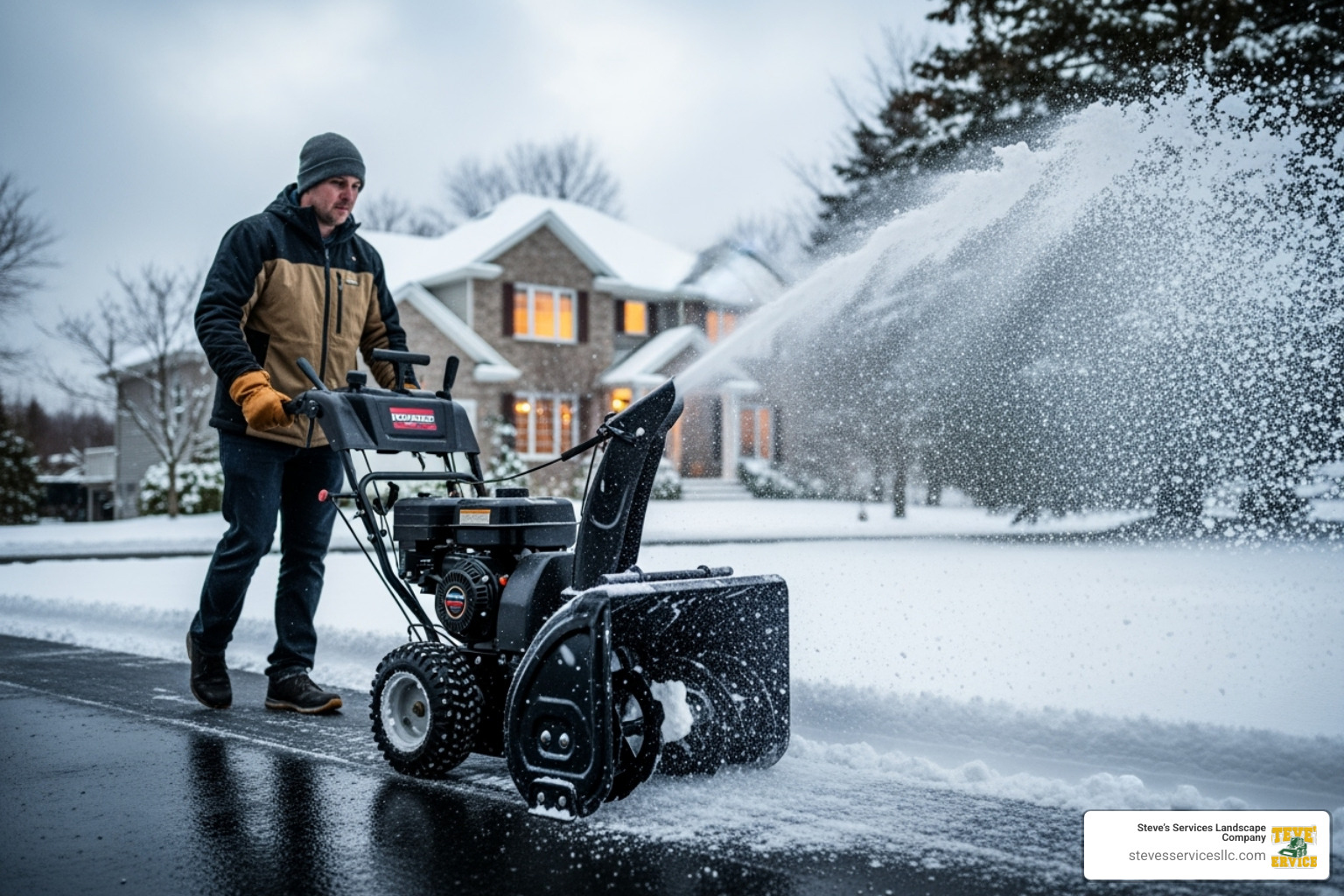
These machines are ideal for light snow up to 8 inches deep on paved surfaces. The auger makes direct contact with the ground, providing a very clean finish on driveways and sidewalks.
However, that ground contact means they are unsuitable for gravel driveways, as they can throw stones and cause damage. With a throwing distance up to 35 feet, they are effective for many residential properties.
For standard paved driveways, like those common in Medford or Malden, a single-stage snow removal blower can be an effective tool for light snowfalls. Their lighter weight makes them maneuverable in tight spaces.
For comprehensive winter preparation beyond DIY solutions, explore our snow removal services.
Two-Stage Snow Blowers
When Mother Nature gets serious, two-stage blowers are built for more serious conditions. These machines use a tag-team approach: the auger collects and feeds snow into the machine, then a powerful impeller launches it out the chute with authority.
The key difference is that the auger doesn’t touch the ground. Adjustable skid shoes keep it slightly lifted, allowing our crews to safely clear both paved and gravel surfaces—a common requirement for properties in areas like Reading and Stoneham.
Most two-stage models are self-propelled, a crucial feature when clearing 12+ inches of snow or heavy, wet storms. The engine powers the wheels, reducing operator fatigue and improving control.
The throwing distance can reach up to 60 feet, which is necessary for larger properties where snow must be moved well away from cleared areas. These machines handle the kind of heavy, wet snow that would clog a single-stage blower.
Check out our guide to the best snow removal equipment for more insights on choosing the right tools.
Three-Stage Snow Blowers
This is the heavyweight of walk-behind snow removal. Three-stage blowers add an accelerator between the auger and impeller, creating a snow-processing powerhouse that can handle whatever New England winters throw at you.
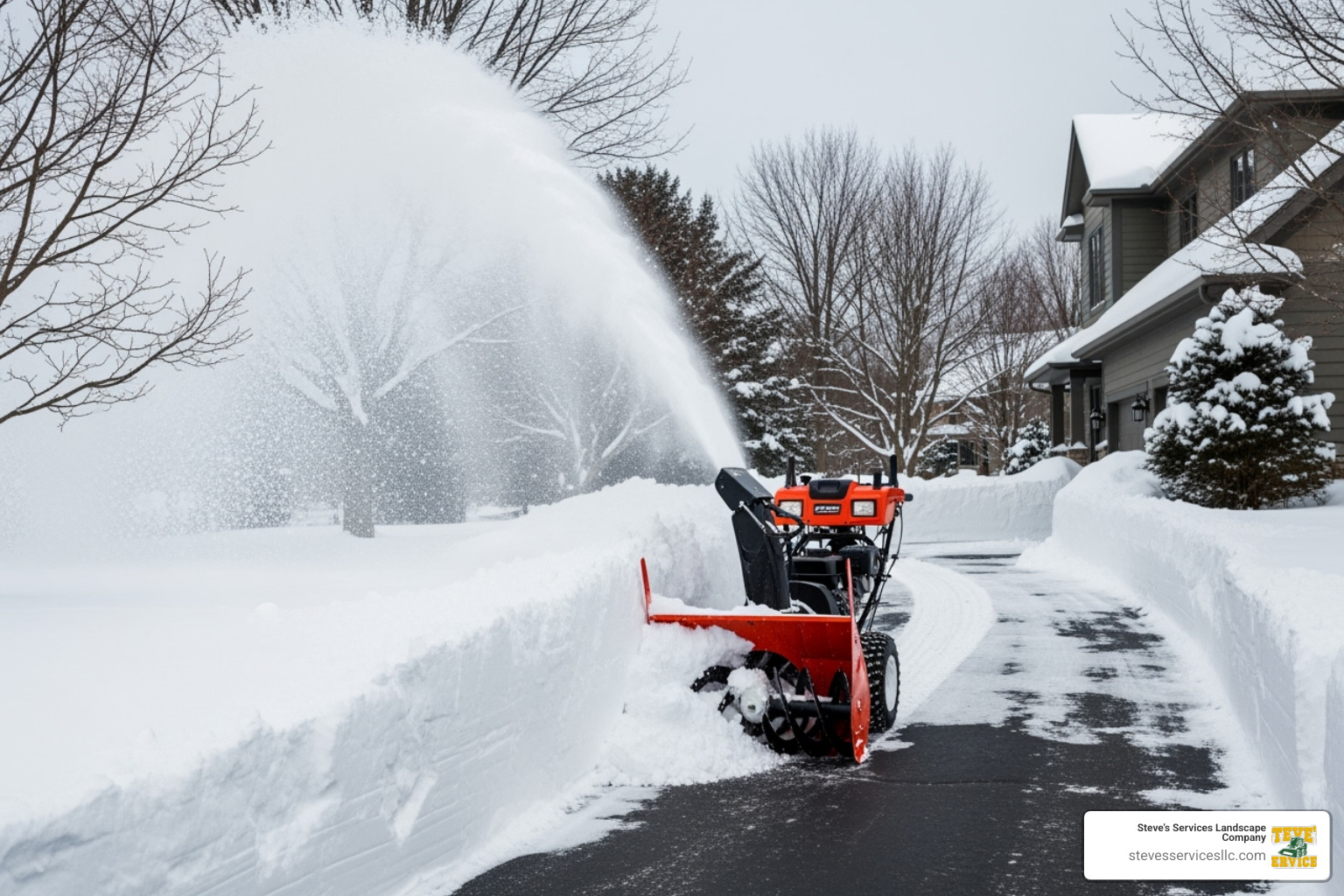
This accelerator chops and grinds snow and ice before feeding it to the impeller, dramatically increasing both speed and volume. These are machines that can clear up to 2 feet of snow and throw it 50 feet or more—even the heavy, wet, icy mix that stops other blowers cold.
These are the go-to machines for properties in places like Winchester or North Reading that regularly face heavy snowfall and icy conditions. They are built with commercial-grade components and provide the power needed to make quick work of stubborn snowdrifts.
While they represent a significant investment in weight and cost, their value is proven on jobs with two-foot snowfalls on long driveways. They provide maximum clearing speed when getting a property cleared quickly and completely is the top priority.
Power Source Considerations: Gas vs. Electric
The choice of power source is a critical decision in a professional snow removal operation, affecting power, runtime, and maintenance schedules. In our experience serving Massachusetts, we’ve learned that each power type has a specific role.
Gas models are the powerful workhorses of the industry, capable of handling nearly any condition. Electric models are quieter, cleaner, and useful for specific applications, but come with performance trade-offs.
Gas-Powered Snow Blowers
When our crews face two feet of heavy, wet snow at 5 AM, they need a snow removal blower that won’t quit. That’s why gas-powered models are the backbone of our fleet. They provide maximum power without being limited by cords or battery life, ensuring the job gets done without interruption.
Gas models typically offer wider clearing paths, increasing efficiency on long driveways in Danvers or sprawling properties in Woburn. Fewer passes means faster service.
The trade-off is that these powerful machines require a strict maintenance schedule, including oil changes, spark plug maintenance, and fuel stabilization for storage. Most two and three-stage versions are self-propelled to help with the weight issue.
For properties that demand maximum clearing power, especially commercial applications, gas remains king. Check out our insights on commercial snow plowing for larger-scale solutions.
Electric Snow Blowers (Cordless & Corded)
Electric snow removal blowers have improved significantly, offering quiet, clean operation that has a place in certain professional contexts. According to Consumer Reports, modern battery-powered models have made significant strides in performance.
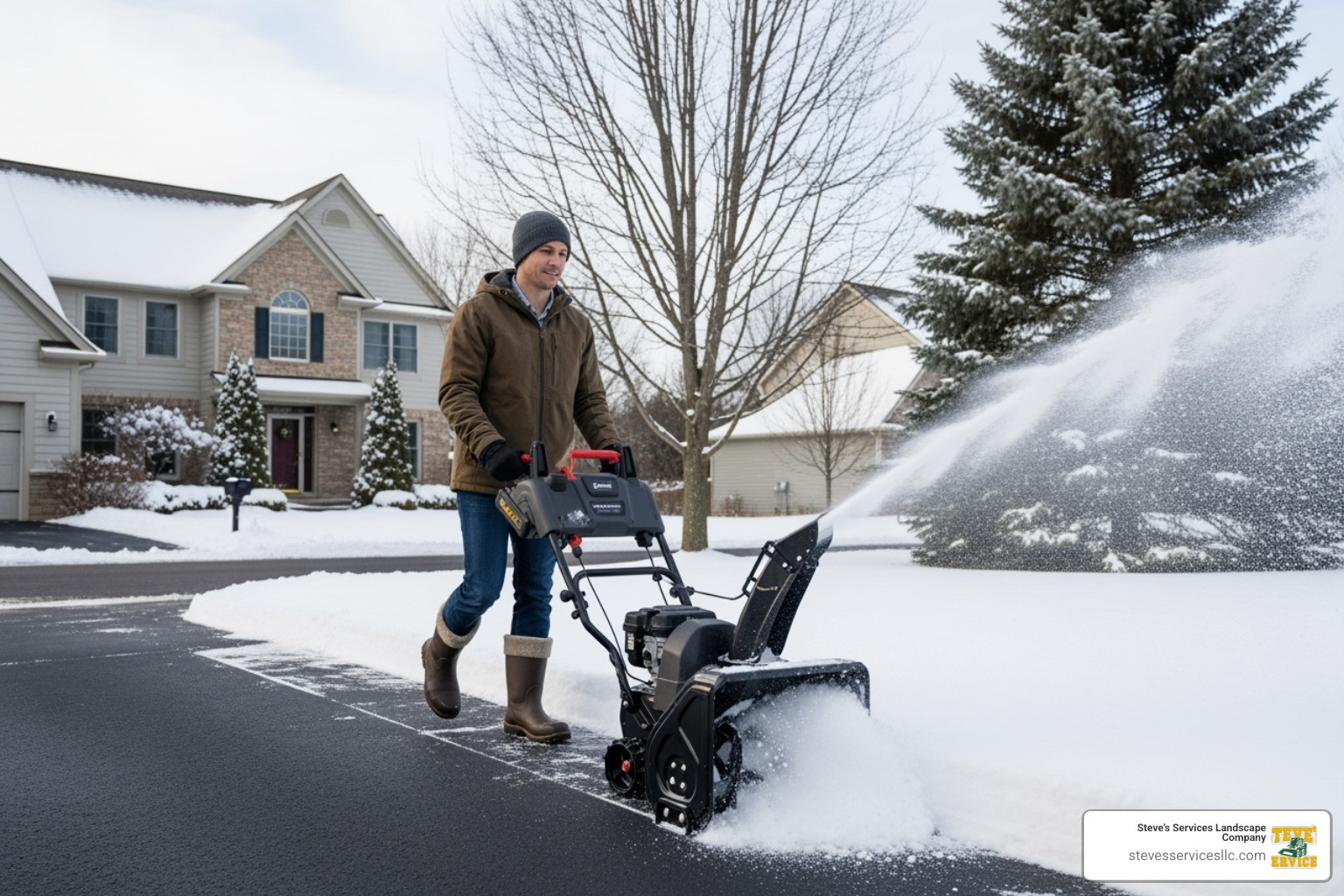
Corded electric models offer consistent power with zero emissions, making them suitable for small, contained areas like patios or walkways where an outlet is accessible. Their primary limitation for professional use is the cord itself.
Cordless battery-powered models offer freedom from the cord, and modern high-voltage systems pack surprising power. Some high-end models can clear an 18-car driveway on a single charge and throw snow up to 50 feet.
Their main advantages are quiet operation—a key consideration for early-morning clearings in residential neighborhoods—and minimal maintenance. However, for professional use, reliance on battery runtime and charging cycles must be carefully managed.
Battery vs. Corded Trade-offs:
- Cordless freedom comes with runtime limits and charging time, plus higher upfront costs for professional-grade batteries.
- Corded reliability means unlimited runtime but restricted mobility and cord management challenges.
- Both electric types offer lighter weight, quieter operation, and eco-friendly performance compared to gas models.
While electric models are excellent for specific, lighter-duty tasks, for the demanding and unpredictable nature of commercial snow removal across communities like Lynnfield or Revere, gas-powered equipment remains the primary tool for ensuring reliability and power.
Essential Features of a Professional Snow Blower
Beyond stage and power source, specific features determine a snow blower’s efficiency, durability, and ease of use for the operator. In our 25+ years in the business, we’ve learned that these details are what separate a good machine from a great one, directly impacting job quality and speed.
Clearing Width and Intake Height
These two specifications define how much snow a blower can handle in a single pass. A wider clearing width (from 18 inches to over 36 inches) means fewer passes are needed to clear a property, which is a critical efficiency factor on any job. A greater intake height (up to 23 inches on larger models) allows our crews to tackle the deep snow from New England nor’easters in one pass, without needing to break down drifts manually.
The key is matching these dimensions to the typical snowfall and property size. A compact electric model might be perfect for quick touch-ups on a walkway, but clearing a long driveway after a big storm requires the efficiency that comes with wider clearing and deeper intake.
Drive System: Push vs. Self-Propelled
The drive system is critical for operator efficiency and safety, especially on large or sloped properties. Push-propelled models are only suitable for small, level areas. Some single-stage models are “auger-assisted,” meaning the spinning auger helps pull the machine forward slightly, but this is not true self-propulsion.
For professional work, a self-propelled system is non-negotiable. The engine powers the wheels, allowing the operator to simply guide the machine. Multiple forward speeds and a reverse gear are essential for matching the pace to the snow conditions and maneuvering safely. On sloped or large properties, a self-propelled drive is a fundamental requirement for professional use.
Essential Convenience Features for a snow removal blower
These features are not luxuries in a professional context; they are essential for safety, efficiency, and performance in harsh conditions.
- Electric start on gas models is a must-have for reliable, quick starting in freezing temperatures.
- Remote chute control allows the operator to change the snow’s direction and angle from the control panel, which is crucial for placing snow precisely and avoiding damage to property or blowing snow into cleared areas.
- Headlights are essential for pre-dawn and nighttime operations, ensuring visibility and safety.
- Heated hand grips reduce operator fatigue and improve dexterity in extreme cold, which is a safety feature.
- One-hand operation on self-propelled models frees up a hand to adjust the chute on the fly, allowing for continuous work and greater efficiency.
These features, while seemingly small, are what enable professional crews to work safely and efficiently for long hours in challenging winter weather.
Heavy-Duty Solutions: Tractor-Mounted Snow Blowers
When walk-behind blowers aren’t enough, professionals turn to tractor-mounted snow removal blowers. These attachments transform a utility tractor into a snow-clearing powerhouse, capable of handling the most challenging winter conditions with best efficiency.
For properties with extensive grounds, long access roads, or large commercial lots, these attachments are the primary tool. A job that would take hours with a walk-behind unit can often be completed in a fraction of the time.
Types of Tractor-Mounted Snow Blowers
Tractor-mounted snow removal blowers come in several configurations, each designed to work with different tractor setups and clearing needs. The key is finding the right match for a tractor’s horsepower and the property’s layout.
Front-mounted snow blowers attach to the front of a tractor, giving the operator excellent visibility. Most are PTO-driven, tapping directly into the tractor’s engine power for maximum performance.
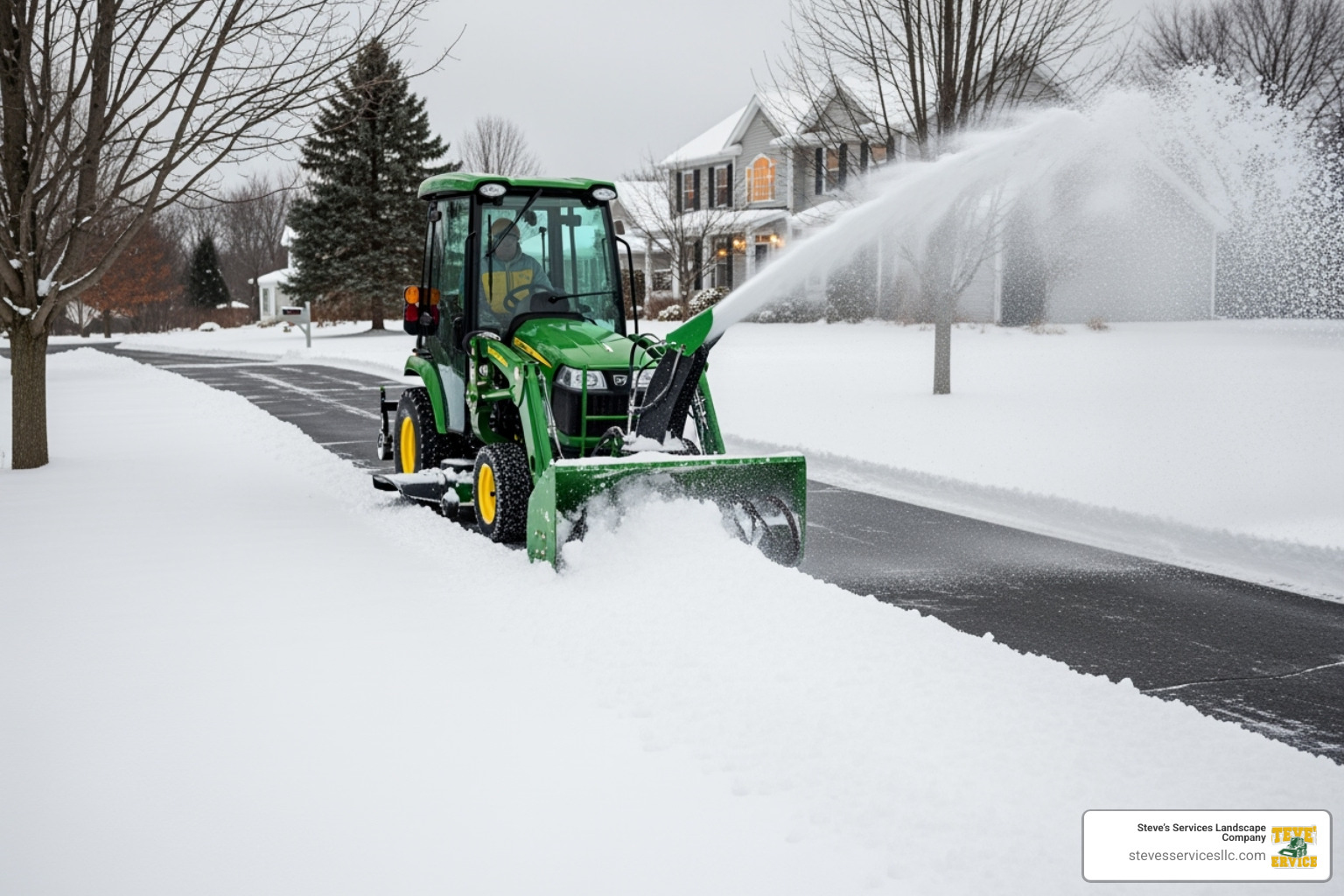
Rear 3-point hitch snow blowers mount to the back of the tractor. While this requires driving in reverse, many operators get comfortable with the setup quickly. The main advantage is that rear blowers can act as a counterweight for other front-mounted attachments.
Loader-mount snow blowers attach directly to a tractor’s loader arms, allowing forward operation while maintaining the versatility of the loader system.
Pull-type snow blowers attach to the 3-point hitch but allow the operator to drive forward while clearing, combining forward visibility with the power of a rear-mounted system.
These industrial-grade attachments are built for serious snow removal, with working widths ranging from about 4 feet up to over 8 feet. The horsepower requirements vary significantly based on size, from 16 HP to 90 HP or more.
When massive snowdrifts pile up, the age-old question becomes whether to plow or blow. Many experienced operators prefer blowers for breaking through packed drifts without creating even larger snow berms, especially on long lanes or open lots.
When Are Tractor Attachments Necessary?
Tractor-mounted blowers are deployed when the scale of the job demands it. The decision is based on several factors:
- Large Driveways and Long Lanes: For driveways stretching hundreds of feet or private roads, a tractor attachment is the only practical solution for timely clearing.
- Acreage and Heavy Snow Drifts: When winter winds create deep, packed drifts over large areas, only the power of a tractor-mounted system can effectively break through and clear the snow.
- Commercial Properties: For large parking lots and commercial campuses, these attachments provide the necessary width and speed to ensure the property is safe and accessible for business.
The initial investment for this equipment is substantial—tractor-mounted blowers typically range from several thousand dollars up to tens of thousands for commercial-grade units, based on general internet data. However, the efficiency gains are immense, allowing professionals to clear vast areas quickly and effectively.
For properties that go beyond what even the largest tractor attachments can handle efficiently, professional services become the most practical solution. Our comprehensive snow plowing services are designed for exactly these large-scale commercial and residential applications.
Conclusion: The Professional Difference in Snow Removal
Choosing the right snow removal equipment is a complex calculation. It requires matching the machine’s stage, power, and features to a property’s unique demands—from the type of surface to the typical depth of snow. As we’ve seen, the considerations for professional-grade work are extensive, focusing on efficiency, safety, and reliability under the harshest conditions.
This is the expertise a professional service provides. Instead of researching, purchasing, maintaining, and operating heavy machinery in the cold, you can rely on a team that has already made the investment in the right equipment for every scenario. The value isn’t just in the tool, but in the experience to use it effectively.
For large-scale or commercial jobs that go beyond what any residential snow removal blower can handle, that’s where professional services make sense. At Steve’s Services, we’ve got the heavy-duty equipment and experienced crew to tackle everything from sprawling commercial lots to complex residential properties throughout communities like Woburn, Medford, and Danvers. When winter gets serious, we ensure your property stays safe and accessible no matter how much snow falls. Learn more about our expert snow management programs.
