How Much Does an Underground Sprinkler System Cost Per Acre?
Understanding the Investment in Large-Scale Irrigation

How much does underground sprinkler system cost per acre is one of the most important questions for property owners considering automated irrigation for larger landscapes. Here’s what you need to know:
Quick Answer: Per-Acre Cost Ranges
| Property Size | Typical Cost Range | Number of Zones |
|---|---|---|
| 1/4 Acre | $2,500 – $6,500 | 3-5 zones |
| 1/2 Acre | $4,000 – $8,500 | 5-7 zones |
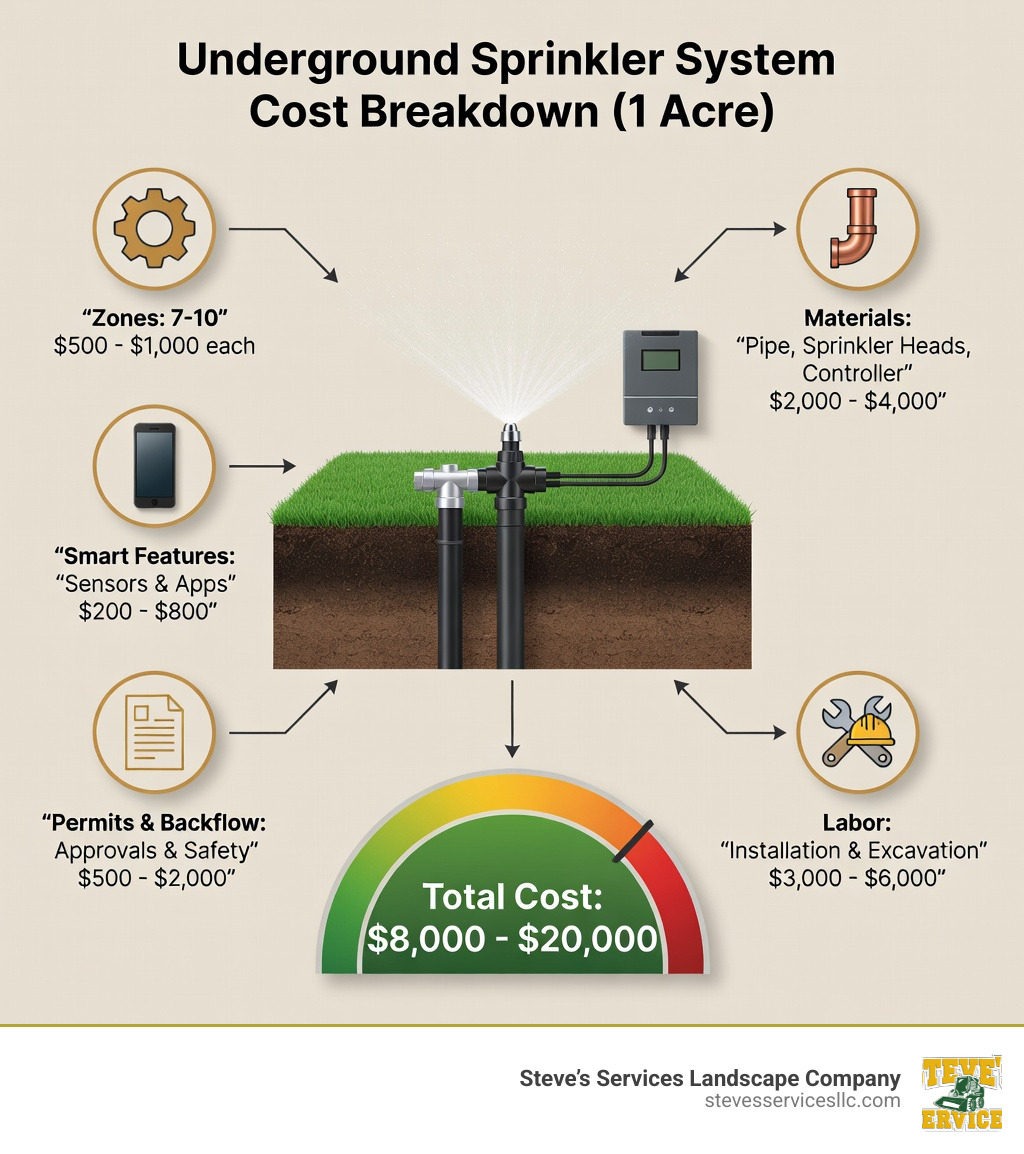
| 1 Acre | $8,000 – $20,000 | 7-10 zones |
| Large Estate (1+ acre) | $10,000 – $45,000+ | 12-20 zones |
Note: These are average costs based on internet data and not actual pricing for Steve’s Services.
The wide range in pricing reflects several factors: soil conditions, terrain complexity, water pressure requirements, and the type of system you choose. For a one-acre property, most installations fall between $9,840 and $12,600, though complex projects with challenging soil or significant slopes can reach much higher.
Why does the cost per acre matter? If you’re managing a large residential property or commercial landscape in Massachusetts, understanding these numbers helps you budget for one of the smartest investments in property maintenance and value. A well-designed irrigation system doesn’t just keep your lawn healthy—it can increase your property value by 7-15% while reducing water usage by 20-50% compared to manual watering.
I’m Steve Sylva, owner of Steve’s Services in Malden, MA, and over the past 25+ years, I’ve helped countless property owners understand how much does underground sprinkler system cost per acre and design irrigation solutions that fit their budgets and landscapes. Here’s everything you need to know about pricing, planning, and maximizing your irrigation investment.
How much does underground sprinkler system cost per acre vocab to learn:
How Much Does an Underground Sprinkler System Cost Per Acre?
When we talk about the cost of irrigating a full acre, we aren’t just multiplying the cost of a small suburban lawn by four. Large properties come with unique logistical challenges that can either save you money through economies of scale or drive prices up due to hydraulic complexity.
Below is a comparison table to help you visualize how costs scale as your green space grows.
| Feature | 1/4 Acre Property | 1/2 Acre Property | 1 Acre Property |
|---|---|---|---|
| Average Cost Range | $2,500 – $10,000 | $4,000 – $15,000 | $8,000 – $45,000 |
| Typical Zones | 3 – 5 | 5 – 7 | 7 – 15 |
| Cost Per Sq. Ft. | $0.29 – $1.00 | $0.25 – $0.80 | $0.20 – $0.75 |
| Installation Time | 1 Day | 1 – 2 Days | 2 – 4 Days |
Note: Pricing ranges are based on average internet data; actual costs for your specific Massachusetts property will vary based on site conditions.
While the total price tag increases with size, the cost per square foot often decreases. This is because “fixed” costs—like the controller, the main backflow preventer, and the mobilization of heavy equipment like trenchers—are spread across a larger area. According to How Much Does a Lawn Sprinkler System Cost? [2026 Data], larger properties benefit from these efficiencies, but the sheer volume of materials (piping and heads) remains the primary driver of the final quote.
Estimating the Total Underground Sprinkler System Cost Per Acre
For those of us living in the North Shore and Greater Boston areas, a “typical” one-acre installation usually sits in the $9,000 to $13,000 range. However, we have seen high-end estate systems with advanced smart features, heavy-duty commercial-grade rotors, and complex landscaping reach $45,000 or more.
Why such a massive range?
- Residential vs. Commercial: Commercial systems often require more durable, high-traffic components and must adhere to stricter municipal codes, often costing between $13,400 and $27,000 per acre.
- Installation Complexity: Retrofitting a system into an established, prize-winning landscape is significantly more labor-intensive than installing one during new lawn installs.
- Economies of Scale: Once we have the trenching machine on-site and the main line tapped, adding more zones is relatively efficient, but the “acre” mark is where many residential water meters hit their limit, potentially requiring expensive upgrades.
Why the Underground Sprinkler System Cost Per Acre Varies by Zone
In the irrigation world, we don’t just price by the acre; we price by the zone. A zone is a group of sprinkler heads controlled by a single valve. For a one-acre property, you can expect anywhere from 7 to 15 zones.
The number of zones is determined by:
- Water Pressure (PSI): If your home has low pressure, we have to create more zones with fewer heads per zone to ensure the water actually reaches the grass.
- Flow Rate (GPM): If your water meter only allows 10 gallons per minute, we can only run a few heads at a time.
- Hydraulic Design: We separate zones based on “micro-climates.” For example, the sunny south-facing side of your acre shouldn’t be on the same zone as the shaded area under your oak trees.
Each additional zone typically adds $500 to $1,000 to the total project cost, covering the valve, wiring, and additional lateral piping.
Key Factors Influencing the Installation Investment
In Massachusetts, we don’t exactly have “easy” dirt. From the rocky ledges in Reading to the heavy clay in Medford, what’s under your grass dictates how much you’ll pay.
Impact of Soil and Terrain on Labor
The biggest “X-factor” in how much does underground sprinkler system cost per acre is labor, specifically trenching.
- Rocky Terrain: If our crew hits a rocky ledge (common in Winchester and Stoneham), excavation time can double. Trenching in rocky soil can add up to $0.40 per linear foot in labor costs.
- Clay Conditions: Heavy clay is slow to dig and even slower to settle, requiring more care during the backfilling process.
- Sloped Lawns: If your acre isn’t flat, we need to install specialized equipment like check valves (to prevent water from draining out of the lowest head) and pressure-compensating heads. These features can add $170 to $530 to the total cost but are essential to prevent erosion and flooding.
Water Source and Pressure Requirements
A one-acre lawn requires a lot of “juice.” Most standard residential water meters (5/8″) are designed for smaller lots. When we move up to a full acre, we often have to evaluate:
- Main Line Size: We may need to run a larger 1.5-inch or 2-inch main line to carry enough water across the property without losing pressure.
- Backflow Prevention: This is a non-negotiable safety device that prevents irrigation water from siphoning back into your drinking water. For large systems, these heavy-duty valves can cost between $450 and $1,700 installed.
- Pump Requirements: If you are drawing from a well or have exceptionally low municipal pressure, a booster pump might be necessary, adding $500–$2,000 to the bill.
For more technical details on how we handle these challenges, check out our page on irrigation systems.
Breakdown of Components, Labor, and Permits
To help you understand where your money goes, let’s look at the “parts and labor” list for a typical one-acre project.
Essential Components for a 1-Acre System:
- Rotor Heads: Used for large open areas ($15–$35 each).
- Spray Nozzles: Used for tight corners and flower beds ($5–$20 each).
- PVC or Poly Piping: Hundreds (if not thousands) of linear feet.
- Control Valves: One for every zone.
- Smart Controller: The “brain” of the system ($200–$500).
- Rain/Soil Sensors: To prevent watering during a Nor’easter ($50–$150).
Material Costs for Large Properties
On a one-acre lot, material costs scale quickly. You aren’t just buying a few heads; you’re buying a network.
- Linear Footage: A typical acre might require 1,500 to 3,000 feet of pipe.
- Heavy-Duty Rotors: We often recommend gear-driven rotors for large spaces because they cover more ground (up to 50-foot radius), which actually reduces the total number of heads and valves needed.
- Wiring Gauges: Because the distance from the controller to the furthest valve can be hundreds of feet, we have to use thicker, more expensive direct-burial wire to prevent voltage drop.
Additional Expenses: Permits and Inspections
Don’t forget the paperwork! In most Massachusetts communities like Saugus or Wakefield, you can’t just start digging.
- Municipal Permits: Plumbing and electrical permits usually range from $50 to $250.
- 811 Utility Marking: This is a free service, but essential. We never dig until all gas, electric, and fiber optic lines are marked.
- Backflow Certification: Many towns require an annual inspection by a certified professional to ensure the backflow device is working, which usually costs $75 to $150.
You can learn more about how these requirements fit into a broader property plan on our landscaping services page.
Smart Technology and Long-Term ROI Per Acre
While the upfront how much does underground sprinkler system cost per acre might seem high, the return on investment (ROI) is significant. According to the EPA, Scientific research on water efficiency and smart controllers shows that weather-based controllers can save over 7,000 gallons of water annually on a standard lot—on an acre, those savings are multiplied.
Efficiency Savings with Advanced Features
Investing in “smart” tech is the best way to lower your monthly water bill.
- Evapotranspiration (ET) Data: Smart controllers use local weather station data to calculate exactly how much water evaporated from your soil and only replace what was lost.
- Soil Moisture Sensors: These “probes” tell the system to stay off if the ground is already damp from a morning mist.
- Leak Detection: Advanced systems can send an alert to your smartphone if they detect a broken head or a cracked pipe, preventing a massive water bill.
As noted in How Much Does It Cost to Install an In-Ground Sprinkler System?, these features can reduce outdoor water use by 20-50%, often paying for themselves within three to five seasons.
Maintenance and System Longevity
A well-installed system should last 20 to 25 years, but only if it’s maintained. For Massachusetts residents, the most critical service is Winterization.
- Fall Blow-Out: We use high-volume air compressors to clear all water from the lines before the ground freezes. If water stays in the pipes, they will burst. This usually costs $130 to $250 for a large system.
- Spring Start-Up: Each spring, we pressurize the system, check for leaks, and adjust heads that may have shifted during the freeze-thaw cycle ($110–$180).
For more tips on keeping your system running, visit our landscape maintenance page.
Regional Considerations for Massachusetts Homeowners
At Steve’s Services, we’ve been working in Everett, Burlington, and Lynnfield for decades. We know that New England presents specific challenges that national “cost calculators” often miss.
- Freeze-Thaw Cycles: Our frost line can go deep. We ensure our lines are buried at the appropriate depth (usually 12 inches) to protect them from the heaving ground.
- Rocky “New England” Soil: We don’t just use standard shovels. Our team uses specialized vibratory plows and trenchers designed to handle the “boulders” hidden under your beautiful lawn.
- Local Water Rates: Communities like Melrose and Winchester have tiered water pricing. A smart system isn’t just a luxury here—it’s a financial necessity to avoid hitting those high-cost water tiers.
Frequently Asked Questions about Irrigation Costs
How many zones are typically needed for a one-acre lawn?
Most one-acre properties require 7 to 12 zones. If you have a mix of open lawn, garden beds, and wooded edges, or if your water pressure is on the lower side, you might need up to 15 zones to ensure even coverage without “dry spots.”
Does a sprinkler system increase property taxes or insurance?
Generally, no. While it increases your home’s resale value (often by 7-15%), it is rarely seen as a “structural” improvement that triggers a property tax reassessment. Some insurance companies actually view it favorably because a well-maintained landscape reduces fire risk in dry seasons.
What is the average annual maintenance cost for a large system?
For a one-acre system, budget between $300 and $600 per year. This covers the spring start-up, the fall winterization, and one or two minor repairs (like replacing a head hit by a lawnmower).
Conclusion
Determining how much does underground sprinkler system cost per acre is the first step toward a healthier, more valuable property. While the initial investment of $8,000 to $20,000 (or more for complex estates) is significant, the benefits of automation, water conservation, and curb appeal provide a lasting return.
Don’t settle for a “cookie-cutter” quote. Every acre in Massachusetts is different. Whether you’re in Danvers, Revere, or Woburn, we invite you to reach out for a customized design that accounts for your soil, your water pressure, and your goals.
Ready to see what a professional irrigation system can do for your property? Explore more about underground sprinkler system cost and let us help you build a landscape that thrives for decades.