What Woburn Homeowners Need to Know About Lawn Care in 2026
If you’re looking for a Woburn lawn service that keeps your property looking sharp through every season, here’s a quick snapshot of what to expect:
Top Woburn Lawn Service Options at a Glance:
| Service Type | What’s Included | Typical Frequency |
|---|---|---|
| Basic Mowing | Mowing, trimming, edging, blowing | Weekly or bi-weekly |
| Lawn Care Program | Fertilization, weed control, grub prevention | Seasonal applications |
| Full Maintenance | Mowing + aeration, overseeding, cleanup | Year-round |
| One-Time Service | Single visit mow and tidy | As needed |
Key facts for Woburn homeowners:
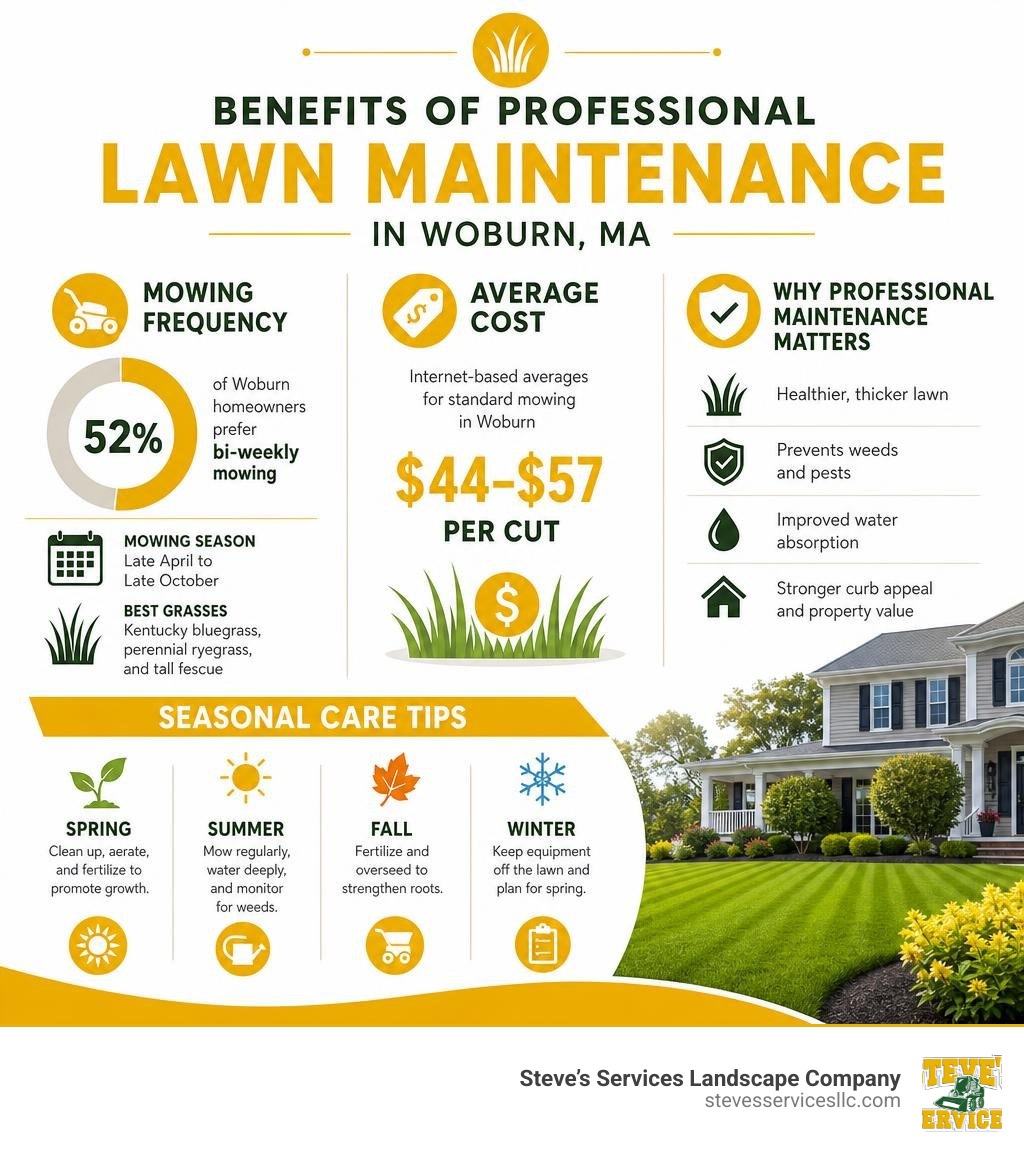
- The mowing season typically runs late April through late October
- Internet-based averages suggest most Woburn residents pay roughly $44–$57 per cut for standard mowing — these are general market figures, not quotes from Steve’s Services
- 52% of Woburn homeowners prefer bi-weekly mowing
- Cool-season grasses like Kentucky bluegrass, perennial ryegrass, and tall fescue perform best in Woburn’s climate
Woburn, MA sits in USDA hardiness zones 5b–7a, which means your lawn faces real seasonal swings — from late spring frosts to humid summers and hard New England winters. That kind of climate puts pressure on turf health year-round. A front lawn that looks great in June can look patchy and stressed by August if it isn’t managed correctly. Getting the care right from the start makes all the difference.
I’m Steve Sylva, owner of Steve’s Services Landscape Company, and I’ve been providing expert lawn care in Woburn MA and surrounding communities since founding the company in 1995. In this guide, I’ll walk you through everything I’ve learned about keeping Woburn lawns healthy, compliant, and picture-perfect across all four seasons.
Simple guide to Woburn lawn service:
The Seasonal Blueprint for Woburn Turf Care

Woburn’s unique geographical layout means that what works for a lawn near the sandy outwash of Horn Pond might not work for a property built on the heavier marine clay or rocky glacial till found in North Woburn or the West Side. Because Woburn spans USDA Hardiness Zones 5b to 7a, we are firmly in “cool-season grass” territory.
To achieve a deep green, resilient carpet of turf, we must design a custom program that caters specifically to these cool-season grass types:
- Kentucky Bluegrass: The gold standard for New England lawns. It is lush, spreads via underground rhizomes to self-heal bare patches, but requires consistent nutrients and water.
- Perennial Ryegrass: Germinates incredibly fast, making it excellent for high-traffic areas. It has a fine texture but doesn’t handle extreme summer heat as well as other varieties.
- Fine-Leaf Fescue: The ultimate shade champion. Fine fescues typically make up 50% to 70% of Massachusetts shade seed mixes because they thrive in low-light, low-moisture areas.
- Tall Fescue: Exceptionally deep-rooted and drought-tolerant. This grass stays green during dry August spells when other grasses go dormant.
The key to unlocking the potential of these grass types lies beneath the surface. Woburn soils naturally trend toward an acidic soil pH of 5.5 to 6.5. When soil is too acidic, grass cannot efficiently absorb vital nutrients like nitrogen, phosphorus, and potassium.
By utilizing professional spring yard clean up services to clear away winter debris and applying a tailored lime treatment, we can gently nudge the soil pH back to a neutral 6.5 to 7.0. This ensures that every drop of our premium lawn fertilizer service goes toward feeding the roots rather than washing away.
Spring and Summer Turf Management
When the ground finally thaws in late April, the spring “flush” begins. This is a period of rapid, aggressive grass growth fueled by spring showers. To keep your turf healthy and prevent shocking the root system, we strictly adhere to the professional One-Third Rule: never remove more than one-third of the grass blade during a single cutting.
Mowing heights must be adjusted carefully depending on the species:
- Kentucky Bluegrass: Keep it between 2.5 and 3.5 inches.
- Perennial Ryegrass: Maintain at 2.0 to 3.0 inches.
- Tall Fescue: Let it grow a bit taller, between 3.0 and 4.0 inches.
During the peak of summer, we raise our mowing heights by 0.5 to 1.0 inch. Taller grass shades the soil, reduces water evaporation, and keeps the root zones cool during dry spells.
Spring is also the critical window for weed control. Applying a pre-emergent crabgrass barrier before the soil temperature consistently reaches 55°F stops crabgrass seeds from germinating.
To keep your lawn properly hydrated through the summer heat without wasting water, a professional sprinkler system installation ensures that your turf receives deep, even watering early in the morning, preventing fungal diseases while conserving water.
Fall Preparation and Winterization
While spring gets all the glory, fall is actually the most important season for long-term turf health in Eastern Massachusetts. September and October present the perfect conditions for core aeration and overseeding.
Core aeration pulls small plugs of soil and thatch out of your lawn, relieving soil compaction and allowing oxygen, water, and nutrients to reach the root zone. Overseeding immediately after aeration fills in thin spots and introduces improved, disease-resistant grass varieties to your lawn.
As winter approaches, we apply a specialized fall winterizer fertilizer. This high-potassium formula doesn’t encourage rapid top growth; instead, it strengthens the root system, allowing the grass to store essential carbohydrates to survive the freezing winter months.
Finally, thorough leaf removal is essential. Heavy mats of fallen leaves block sunlight and trap moisture, creating the perfect breeding ground for snow mold.
If your lawn has suffered severe damage over the year, fall is also an ideal time to explore professional lawn installation services to start fresh for the coming spring.
Choosing the Right Woburn Lawn Service for Your Property

Selecting a professional Woburn lawn service involves more than just finding someone with a mower. Woburn has specific municipal regulations, environmental guidelines, and unique neighborhood characteristics that require local expertise.
For instance, if your property is located near Horn Pond, the Shaker Glen conservation area, or any of Woburn’s local wetlands, your lawn care must comply with the Massachusetts Wetlands Protection Act). Homeowners and commercial operators working near these protected areas must coordinate carefully with the Woburn Conservation Commission. In some cases, a formal Notice of Intent or Request for Determination of Applicability is required before executing major landscape alterations or chemical applications.
Furthermore, Woburn enforces strict noise control ordinances regarding the operation of power equipment. Mowing and landscaping equipment can only be operated during the following hours:
- Weekdays: 7:00 AM to 9:00 PM
- Saturdays: 8:00 AM to 8:00 PM
A professional team understands these local laws, respects your neighbors, and ensures full compliance with stormwater management rules (such as MS4 compliance), ensuring that grass clippings are never blown into storm drains or public streets where they can pollute local waterways. This is why investing in expert lawn care in Woburn MA is the smartest move for your property.
Why a Professional Woburn Lawn Service Outperforms DIY
While taking care of your own lawn might sound like a weekend hobby, the reality often involves endless trips to the garden center, struggling with heavy equipment, and trying to diagnose mysterious brown spots.
Hiring a professional service saves you valuable weekend time and delivers superior results thanks to high-end commercial equipment. For example, professional mower blades are sharpened every 20 to 25 hours of use. Dull residential blades tear the grass rather than cutting it cleanly, leaving jagged, brown tips that make the lawn look dull and open the door to turf diseases.
Speaking of diseases, our local cool-season lawns are highly susceptible to pathogens like brown patch, dollar spot, red thread, and snow mold. Identifying these early requires a trained eye.
If you are dealing with a bare, patchy lawn that needs a complete overhaul, we can implement advanced turf establishment methods like professional hydroseeding services to quickly grow a thick, uniform lawn that naturally crowds out weeds.
What to Expect From a Premium Woburn Lawn Service Package
When you hire a high-quality lawn care provider, you should expect a comprehensive approach to every visit. A standard, premium maintenance visit includes:
- Precision Mowing: Cutting the turf at the optimal height for the current weather conditions.
- Mechanical Edging: Creating clean, vertical lines along driveways, walkways, and patios.
- String Trimming (Weed Whipping): Carefully cutting grass around trees, fences, and foundation walls.
- Debris Blowing: Clearing all grass clippings off hard surfaces, patios, and garden beds.
- Grasscycling: Returning finely chopped grass clippings back to the lawn. Clippings decompose rapidly and return up to 25% of essential nitrogen back to the soil, acting as a natural, free fertilizer.
By wrapping these tasks into a consistent landscape maintenance schedule, your property stays pristine without you ever having to lift a finger.
Understanding Lawn Care Costs and Service Frequencies in Woburn
Finding the right balance between how often your lawn is mowed and your seasonal budget is key to maintaining a beautiful yard. Let’s look at how service frequencies impact your turf’s health:
| Mowing Frequency | Best Suited For | Turf Health Impact |
|---|---|---|
| Weekly | Spring flush, high-input Kentucky bluegrass lawns, properties with irrigation | Excellent. Consistently respects the One-Third Rule, resulting in dense, weed-resistant turf. |
| Bi-Weekly | Slow-growing summer periods, low-input fescue lawns, shaded properties | Good. May occasionally violate the One-Third Rule during rapid spring growth, leading to minor turf stress. |
| Monthly | Extremely slow-growing turf, vacant lots, or budget-focused properties | Poor. Regularly violates the One-Third Rule, leading to weed invasion, clumping, and scalped grass. |
The average yard size in Woburn is approximately 9,358 square feet. The overall cost of your lawn service depends heavily on this size, the slope of your property, the number of obstacles (like playsets, garden beds, and fences), and how often you schedule service.
Mowing Frequency and Homeowner Preferences
Local data indicates that Woburn homeowners have distinct preferences when it comes to maintaining their yards:
- Weekly Mowing (approx. 27% to 28% of homeowners): This is highly recommended during the active spring growing season (May through June) to maintain turf density and prevent weed seeds from taking root.
- Bi-Weekly Mowing (approx. 52% of homeowners): The most popular choice. It offers a great balance of neatness and value, especially during the hot, dry summer months when grass growth naturally slows down.
- Monthly Mowing (approx. 18% to 20% of homeowners): While budget-friendly, monthly mowing is generally discouraged for healthy lawns. Cutting off weeks of overgrown grass at once scalps the turf, exposes the soil to weed seeds, and damages the root system.
Average Costs vs. Comprehensive Care Packages
When planning your landscaping budget, it is helpful to look at general market pricing. Please note that the figures below represent internet-based averages across the region and are not specific quotes for Steve’s Services:
- Average Standard Cut: Internet-based market averages sit around $50.47 per cut for a standard-sized yard (under 10,000 sq. ft.).
- Broad Market Pricing Range: Depending on the size of your property, terrain complexity, and frequency, standard mowing rates across the industry typically range from $44 to $180+ per cut. The high end of this range represents large, estate-sized properties or highly complex terrains that require specialized equipment and extra labor.
To keep a lawn truly healthy, simple mowing is rarely enough. Many homeowners choose to bundle their mowing with seasonal care packages. In Woburn, roughly 10% of lawns receive professional fertilization programs, 13% utilize core aeration, and 10% schedule comprehensive spring and fall yard cleanups to keep their properties looking their absolute best.
Frequently Asked Questions About Woburn Lawn Care and Snow Management
How often should my lawn be mowed during the peak growing season in Woburn?
During the peak spring growing season (typically mid-May through June), we highly recommend weekly mowing. The combination of cool spring temperatures and frequent rain causes cool-season grasses to grow rapidly. Mowing every 7 days ensures you never cut off more than one-third of the grass blade, keeping the lawn lush, green, and stress-free. During the hot, dry spells of July and August, this frequency can often be extended to every 10 to 14 days.
What are the local Woburn regulations regarding yard waste and noise?
The City of Woburn encourages home composting but also provides curbside yard waste collection from April through November. All yard waste must be placed curbside by 7:00 AM on your scheduled trash day in biodegradable paper bags only or in open, marked barrels. Plastic bags are strictly prohibited and will not be collected.
Additionally, you must respect the city’s noise ordinances. Power equipment, including lawnmowers and leaf blowers, can only be operated between 7:00 AM and 9:00 PM on weekdays, and between 8:00 AM and 8:00 PM on Saturdays.
How does commercial snow plowing and management ensure safety and municipal compliance for Woburn businesses during major winter storms?
Commercial snow management is a high-stakes service where safety, speed, and local compliance are paramount. For commercial properties, apartment complexes, and retail centers in Woburn, a winter storm can shut down operations and create massive liability risks.
Our commercial snow services operate on a zero-tolerance policy. We monitor local meteorological data to deploy our fleet before the first snowflake falls, applying pre-treatment liquid brines and rock salt to prevent ice from bonding to pavement.
Throughout the storm, our team performs continuous clearing of parking lots, fire lanes, and pedestrian walkways to maintain safe access. We ensure full compliance with Woburn municipal snow removal ordinances, which prohibit pushing snow into public streets or blocking municipal sidewalks.
Furthermore, we carefully manage snow pile placement to preserve critical sightlines at property exits and prevent hazardous “freeze-thaw” cycles where melting snow runs across walkways and refreezes into black ice.
Conclusion
Achieving a picture-perfect front yard in Woburn, MA is a year-round journey. From balancing the naturally acidic soil with lime in the spring to maintaining the perfect mowing height during the summer heat and aerating in the fall, every step directly impacts the long-term health and value of your property.
At Steve’s Services Landscape Company, we have spent over three decades mastering the science of New England turf care. Whether you need ongoing landscape maintenance, a complete lawn overhaul, or reliable commercial snow management when the winter weather hits, we are here to help.
Contact us today to discuss your property’s needs and let us help you build a lawn that makes your home the pride of the neighborhood!