Why Professional Hedge Trimming Services Transform Your Property
Hedge Trimming Services are essential for maintaining the health, appearance, and functionality of your landscape. Whether you need privacy screening, wind protection, or enhanced curb appeal, properly maintained hedges can increase your property value while creating beautiful outdoor boundaries.
What You Need to Know About Hedge Trimming Services:
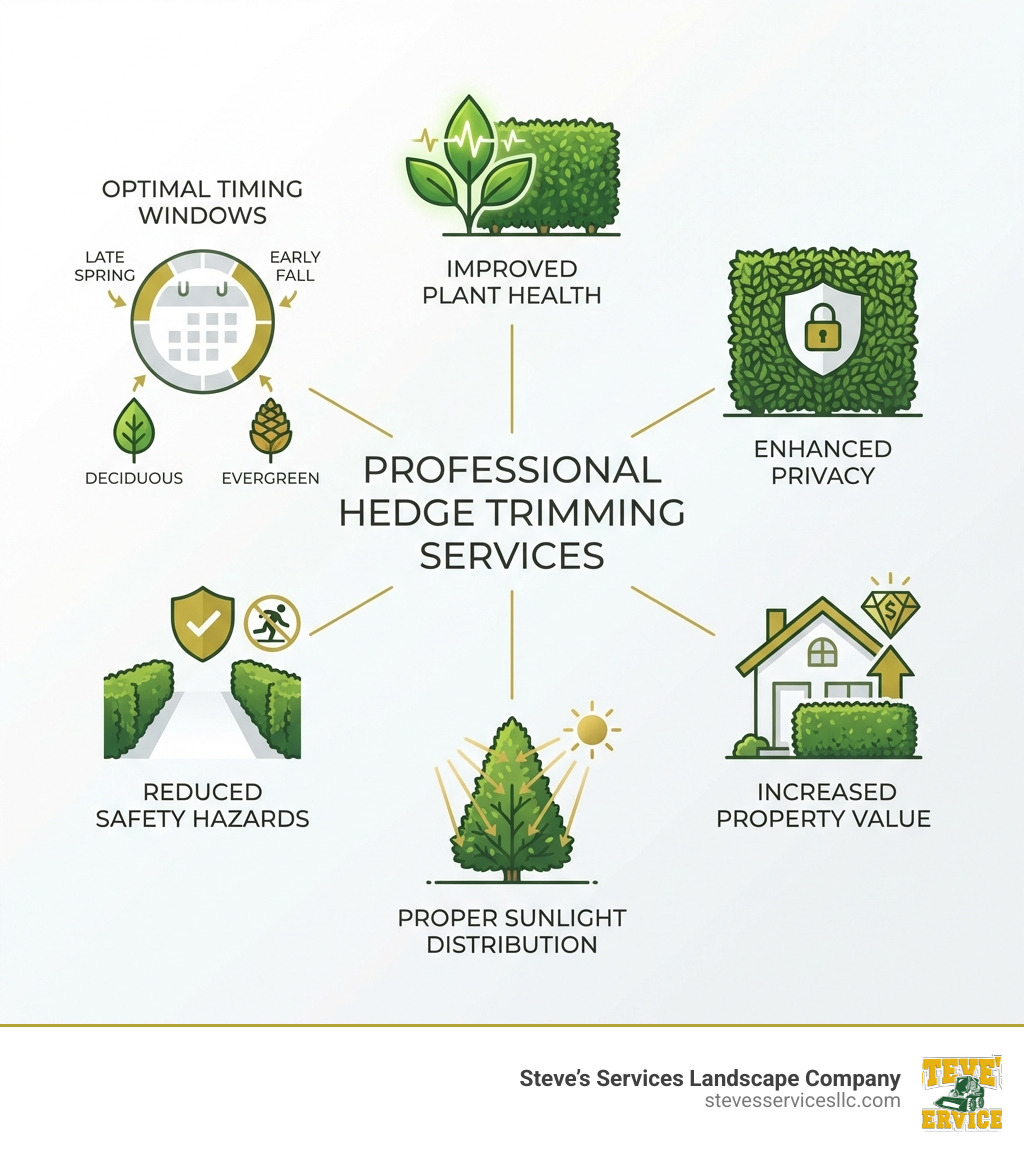
- Timing: Best performed in late spring or early fall when plants are dormant, avoiding frost risk and extreme heat
- Frequency: Most hedges require professional trimming 1-2 times annually to maintain health and appearance
- Technique: Professionals shape hedges with a wider base than top, allowing sunlight to reach lower branches and promoting even growth
- The One-Third Rule: Never remove more than one-third of a hedge’s growth at once to prevent plant stress
- Cost: Average prices range widely from $30/hour for basic trimming to $300+ for complex projects (these are internet averages, not Steve’s Services pricing)
- Professional Advantage: Specialized equipment, safety training, proper insurance, and thorough debris cleanup
Proper hedge maintenance goes beyond simple aesthetics. Well-trimmed hedges promote healthy growth by improving sunlight penetration and air circulation throughout the plant. They also reduce hazards from overgrown branches, encourage flowering and fruiting in appropriate species, and can extend the lifespan of cedar hedges to 30-60 years with minimal ongoing maintenance.
The difference between amateur and professional results often comes down to understanding plant biology and using proper techniques. As one homeowner discovered, professional services transformed their “impossible overgrown hedges” into “incredible-looking hedges” that hadn’t looked that good in years—complete with thorough cleanup and debris recycling within 24 hours.
I’m Steve Sylva, and with over 25 years of landscape experience, I’ve helped countless Massachusetts homeowners maintain healthy, beautiful hedges through proper trimming techniques and species-specific care. Through Steve’s Services, we’ve perfected the balance between aesthetic goals and plant health, ensuring your hedges provide privacy, beauty, and value for decades to come.
Glossary for Hedge Trimming Services:
The Science of Timing Your Hedge Trimming Services
Timing is everything when it comes to the health of your landscape. In Massachusetts, we deal with a unique climate that dictates exactly when we should be out there with the shears. Trimming at the wrong time isn’t just a cosmetic mistake; it can actually invite disease or cause “winter burn” if the plant doesn’t have time to heal before the frost hits.
When we provide Hedge Trimming Services, we look closely at the plant’s dormancy. Most hedges are in their most dormant state in late spring and early fall. This is the “Goldilocks” zone for trimming–not too cold that the plant is brittle, and not so hot that the plant is already stressed by drought.
Optimal Seasonal Windows
For the majority of the hedges we see in towns like Burlington and Reading, there are two primary windows:
- Late Spring (Late April to June): This is ideal for most evergreen and non-flowering hedges. Trimming now allows the hedge to put its energy into new, controlled growth throughout the summer.
- Early Fall (September to October): This window is perfect for a final “tidy up” before winter. However, we always make sure to finish at least six weeks before the first hard frost. This gives the “cuts” time to callous over.
If you have flowering species, the rules change slightly. You generally want to wait until after they have finished blooming to avoid cutting off next year’s flower buds. For more detailed information on specific plant timing, you can check out our guide on shrub pruning.
Avoiding Environmental Stress
We strongly advise against heavy Hedge Trimming Services during periods of extreme heat or severe drought. When a plant is struggling to find water, cutting its foliage is like asking a marathon runner to give blood in the middle of a race–it’s just too much stress.
Similarly, late autumn trimming can be risky. If you stimulate new growth too late in the season, that tender new foliage won’t have “hardened off” before the Massachusetts winter arrives. The result? Ugly brown patches known as winter burn that can take years to grow out.
Advanced Techniques for Structural Integrity
Maintaining a hedge is about more than just making it look like a green box. It’s about engineering a living wall that is strong enough to withstand heavy New England snow and healthy enough to stay green from top to bottom.
Precision Shaping in Hedge Trimming Services
One of the most common mistakes we see is the “Upside Down V” or the “Perfect Cube.” While a cube looks nice on day one, it’s a death sentence for the bottom branches. Why? Because the top branches shade out the bottom ones.
When we perform Hedge Trimming Services, we use a technique called “tapering.” We ensure the base of the hedge is wider than the top. This allows sunlight to penetrate all the way to the ground, preventing that “bare leg” look where the bottom of the hedge is just brown sticks. This shape also helps snow shed more easily, preventing heavy drifts from snapping the internal structure of the hedge.
| Feature | Trimming | Pruning | Shaping |
|---|---|---|---|
| Primary Goal | Aesthetic neatness | Plant health/structure | Architectural form |
| Focus Area | Outer foliage | Dead or diseased wood | Overall silhouette |
| Frequency | 1-2 times per year | As needed | Once a year |
| Tools Used | Power trimmers | Hand shears/loppers | String lines/levels |
For those looking for a truly “wow” factor, our professional hedge trimming team uses string line guides and levels to ensure perfectly straight lines that would make a master carpenter jealous. You can learn more about how we handle different types of greenery on our bush and shrub trimming page.
The One-Third Rule for Plant Health
In arboriculture, there is a golden rule: Never remove more than one-third of the plant’s total foliage in a single season. This is crucial for maintaining foliage density and reducing stress. If a hedge has been neglected for years, we don’t try to fix it all at once. Instead, we perform “rejuvenation pruning” over several seasons, slowly bringing the hedge back to its ideal size without killing it.
This rule is especially important for specific varieties. For example, pruning box bushes requires a very delicate touch to maintain their dense, slow-growing nature.
Species-Specific Care Strategies
Not all hedges are created equal. A cedar hedge in Danvers has very different needs than a lilac hedge in Malden. Understanding these differences is what separates a general laborer from a professional specialist.
Nurturing Coniferous Evergreens
The Ontario White Cedar is a staple in Massachusetts landscapes. These are the workhorses of the hedge world, providing year-round privacy, wind protection, and noise reduction.
- Growth Rate: Once established, these can grow up to 3 feet per year.
- Maintenance: They love consistency. Trimming them once a year at the same time keeps them thick and rich in color.
- Longevity: With proper care, a cedar hedge can last 30 to 60 years.
We often suggest applying cedar mulch at the base to retain moisture, as these plants are thirsty! You can find more tips on keeping these beauties in shape with our guide on trimming beech hedges, which shares many of the same structural principles.
Managing Flowering and Deciduous Hedges
Deciduous hedges, like Lilac, Spirea, or Privet, offer seasonal color but require a different approach. These are often “informal” hedges. Instead of a tight, sheared look, we often use selective thinning to encourage more flowers.
- Lilacs: Should be trimmed immediately after the flowers fade.
- Spirea: Benefits from a “haircut” in late winter or early spring to encourage vigorous new flowering stems.
- Rejuvenation: Deciduous shrubs are much more forgiving. You can often cut them back quite hard to “reset” an overgrown hedge, something you can never do with a cedar.
Professional Standards and Investment Factors
Hiring a professional for Hedge Trimming Services is an investment in your property’s future. It’s about more than just saving a Saturday; it’s about safety, liability, and professional results.
Understanding the Cost of Hedge Trimming Services
When you search for Hedge Trimming Services, you will see a wide range of prices. Based on internet data, basic hourly rates can start as low as $30 per hour for simple tasks. However, for professional-grade work involving large hedges, specialized equipment, and full debris removal, project costs can range significantly.
Note: The following figures are based on average internet data and do not reflect the actual pricing for Steve’s Services.
- Small/Basic Trim: $30 – $100
- Medium/Standard Hedge: $150 – $450
- Large/Complex Project: $500 – $1,500+
As you can see, the high end of professional work is often at least 3x the average “starting” price because it accounts for height, thickness, and the amount of debris generated. For a more tailored look at what influences these numbers, see our page on hedge trimming cost.
Debris Management and Site Cleanup
One of the most overlooked parts of Hedge Trimming Services is what happens after the cutting is done. A large hedge can produce a mountain of clippings. We believe your yard should look better when we leave than when we arrived.
We use heavy-duty tarps to catch clippings as we work, ensuring your mulch beds and lawn stay clean. We also prioritize organic disposal. For many of our clients in Everett and Stoneham, we arrange for clippings to be recycled into mulch or compost, keeping your landscape eco-friendly. If you’re looking for a team that treats your yard like their own, you can find hedge trimming near me through our service area links.
Frequently Asked Questions about Hedge Maintenance
How often should professional hedge trimming be performed?
For most residential properties in Massachusetts, we recommend professional trimming 1-2 times per year. An annual trim is the bare minimum to keep a hedge healthy and prevent it from becoming “woody” on the inside. If you are looking for a very sharp, formal look (like a boxwood or a formal privet), twice a year—once in late spring and once in late summer—is the gold standard.
What is the difference between trimming and pruning?
While people often use the terms interchangeably, they are different!
- Trimming is like a haircut; it focuses on the exterior “envelope” of the hedge to maintain its shape and aesthetic.
- Pruning is more like surgery; it involves reaching inside the hedge to remove dead, diseased, or crossing branches. This improves airflow and light penetration, which is vital for the plant’s long-term health.
Why is professional service preferred over DIY?
Beyond the obvious benefit of not having to spend your weekend on a ladder, professional services offer:
- Specialized Equipment: We use professional-grade gas and battery trimmers that provide a much cleaner cut than homeowner-grade tools.
- Safety: Trimming a 10-foot hedge requires ladders, harnesses, and experience. It’s one of the most common ways homeowners end up in the ER.
- Insurance: We are fully insured. If a branch falls the wrong way or an accident happens, you are protected.
- Plant Health: We know exactly where to cut to encourage growth rather than stunted “stubs.”
Conclusion
Your hedges are the frame for your home’s “picture.” When they are well-maintained, they provide a sense of order, privacy, and luxury that few other landscape features can match. At Steve’s Services, we take pride in serving our neighbors across Everett, Medford, Winchester, and the surrounding communities with top-tier Hedge Trimming Services.
Whether you have a row of towering cedars that need a annual “top-off” or a set of decorative shrubs that need precision shaping, our team has the tools, the experience, and the dedication to get the job done right. We don’t just cut bushes; we nurture your landscape’s potential.
Ready to transform your property? Book your professional hedge trimming near me and let us help your neighbors say “WOW!” when they walk by your home.