
Professional Hedge Trimming: Top 5 2025 Benefits
Why Professional Hedge Trimming Matters for Your Property
Professional hedge trimming is a specialized landscaping service that goes far beyond simple maintenance—it improves your property’s curb appeal, promotes healthy plant growth, prevents disease and pest infestations, and can boost your home’s resale value by up to 15%. Here’s what you need to know:
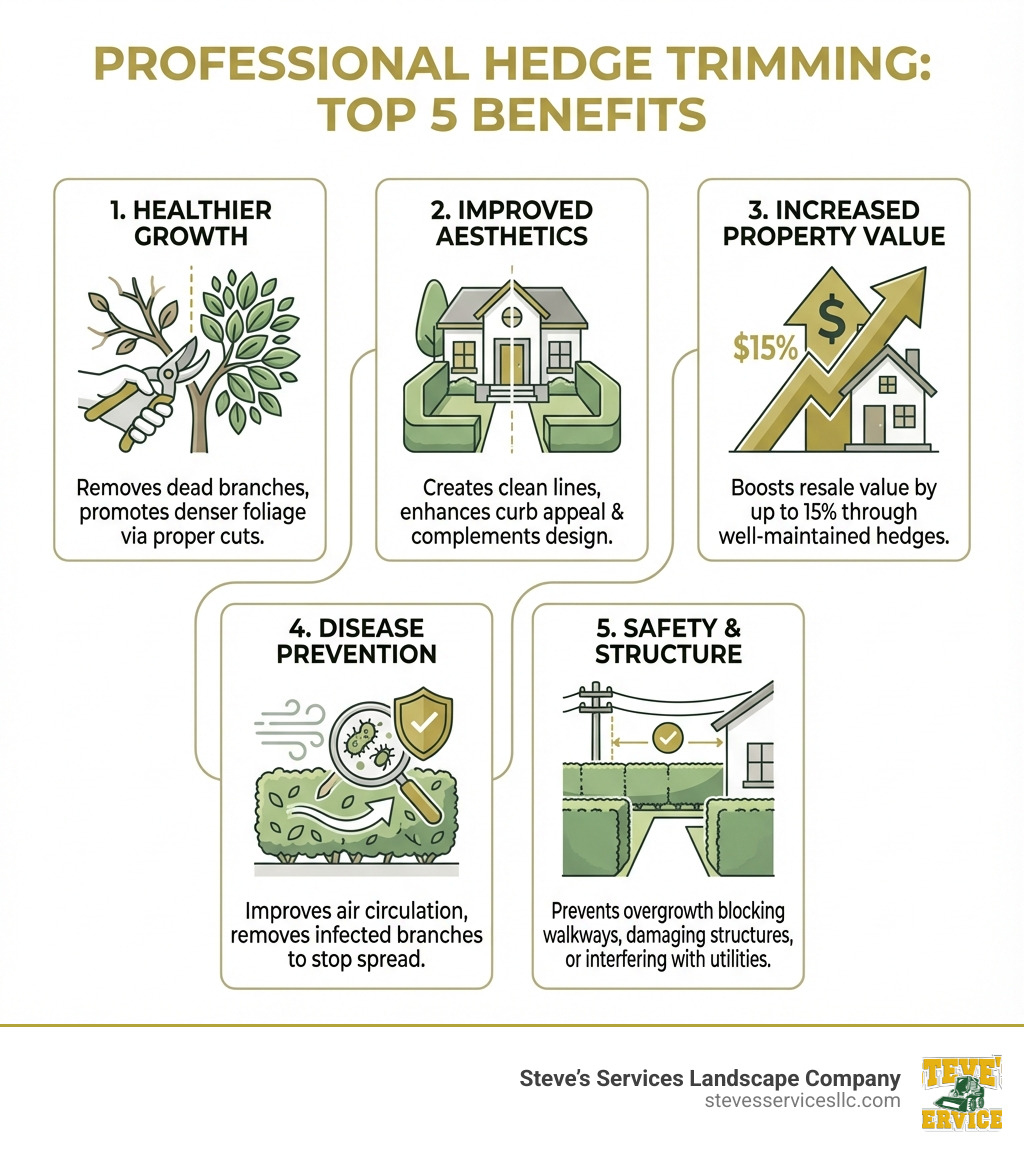
Key Benefits of Professional Hedge Trimming:
- Healthier Growth – Removes dead branches and promotes denser foliage through proper technique
- Improved Aesthetics – Creates clean, precise lines that frame your property beautifully
- Increased Property Value – Well-maintained hedges can add up to 15% to resale value
- Disease Prevention – Improves air circulation and removes infected branches before problems spread
- Safety & Structure – Prevents overgrowth from encroaching on walkways, structures, and power lines
Many homeowners underestimate what’s involved in professional hedge care. It’s not just about running a trimmer along your hedges once a year. True professional hedge trimming requires understanding plant biology, knowing when and how to cut different species, using specialized equipment safely, and recognizing the signs of disease or structural problems before they become costly issues.
The reality? Improper trimming can weaken or permanently damage your hedges, leading to bare patches, disease vulnerability, or even plant death. As one industry expert notes, “It is better not to prune than to do it incorrectly.”
I’m Steve Sylva, owner of Steve’s Services with over 25 years of landscape maintenance experience in the Massachusetts area, and I’ve seen how professional hedge trimming transforms properties while protecting your investment in these valuable landscape features. In this guide, I’ll walk you through what professional hedge trimming really entails—from the specialized techniques and equipment we use, to timing considerations, safety protocols, and what you should expect when hiring a professional service.
The Value of Professional Care: More Than Just a Tidy-Up
When we talk about the benefits of professional hedge trimming, we’re discussing much more than just a neat appearance. Well-maintained hedges are a valuable asset to any property, offering a range of aesthetic, functional, and environmental advantages that contribute significantly to your home’s overall health and appeal.
One of the most immediate and noticeable benefits is the dramatic improvement in curb appeal. Neatly trimmed hedges instantly lift the aesthetics of your property, creating clean lines and a polished look that makes a lasting impression. This improved visual appeal directly translates into increased property value. In fact, statistics suggest that professionally trimmed hedges can boost a home’s resale value by up to 15%. This isn’t just a number; it’s a testament to how potential buyers perceive a well-cared-for landscape as an indicator of a well-maintained home.
Beyond beauty, professional hedge trimming is crucial for the health and longevity of your hedges. Regular trimming, when done correctly, encourages thicker, fuller growth, which is particularly important for privacy hedges that serve as natural screens. By removing dead, weak, or diseased branches, we actively prevent the spread of disease and pest infestations. This proactive approach ensures that your hedges remain vibrant and robust, rather than becoming susceptible to health issues that can quickly spread throughout your landscape. Proper trimming also ensures a healthy balance of light and air circulation within the hedge, which is vital for preventing fungal infections and promoting overall plant vigor.
Hedges also offer significant structural integrity and functional benefits. They can act as natural barriers, providing privacy and security, and even serving as windbreaks to protect your home from the elements. Hedges can also help to define property lines and create a sense of order in your garden. Environmentally, well-maintained hedges are essential components of a thriving ecosystem. They contribute to local biodiversity by providing shelter and food for wildlife, act as natural soundproofing, and can even help filter dust and air pollution, contributing to a healthier environment around your home in Massachusetts.
However, the reverse is also true: neglected hedges can quickly become liabilities. Signs of neglect include overgrowth that encroaches on walkways, driveways, or even structures, creating hazards and obscuring views. Untrimmed hedges can become leggy, sparse, and susceptible to pests and diseases, losing their aesthetic appeal and functional benefits.
The risks of improper trimming are substantial. As experts in the field, we know that incorrect techniques can weaken or deform healthy plants, making them unable to absorb sufficient nutrients. This can lead to bare patches, stunted growth, or even permanent damage that necessitates costly removal and replacement. It’s a delicate balance of understanding the specific needs of each hedge species and executing precise cuts to encourage healthy growth while maintaining the desired shape.
That’s why investing in professional hedge trimming is not just about keeping your yard tidy; it’s about making a smart, long-term investment in the health, beauty, and value of your property. For more information about how we can help maintain the beauty and health of your entire outdoor space, explore our Landscape Maintenance Services.
The Professional’s Calendar: Timing, Frequency, and Technique
Understanding when and how to trim hedges is an art and a science, and it’s a cornerstone of professional hedge trimming. The timing, frequency, and techniques we apply are all custom to the specific species of hedge, its growth rate, and your aesthetic goals.
First, let’s clarify a common point of confusion: the difference between pruning and trimming. While often used interchangeably, they have distinct purposes. Hedge trimming primarily focuses on cleaning up a hedge’s appearance by removing overgrown branches to manage excessive growth and maintain a desired shape. Think of it as a haircut for your hedge. Pruning, on the other hand, is more about the health and structural integrity of the plant. It involves specifically removing loose, dead, diseased, or weak branches that are at risk of harming other plants or people, or to encourage healthier growth and better air circulation. Often, we perform both trimming and pruning together to achieve a healthy and good-looking hedge.
When is the best time for professional hedge trimming? For most hedges, the optimal time for significant pruning or shaping is late winter to early spring, when plants are dormant. Trimming during this dormant period allows the plant to direct its energy more efficiently into new growth once spring arrives. It also minimizes stress on the plant and reduces the risk of disease entry through fresh cuts.
However, maintenance trimming can occur during the growing season. For instance, maintenance trimming to keep a hedge tidy and neat is generally best performed in late spring to early summer. We advise against trimming during extreme heat or drought, as this can severely stress the plant. Similarly, cutting hedges too late in the fall can stimulate new, tender growth that is vulnerable to damage from winter cold. If a hedge needs repair due to damage, we recommend addressing it as soon as possible, regardless of the season, to prevent further issues.
The frequency of trimming largely depends on the hedge species and its growth rate. Fast-growing hedges might require 2-4 trims per year to maintain their shape and density. Privacy hedges, which we aim to keep thick and full, typically benefit from 1-2 trims annually. More formal hedges, which demand precise lines and shapes, often require trimming two or three times a year to retain their meticulous appearance.
Informal hedges, conversely, may only need one trim per year to keep them healthy and within bounds. It’s also crucial to remember that flowering shrubs should generally be trimmed after they have finished flowering to avoid cutting off the current season’s blooms. As a general rule, we also avoid trimming conifer hedges after August to prevent potential dieback.
For new hedges, formative pruning is essential in their early years to establish a strong structure and desired shape. This initial shaping helps guide their growth and ensures they develop into healthy, dense barriers or features.
Best Hedge Species for Different Purposes in Massachusetts
Choosing the right hedge species for your property in Massachusetts is key to its success. Here are some excellent choices for various purposes:
For Privacy and Screening:
- Emerald Cedar / Eastern White Cedar: These evergreens are incredibly popular in our region for creating dense, year-round privacy screens. They offer excellent coverage and respond well to regular trimming.
- Yew (Taxus spp.): A classic evergreen, yews are dense, shade-tolerant, and can be shaped formally or informally. They are long-lived and provide consistent privacy.
- Hemlock (Tsuga canadensis): A native evergreen that can form a beautiful, soft-textured hedge, providing excellent privacy and a natural look.
- Privet (Ligustrum spp.): While often semi-evergreen or deciduous in our climate, privet grows quickly and densely, making it a good choice for a fast-growing privacy screen.
For Formal Gardens and Structure:
- Boxwood (Buxus spp.): The quintessential formal hedge, boxwood is evergreen, slow-growing, and holds its shape beautifully with precise trimming. It’s perfect for creating borders, knot gardens, or intricate designs.
- Hornbeam (Carpinus betulus): A deciduous tree that can be tightly clipped into a formal hedge, retaining its brown leaves through winter for some visual interest.
- Columnar Beech (Fagus sylvatica ‘Fastigiata’): While a tree, it can be planted closely to form a magnificent, formal deciduous screen or hedge, known for its upright growth and beautiful foliage.
Our team at Steve’s Services understands the unique growth habits of these and many other species common in Massachusetts. We tailor our professional hedge trimming approach to ensure each hedge thrives according to its specific needs. For more detailed guidance on trimming practices, you can refer to a comprehensive Hedge Trimming Guide. And if you’re looking for expert care for your shrubs beyond just hedges, we invite you to Learn about our Shrub Pruning services.
The Arborist’s Toolkit and Safety Protocols for Professional Hedge Trimming
At Steve’s Services, professional hedge trimming is executed with precision, efficiency, and above all, safety. This commitment is reflected in the specialized equipment we use and the stringent safety protocols our experienced team adheres to on every job in Massachusetts.
Our arborists and landscape professionals come equipped with a comprehensive toolkit designed to handle hedges of all sizes and types. This includes:
- Professional-Grade Hedge Trimmers: These are the workhorses of our operation. We use high-performance models, often battery, electric, or petrol-powered, known for their durability, power, and reliability. These trimmers come with high cutting capacities, suitable for frequent trimming and cutting through even overgrown hedges. We select models with high-speed trim cutting for fine shaping and high-torque coarse cutting for tackling tougher, thicker branches.
- Pole Trimmers: For taller hedges or those in hard-to-reach areas, pole trimmers are indispensable. They allow us to extend our reach safely without the need for precarious ladders, ensuring even cuts from top to bottom.
- Hand Shears and Pruners: For detailed shaping, delicate species like boxwoods, or removing specific dead branches, hand shears and pruners offer the precision needed for clean, healthy cuts.
- Scaffolding or Lifts: For very large or exceptionally tall hedges, we use stable scaffolding or specialized lifts. This ensures our team can work safely and effectively at height, achieving uniform results across the entire hedge.
- Tarps and Cleanup Tools: A critical, often overlooked, part of professional hedge trimming is the cleanup. We always lay down tarps to collect debris, making the post-trimming cleanup meticulous and leaving your property neat and tidy.
You can see examples of the kind of robust equipment we use by exploring products like Commercial Hedge Trimmers.
Safety is paramount in all our operations. Our team undergoes continuous safety training and strictly adheres to industry regulations, often implementing our own protocols that exceed standard requirements. Before any trimming begins, we conduct a thorough site assessment to identify potential hazards, such as hidden wires, uneven terrain, or nearby structures.
Our safety precautions include:
- Personal Protective Equipment (PPE): All our team members wear appropriate PPE, including eye protection (safety glasses), hearing protection (ear plugs for petrol equipment), gloves, safety boots, and high-visibility clothing.
- Wildlife Checks: We always check hedges for nesting birds or sheltering animals, especially during nesting seasons (typically March to August), to avoid disturbing local wildlife.
- Property Protection: We take great care to protect your property during the trimming process. This includes using tarps to catch debris and ensuring that equipment is operated away from vulnerable plants or structures.
- Trained Personnel: Our team consists of skilled arborists and landscape professionals who are not only trained in proper trimming techniques but also in safe equipment operation and emergency procedures.
By combining the right tools with rigorous safety practices, we ensure that your professional hedge trimming is performed efficiently, effectively, and without incident. This meticulous approach extends to all our tree care services, including our Tree Pruning and Removal services.
Advanced Techniques and Cost Considerations
Beyond routine maintenance, professional hedge trimming encompasses advanced techniques for restoration and artistic shaping, alongside transparent cost considerations. Whether your hedges are overgrown, damaged, or you simply envision a more sculpted aesthetic, our expertise delivers custom solutions.
Managing Overgrown Hedges and Creating Garden Art
Overgrown hedges can be daunting, but with a professional approach, they can often be restored to their former glory. This process, known as restorative pruning, requires patience and a deep understanding of plant biology. For severely overgrown hedges, it may be difficult to restore them to their original appearance in a single session. Instead, we often recommend a gradual reduction, where we strategically reduce height and spread over multiple sessions to avoid shocking the plant or creating unsightly bare patches.
Our process for managing overgrown or damaged hedges typically involves:
- Assessment: First, we assess the root cause of the damage or overgrowth, whether it’s due to snow, pests, or previous improper maintenance.
- Debris Removal: We carefully clear out dead branches, interior debris, and needles. This improves airflow, allows sunlight to penetrate deeper into the hedge, and promotes healthy regrowth.
- Reshaping: We gradually reshape the hedge, always prioritizing the plant’s health. If a hedge was planted too deeply, struggling with poor root oxygenation, we might remove excess soil from the root crown to restore airflow.
- Structural Support: In some cases, especially for damaged hedges, structural support might be needed to help the plant recover its form.
While restoration focuses on health and structure, hedge trimming can also be a medium for garden art. Topiary and hedge sculpting transform ordinary hedges into extraordinary landscape features. Our skilled professionals can create stunning designs, from precise geometric forms to whimsical shapes.
- Topiary: We can shape hedges into classic forms like globes, pyramids, and boxes, or even more intricate animal shapes. This requires selecting the right plant species and applying years of skilled, patient trimming to achieve and maintain the desired form.
- Hedge Sculpting: For a more artistic and free-flowing look, we can create unique features like rolling waves or dramatic castle tops. These custom designs require a high level of artistry and precision to execute, turning a simple hedge into a living sculpture.
Maintaining these sculpted hedges requires regular, expert trimming to preserve their intricate forms. This level of precision and artistry is a hallmark of professional hedge trimming.
However, there are times when a hedge is beyond saving due to severe disease, irreversible damage, or simply being in the wrong place. In such instances, we can assist with removal. If a hedge can’t be saved, you might need to consider Bush Removal Near Me.
Understanding the Cost of Professional Hedge Trimming
The cost of professional hedge trimming can vary widely, reflecting the complexity and scale of the work involved. The prices we discuss here are average costs based on internet data and not actual costs for Steve’s Services. We always provide a detailed, personalized quote after assessing your specific needs.
Several key factors influence the cost of hedge trimming services:
- Hedge Size: This is arguably the most significant factor.
- Small Hedges (under 3 feet tall, 10 feet long): Average costs can range from $50–$200.
- Medium Hedges (3–6 feet tall, 10–20 feet long): Average costs typically fall between $100–$300.
- Large Hedges (over 6 feet tall, 20+ feet long): Expect average costs from $300–$1,000.
- Extra Large or Overgrown Hedges: These projects often start at $600 and can go significantly higher, sometimes exceeding $1,500, due to increased time, labor, and specialized equipment requirements.
- Accessibility: Hedges that are difficult to access (e.g., on a steep slope, near obstacles, or requiring specialized equipment like lifts) will generally cost more.
- Condition: Overgrown or damaged hedges require more extensive work, including interior debris removal, gradual reshaping, and potentially multiple sessions, all of which add to the cost. Hedges that are bare, turning brown, or have significant holes will also require more restorative effort.
- Complexity of Design: Basic, straight trimming is less labor-intensive than intricate topiary or formal shaping, which demands advanced techniques and more time.
- Debris Removal: While often included, extensive debris from very large or overgrown hedges might incur an additional charge for disposal.
- Hedge Species: Different species have different needs. Delicate hedges like Boxwoods require precise cuts, fast-growing species like buckthorn need more frequent trimming, and evergreens like Cedars or Yews need careful pruning to prevent interior dieback. These specific requirements can influence the time and expertise needed, affecting the overall cost.
- Pricing Structure: Some services might offer an hourly rate, which can range from $30 to over $100 per hour based on internet data, while others prefer project-based pricing for clarity. Some services may also have a minimum project fee.
Is professional hedge trimming worth the cost? Absolutely. It ensures healthy growth through precise cuts, significantly improves curb appeal, adds substantial property value, and helps you avoid costly mistakes that can cause permanent damage to your valuable landscape features. Considering that well-maintained hedges can boost resale value by up to 15%, the investment often pays for itself.
For a clearer understanding of what goes into pricing, and to get a custom estimate for your property, we encourage you to review our dedicated page on Hedge Trimming Cost.
Frequently Asked Questions about Professional Hedge Trimming
We often hear similar questions from our clients across Burlington, Danvers, Everett, Lynnfield, Medford, Melrose, North Reading, Reading, Revere, Saugus, Stoneham, Winchester, Woburn, Malden, and Wakefield, MA. Here are some of the most common inquiries about professional hedge trimming:
What is the difference between pruning and trimming hedges?
While the terms are often used interchangeably, there’s a key distinction in professional hedge trimming. Trimming primarily focuses on the aesthetic aspect—it’s about removing overgrown branches to maintain a hedge’s desired size, shape, and neat appearance. Think of it as a regular haircut. Pruning, on the other hand, is a more targeted process aimed at the health and structural integrity of the plant.
It involves carefully removing dead, diseased, damaged, or weak branches to encourage healthier growth, improve air circulation, and prevent the spread of infections. Often, our professional service combines both trimming and pruning to ensure your hedges are both beautiful and robust.
How often should my hedges be trimmed?
The frequency of professional hedge trimming largely depends on the specific hedge species, its growth rate, and your desired aesthetic.
- Fast-growing hedges (like some Privet varieties) might need trimming 2-4 times a year to keep them in check.
- Privacy hedges, which we aim to keep dense and full, typically benefit from 1-2 trims annually.
- Formal hedges, requiring precise lines and shapes, may need trimming 2-3 times a year to maintain their meticulous form.
- Informal hedges might only need one trim per year for health and general tidiness.
- We generally recommend a major shaping or size reduction in late winter to early spring when the plants are dormant, with lighter maintenance trims in late spring to early summer. Avoid trimming during extreme heat or too late in the fall to prevent stress and new growth vulnerable to winter cold. We always assess your specific hedges to recommend the optimal schedule.
Can a severely overgrown or damaged hedge be saved?
In many cases, yes, a severely overgrown or damaged hedge can be saved and restored through professional hedge trimming and care, but it requires expertise and patience. The first step is to assess the extent of the damage or overgrowth and identify the root cause (e.g., snow, pests, previous improper trimming, or planting too deeply).
Our approach often involves:
- Gradual Reduction: For very overgrown hedges, we might reduce their height and spread incrementally over multiple sessions to avoid shocking the plant.
- Deadwood and Debris Removal: Clearing out dead branches, interior debris, and needles is crucial. This improves air circulation and sunlight penetration, promoting new, healthy growth.
- Addressing Root Causes: If a hedge was planted too deeply and is struggling, we can carefully remove excess soil from the root crown to restore proper airflow. If pests or diseases are present, we’ll recommend appropriate treatments.
- Reshaping: We carefully reshape the hedge, focusing on encouraging healthy regrowth and filling in bare or patchy areas.
While some hedges may be too far gone to fully restore their original appearance, many can be refreshd to become healthy, attractive landscape features once more. We’ll always provide an honest assessment of your hedge’s potential for recovery.
Conclusion
As we’ve explored, professional hedge trimming is a critical aspect of landscape maintenance that offers far-reaching benefits for your property in Massachusetts. It’s an investment that pays dividends in improved curb appeal, increased property value, and the long-term health and vitality of your hedges. From promoting denser growth and preventing disease to ensuring structural integrity and contributing to a healthier environment, the expertise of trained professionals makes all the difference.
We understand that hedges are more than just plants; they are living features that define your outdoor space, provide privacy, and add character to your home. That’s why we approach every job with precision, using specialized equipment and adhering to strict safety protocols, ensuring meticulous care from start to finish. We tailor our services to the unique needs of your hedges, whether they require routine maintenance, restorative pruning, or artistic shaping.
At Steve’s Services, we pride ourselves on bringing over 25 years of experience and a deep understanding of horticulture to every landscape project. We believe in providing personalized solutions that not only meet but exceed your expectations, changing your hedges into a source of pride.
Don’t let your hedges become a neglected liability. Invest in their health and beauty with the experts who truly understand what it takes to make them thrive. For expert hedge trimming services that improve your property’s value and appeal, contact us today!
