
Why a Golf Course-Quality Lawn Starts with the Right Nutrition
Commercial lawn fertilizer is a professional-grade turf nutrition product designed to deliver consistent, concentrated nutrients that create dense, vibrant grass while suppressing weeds and improving soil health. Here’s what makes it different from residential products:
Key Features of Commercial Lawn Fertilizer:
- Higher nutrient concentration (often 20-30% nitrogen vs. 10-15% in residential products)
- Slow-release technology that feeds turf for 6-12 weeks per application
- Professional formulations custom to specific grass types and soil conditions
- Bulk packaging (typically 50-pound bags) for large-area coverage
- Specialized blends that include micronutrients for optimal turf health
When to Use Commercial Lawn Fertilizer:
- Spring: After grass begins active growth (late April/May for cool-season grasses)
- Summer: Light maintenance applications for warm-season grasses
- Fall: Primary feeding window for cool-season grasses (September-November)
- Application rate: Maximum 1 pound of nitrogen per 1,000 square feet per application
The difference between an ordinary lawn and one that stops people in their tracks comes down to what you feed it. Professional-grade fertilization isn’t just about aesthetics—it’s about enhancing property value, providing environmental benefits, and creating spaces that make lasting first impressions.
I’m Steve Sylva, owner of Steve’s Services in Malden, MA. With over 25 years of experience managing landscapes across Massachusetts, I’ve seen how the right commercial lawn fertilizer program transforms properties from patchy and pale to golf course green. For any office complex, HOA, or large estate, professional turf nutrition is the foundation for a landscape that boosts property value and impresses every visitor.
Find more about commercial lawn fertilizer:
The Science Behind Professional Turf Nutrition
A golf course-quality lawn is achieved through science, not magic. Like any living organism, turf requires a balanced diet of essential nutrients to thrive. Without it, grass becomes discolored, slow-growing, and susceptible to weeds and pests. Professional commercial lawn fertilizer programs fill these nutritional gaps, ensuring robust growth, vibrant color, and resilience.
At Steve’s Services, our approach focuses on delivering the right blend of macronutrients and micronutrients, optimizing nutrient availability, and enhancing soil health to promote dense turf that naturally suppresses weeds.
Understanding N-P-K and Their Roles
The N-P-K ratio on any fertilizer bag represents the percentage by weight of three primary macronutrients. These elements are required by turfgrasses in the greatest quantities and play vital roles in lawn health:
- Nitrogen (N): As the most-needed nutrient, nitrogen is the powerhouse behind lush, green leaf growth, shoot density, and vibrant color, making it crucial for your property’s aesthetic appeal.
- Phosphorus (P): Critical for establishing new lawns and strong root development, phosphorus acts as an energy transfer agent within the plant. It must be used responsibly, as many states regulate its use to protect waterways. Always check local Massachusetts regulations before application.
- Potassium (K): Known as the “stress reliever,” potassium is essential for rooting, disease resistance, drought tolerance, and winter hardiness. It helps turf withstand environmental pressures and recover quickly.
Beyond N-P-K, turfgrass also requires secondary macronutrients (Calcium, Magnesium, Sulfur) and micronutrients (Iron, Manganese, etc.). While needed in minute quantities, they are essential for optimal color and growth. For instance, iron is often supplemented to improve the dark green color of turf.
Key Differences in Commercial Lawn Fertilizer vs. Residential
Commercial lawn fertilizer isn’t just a larger bag of homeowner-grade product. The differences are fundamental to achieving professional results on large properties:
- Higher Nutrient Concentration & Advanced Formulations: Commercial products have more active nutrients (20-30% nitrogen) and use advanced slow-release technology. This provides consistent feeding for weeks, reduces burn risk, and minimizes environmental runoff.
- Precision and Efficiency: Professional fertilizers are engineered with uniform granular sizes for even spreading with commercial-grade equipment. This ensures consistent results across vast landscapes, something residential products can’t match.
- Custom Blends & Bulk Packaging: Formulations are often customized for specific turf types and climates and come in large, 50-pound bags, making them cost-effective for large-scale use.
These distinctions allow professionals to deliver consistent, high-quality results that meet the demands of commercial properties.
Slow-Release vs. Quick-Release Fertilizers
Understanding the difference between slow-release and quick-release nitrogen is crucial for an effective lawn program.
| Feature | Slow-Release Fertilizers | Quick-Release Fertilizers |
|---|---|---|
| Nutrient Delivery | Gradual, consistent feeding over time | Immediate flush of nutrients |
| Longevity | Long-lasting (6-12 weeks, some up to 400+ days) | Short-lived (2-4 weeks) |
| Burn Risk | Low risk, even at higher application rates | High risk if over-applied or not watered in |
| Leaching Potential | Reduced, nutrients are less likely to wash away | Higher, more prone to runoff and environmental impact |
| Growth Response | Uniform, steady growth; less frequent mowing | Rapid, often excessive growth spurt; more frequent mowing |
| Color Response | Consistent, sustained green color | Quick green-up, but color may fade faster |
| Labor Savings | Fewer applications needed, saving time and labor | More frequent applications required |
| Cost | Generally higher per bag, but often more cost-effective per season due to longevity | Generally lower per bag, but can be more expensive overall due to frequency |
Slow-Release Fertilizers: These products use coated granules or organic materials to release nutrients gradually, triggered by soil temperature, moisture, or microbes. Key advantages include consistent feeding, reduced environmental impact, lower burn risk, and labor savings from fewer applications.
Quick-Release Fertilizers: Containing water-soluble nitrogen, these fertilizers are immediately available to the turf. They provide a rapid green-up and are useful for a fast visual improvement, for use in cooler temperatures, or to kickstart growth in new lawns.
For most Massachusetts properties, we use a balanced approach, favoring slow-release nitrogen for sustained health and environmental safety, with quick-release products for targeted boosts.
Developing Your Commercial Fertilization Strategy
A vibrant commercial lawn results from strategic planning, not guesswork. At Steve’s Services, our data-driven approach starts with a site assessment and focuses on long-term turf health. This ensures every application of commercial lawn fertilizer is precisely what your property needs.
Our goal isn’t just to make your grass green; it’s to build a resilient, healthy ecosystem that improves your property’s value. This strategy is especially important for new lawn installs, where the right foundation sets the stage for future success. More info about new lawn installs
The Role of Soil Testing
Soil testing is the cornerstone of any effective fertilization program. Fertilizing without it is guesswork that can waste product, harm the environment, and lead to an unhealthy lawn. A soil test provides key insights:
- Nutrient Deficiencies: It reveals exactly which nutrients are lacking or in excess, allowing us to select a fertilizer blend that avoids unnecessary ingredients, saving money and protecting waterways.
- pH Levels: Soil pH affects nutrient availability. A test shows if the pH is optimal for turfgrass or if amendments are needed for better nutrient absorption.
- Organic Matter: This indicates the soil’s capacity to hold water and nutrients, which can influence how much fertilizer is needed.
- Cation Exchange Capacity (CEC): This measures the soil’s ability to hold nutrients. Low-CEC soils, like sand, may need slow-release fertilizers or more frequent, lighter applications to prevent nutrient loss.
With this data, we make informed decisions to select the perfect commercial lawn fertilizer blend and application rates, ensuring a more effective and environmentally responsible program. For more in-depth information, you can refer to Fertilizer Recommendations from Purdue University.
Matching Fertilizer to Grass Type and Climate
Massachusetts is home to cool-season grasses that thrive in spring and fall. Understanding your grass type and our climate is key to selecting the right commercial lawn fertilizer and timing applications correctly.
- Cool-Season Grasses: Varieties like Kentucky bluegrass, perennial ryegrass, and fescues are prevalent in our service areas of Burlington, Danvers, and Everett. Our strategy focuses on fall applications to strengthen roots and spring applications to support growth. We avoid aggressive summer fertilization, which can stress these grasses.
- Warm-Season Grasses: Though less common here, grasses like zoysiagrass would receive their primary fertilization during the summer months when they are actively growing.
Our local climate dictates a fertilization calendar that delivers 2 to 4 pounds of actual nitrogen per 1,000 square feet annually, typically over 3 to 4 applications. We always adjust for factors like soil type and site conditions (e.g., shady areas need about 50% less fertilizer).
Timing and Frequency: A Year-Round Calendar
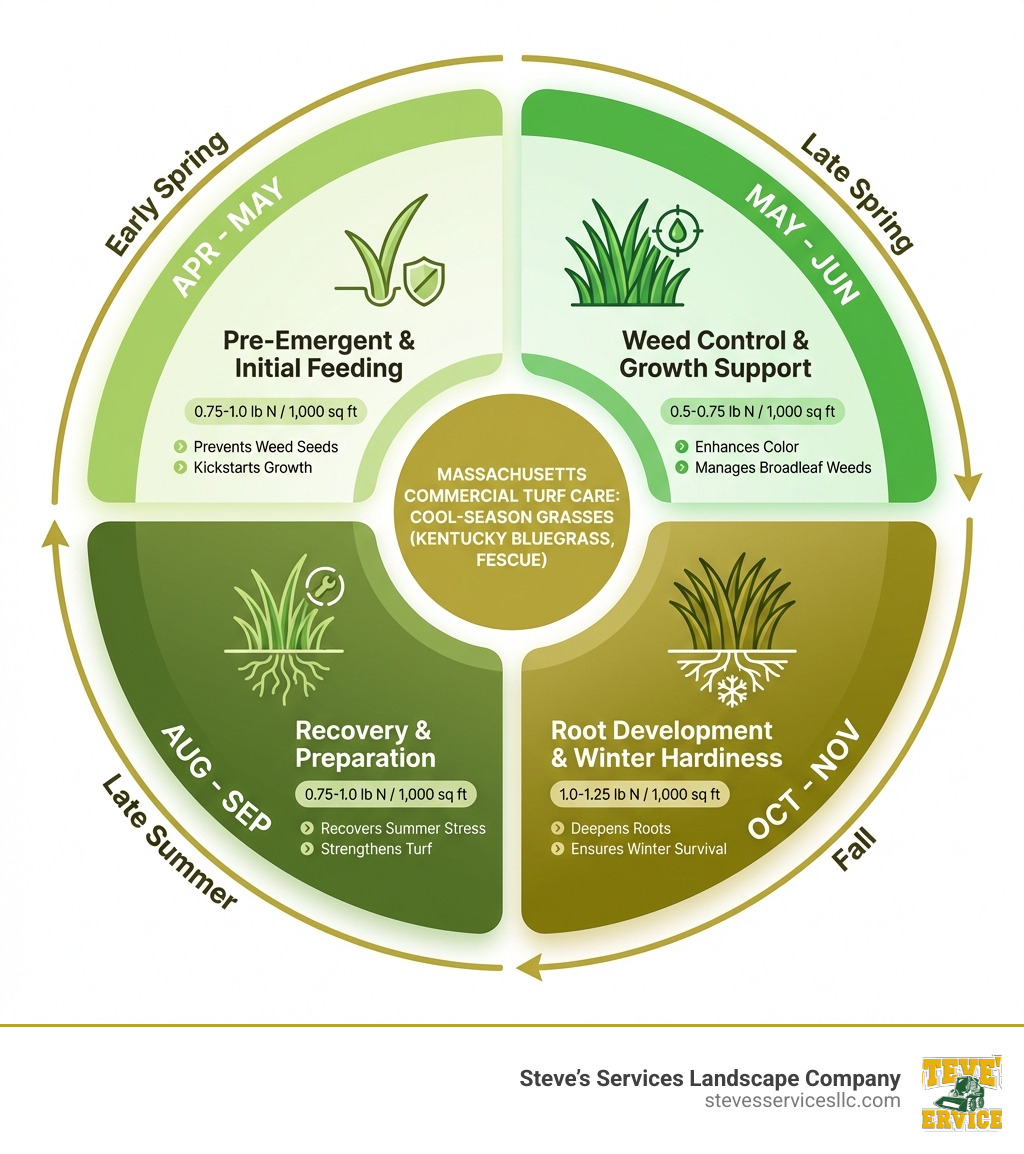
A year-round calendar is key to maintaining a healthy commercial lawn. Our four-application program is timed to support the growth cycles of cool-season grasses:
- Spring Application (Late April/May): As grass emerges from dormancy, we apply a balanced commercial lawn fertilizer to promote root development and green-up. This application often includes pre-emergent crabgrass control. We apply nitrogen after the initial growth flush to avoid over-stimulation.
- Summer Maintenance (June-August): Summer applications are lighter, using slow-release formulas to sustain the lawn without pushing aggressive growth during heat stress. We also perform spot treatments for weeds.
- Fall Fertilization (September-October): This is the most critical application for cool-season grasses. It provides nutrients for root development, increasing resistance to disease, drought, and winter damage. It also helps the lawn store energy for a quicker spring green-up.
- Late Fall/Winter Preparation (Late October/November): A final “winterizer” application after top growth stops helps the lawn store nutrients for winter survival and promotes an even earlier green-up next spring.
This strategic timing works in harmony with our spring yard clean-ups and fall yard clean-ups to maintain optimal landscape health.
Best Practices for Application and Environmental Safety
Proper application of commercial lawn fertilizer is as important as choosing the right product. Our team at Steve’s Services adheres to strict best practices to ensure uniform coverage, maximize nutrient uptake, and safeguard the environment in communities like Woburn, Malden, and Wakefield.
Environmental stewardship is a core value. We implement techniques that prevent fertilizer runoff and protect local waterways, a diligent approach integrated into all our landscape maintenance services.
Best Practices for Applying Commercial Lawn Fertilizer
Effective application requires precision, the right equipment, and proven techniques:
- Equipment Selection: We use commercial-grade broadcast spreaders for efficient, uniform coverage on large properties. Near hardscapes or water, we use drop spreaders for controlled application. Liquid methods are also used for quick absorption.
- Calibration and Rate: We calibrate our spreaders to apply no more than 1 pound of actual nitrogen per 1,000 square feet in a single application, a widely accepted best practice.
- Dry Grass Blades: We apply granular fertilizer to dry grass, allowing granules to fall to the soil surface rather than sticking to wet leaves and causing burn.
- Watering-in Fertilizer: After application, we water the lawn to wash granules into the soil for root absorption. This critical step prevents fertilizer burn and activates the nutrients without causing runoff.
- Returning Grass Clippings: Leaving grass clippings on the lawn can contribute up to 1.0 lb of nitrogen per 1,000 sq ft annually, potentially reducing overall fertilizer needs.
Avoiding Common Pitfalls: Over-Fertilization and Runoff
Improper fertilization can damage your lawn and the environment. We are vigilant in avoiding these pitfalls:
- Over-Fertilization: Applying too much commercial lawn fertilizer causes several problems:
- Lawn Burn: Excess salts dehydrate and “burn” the grass, turning it brown or yellow.
- Excessive Growth, Weak Roots: Too much nitrogen promotes weak top growth instead of strong roots, creating a less resilient lawn.
- Disease Susceptibility: Over-fertilized lawns can become more prone to certain diseases.
- Water Pollution (Runoff and Leaching): This is a major environmental concern. Improperly applied fertilizer can wash into storm drains (runoff) or seep into groundwater (leaching), leading to:
- Algae Blooms: Excess nutrients fuel algae growth in waterways, which depletes oxygen and harms aquatic life.
- Contaminated Drinking Water: Leached nitrates can contaminate drinking water sources.
To prevent these issues, we use soil testing, establish buffer zones near water, keep fertilizer off hardscapes, favor slow-release products, and never apply to frozen ground. For more information, we consult resources like the Responsible Use of Fertilizers guide.
The Business Side: Costs and Regulations
Investing in a professional commercial lawn fertilizer program for your property in communities like Reading, Stoneham, or Saugus is a business decision. It involves understanding cost analysis, budgeting, and navigating regulatory compliance. At Steve’s Services, we help clients achieve a strong return on investment through superior lawn health, while ensuring all applications meet state and local requirements.
Cost Considerations for a Commercial Program
The cost of a commercial lawn fertilization program varies, but it’s an investment that pays dividends in property aesthetics and value. Key factors include:
- Square Footage: Larger properties incur higher costs for product and labor.
- Product Type: Premium slow-release or specialized formulas cost more than standard blends but can be more cost-effective annually.
- Number of Applications: A comprehensive program typically involves 3-4 applications per year.
- Labor Costs: Professional expertise and equipment are significant cost factors.
- Soil Test: An upfront cost that saves money by guiding precise fertilization.
Average Cost Disclaimer: These are average costs based on internet data for commercial fertilization services and not actual costs for Steve’s Services. For a precise quote custom to your property, please contact us directly.
Generally, for commercial properties, you might expect costs to range from $250 to over $1500 per application, depending on property size and program complexity. Bulk purchasing can reduce costs for very large properties.
Legal and Regulatory Compliance
Fertilizer application requires adherence to legal and environmental standards. As a professional Massachusetts landscaping company, we are fully committed to compliance:
- Local Ordinances and State Laws: We stay informed on all Massachusetts regulations regarding fertilizer application, particularly those protecting against nutrient runoff.
- Applicator Licensing: Our technicians are properly trained and licensed to apply commercial lawn fertilizer and other lawn care products safely and effectively.
- Safety Data Sheets (SDS): We maintain SDS for all products, providing critical information on safe handling and emergency procedures.
- Record Keeping: We maintain meticulous records of all applications, ensuring accountability, tracking results, and demonstrating compliance.
Choosing a professional service like Steve’s Services ensures your fertilization program is both effective and fully compliant.
Frequently Asked Questions about Commercial Fertilization
Property managers in Lynnfield, Melrose, and Revere often ask about commercial lawn fertilizer. Here are answers to common questions:
How much nitrogen does a commercial lawn typically need per year?
A commercial lawn typically needs 2 to 4 pounds of actual nitrogen per 1,000 square feet annually. This varies based on several factors:
- Grass Type: High-maintenance grasses like Kentucky bluegrass (3-4 lbs/yr) need more nitrogen than tall fescue (2-3 lbs/yr).
- Desired Maintenance Level: A “golf course green” look requires more nitrogen than a lower-maintenance turf.
- Soil Test Guidance: A soil test provides the most accurate recommendation for nitrogen needs.
- Clipping Management: Returning grass clippings can contribute about 1.0 lb of nitrogen per 1,000 sq ft annually.
- Environmental Factors: Sandy soils may need more frequent, lighter applications to prevent leaching, while shady areas need about 50% less nitrogen.
We apply no more than 1 pound of actual nitrogen per 1,000 square feet in a single application.
Can I use commercial fertilizer on my home lawn?
While possible, using commercial lawn fertilizer on a home lawn is not recommended for DIY application due to several risks:
- Higher Concentration Risks: Commercial products are highly concentrated, and miscalculation can easily burn your lawn.
- Specialized Formulations: These products are designed for professional equipment, making even application with a residential spreader difficult.
- Professional Expertise: Professionals are trained to handle complex formulations and understand specific turf and soil needs.
- Cost-Effectiveness: Bulk commercial fertilizer is often not cost-effective for smaller home lawns.
For home lawns, it’s safer to use residential products or hire a professional service like Steve’s Services.
Why is fall fertilization so important for commercial properties?
Fall fertilization is the most crucial application for cool-season lawns in Massachusetts for several reasons:
- Root System Development: Cool fall air and warm soil are ideal for developing deep, robust root systems, the foundation of a resilient lawn.
- Winter Hardiness: A well-fed lawn stores nutrients to better withstand winter stresses like freezing temperatures and snow.
- Early Spring Green-Up: Lawns fed in the fall emerge from winter dormancy earlier and green up more quickly and uniformly in the spring.
- Disease Resistance: A healthy lawn entering winter is less susceptible to winter and spring diseases.
Essentially, fall fertilization sets your commercial property up for success for the entire next growing season.
Achieve a Healthier, Greener Commercial Property
Achieving a golf course-quality lawn for your Massachusetts commercial property is the result of a planned and expertly executed commercial lawn fertilizer program. Understanding the science, using precise application techniques, and following environmental best practices all contribute to a landscape that makes a powerful statement.
The benefits extend beyond aesthetics, contributing to increased property value, a positive first impression, and environmental advantages like reduced runoff. By choosing professional expertise, you’re investing in the long-term health and vibrancy of your commercial landscape.
At Steve’s Services, we pride ourselves on delivering personalized solutions and exceptional customer service, backed by over 25 years of experience in communities across Massachusetts, including Everett, Burlington, Danvers, and beyond. Let us transform your commercial property into a lush, green asset that stands out.
Contact us for a professional fertilizing program to find how we can lift your commercial landscape.
