What Does a Residential Irrigation System Actually Cost?
The average cost for residential irrigation system installation ranges from about $1,600 to $10,000+, depending on your lawn size, system type, and location. Here’s a quick snapshot based on internet averages:
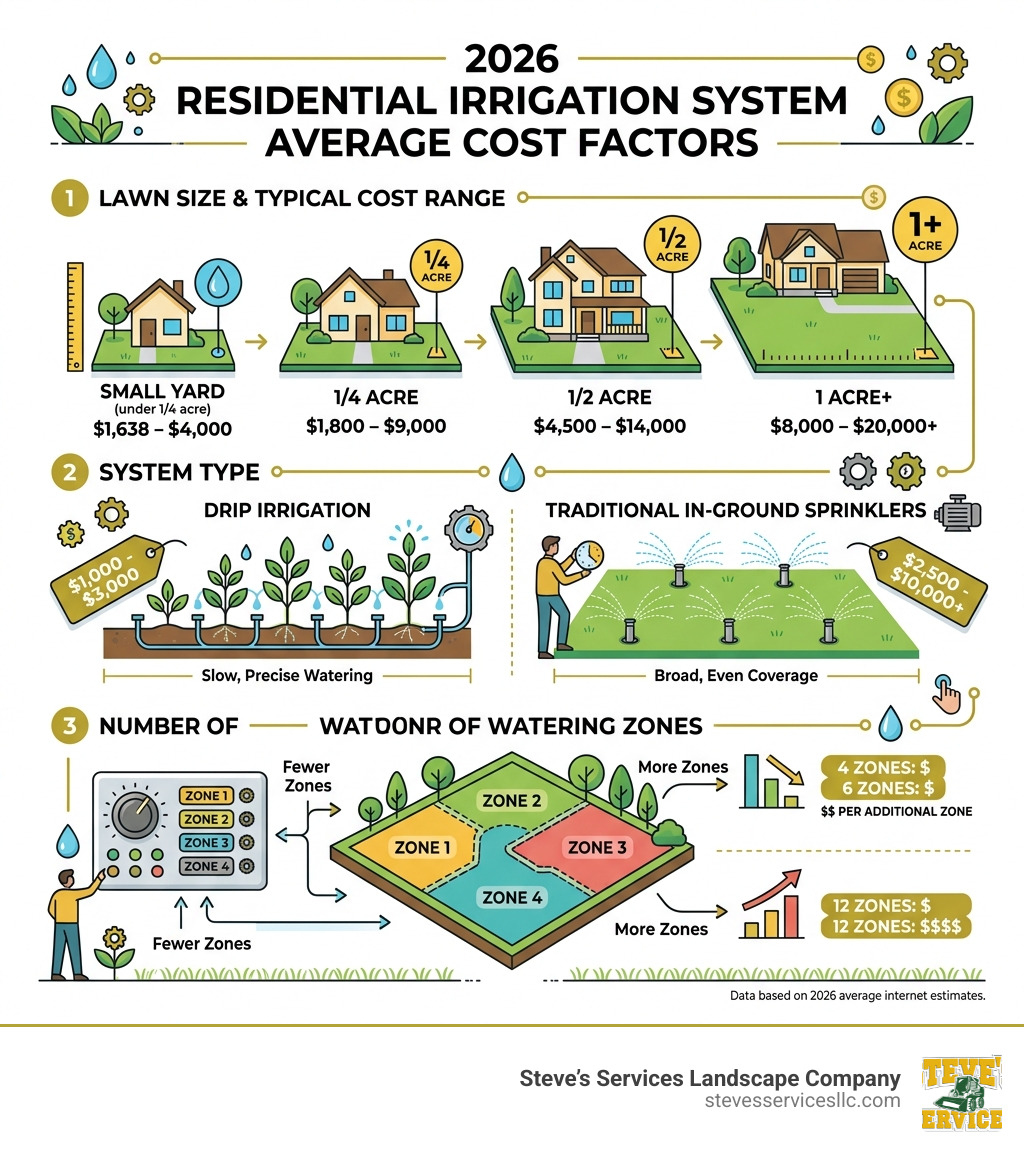
| Lawn Size | Typical Cost Range |
|---|---|
| Small yard (under 1/4 acre) | $1,638 – $4,000 |
| 1/4 acre | $1,800 – $9,000 |
| 1/2 acre | $4,500 – $14,000 |
| 1 acre+ | $8,000 – $20,000+ |
Note: These are average costs based on national internet data and do not reflect actual pricing from Steve’s Services. Your local quote may vary.
Most homeowners in the greater Boston area spend somewhere between $2,500 and $5,500 for a standard in-ground sprinkler system. But that number can swing dramatically based on your soil, yard layout, number of watering zones, and the type of system you choose.
A well-designed irrigation system does more than keep your grass green. It saves you time, protects your landscaping investment, and can even boost your home’s resale value. But before you commit, it helps to understand what you’re actually paying for.
I’m Steve Sylva, owner of Steve’s Services in Malden, MA, and with over 25 years of hands-on experience helping homeowners across Eastern Massachusetts plan and install irrigation systems, I’ve seen how the average cost for residential irrigation system varies block by block. In this guide, I’ll walk you through everything you need to know to budget smart.
Basic average cost for residential irrigation system glossary:
Breaking Down the Average Cost for Residential Irrigation System
When you start looking into the average cost for residential irrigation system installation, you’ll find that “average” is a bit of a moving target. While national data suggests a typical range of $2,540 to $3,581, high-end custom installations for large estates can easily exceed $10,000 or even $20,000.
It is important to remember that these figures are based on broad internet data and market reports; they are not specific quotes for our services at Steve’s Services. However, they provide a helpful baseline for your initial budgeting. You can find more info about irrigation systems to see how these components come together.
The total investment is usually split between materials (about 30-40%) and professional labor (60-70%). In areas like Medford or Winchester, where soil can be rocky or the terrain sloped, labor costs often sit at the higher end of the spectrum. According to How Much Does a Sprinkler System Cost? (2026), factors like the number of sprinkler heads and the complexity of the controller also play a major role in the final bill.
Cost by Lawn Size and Square Footage
Lawn size is the most significant “fixed” variable in your estimate. Most professionals use a square footage model or a per-acre rate to provide a rough estimate. For an average lawn sprinkler system cost, you can expect to pay anywhere from $0.20 to $1.00 per square foot for standard coverage.
- 1/4 Acre (approx. 10,890 sq. ft.): This is the most common residential lot size in suburban Massachusetts. Internet data suggests a range of $1,800 to $9,000. The wide range accounts for the difference between a basic “no-frills” setup and a high-tech system with smart sensors.
- 1/2 Acre: As the size doubles, so does the complexity. Expect ranges between $4,500 and $14,000.
- 1 Acre and Larger: For expansive properties in Lynnfield or North Reading, costs typically start around $8,000 and can climb above $20,000. For more details, check out our detailed guide to underground sprinkler costs per acre.
Interestingly, the cost per square foot often decreases as the lot size increases. This is because the “fixed” costs—like the controller, the main water line connection, and the backflow preventer—are spread across a larger area.
Impact of Watering Zones on Your Total Investment
A “zone” is a specific area of your yard controlled by a single valve. We divide yards into zones because most residential water lines don’t have enough pressure to pop up every sprinkler head at once. If you tried to water the whole yard at once, you’d get a sad little dribble instead of a powerful spray.
The average cost for residential irrigation system zones typically ranges from $600 to $2,000 per zone. A standard 1/4 acre yard usually requires 3 to 6 zones. Here is what goes into each zone:
- Solenoid Valves: These receive an electrical signal from the controller to open or close.
- Manifolds: This is the “hub” where the main water line splits into different zone pipes.
- Piping and Heads: Each zone has its own network of lateral pipes and specific sprinkler heads.
If your property has high-pressure needs or complex landscaping (like separate zones for a flower garden and a turf lawn), you will need more zones, which increases the cost to install sprinklers. To learn more about the technical requirements, read our guide on how much to install an irrigation system.
Comparing Underground, Drip, and Automatic Sprinkler Costs
Choosing the right system type is a balance between your budget and your plants’ needs. While traditional underground sprinklers are the gold standard for lush lawns, drip irrigation is becoming increasingly popular for gardens and flower beds due to its incredible efficiency.

According to How Much Does Sprinkler System Installation Cost? [2026 Data] | Angi, an automatic system is the most popular choice because it removes the “human error” factor. You don’t have to remember to turn the hose on or off; the system handles it all, even when you’re on vacation.
Average Cost for Residential Irrigation System: Drip vs. Sprinkler
Drip irrigation works by delivering water directly to the roots of the plants through a network of tubes and emitters. It’s significantly more efficient than spray heads because it minimizes evaporation and runoff.
- Drip Irrigation Costs: For a small garden area, a professional installation might range from $450 to $1,500. For larger properties, internet data suggests costs between $1,800 and $4,500 per acre for extensive agricultural-style setups.
- Subsurface Systems: These are high-end drip lines buried beneath the turf. They are expensive ($1.50 to $4.50 per sq. ft.) but offer the ultimate in water conservation and aesthetics.
- Traditional Sprinklers: These are more cost-effective for large open areas of grass, ranging from $0.20 to $1.00 per square foot.
Many homeowners in Saugus and Stoneham opt for a hybrid approach: traditional rotors for the lawn and drip irrigation installation services for their perennial gardens and shrub borders.
Component Pricing: Heads, Controllers, and Sensors
The “brains” and “muscles” of your system also impact the average cost for residential irrigation system setups.
- Sprinkler Heads: These range from $2.50 to $40 each.
- Pop-up Spray Heads: Best for small areas; $2 – $10 each.
- Rotary Heads: Best for large lawns; $10 – $30 each.
- Bubblers: Best for trees and shrubs; $5 – $15 each.
- Controllers (The Brains): A basic manual timer might cost $50, while a high-end smart controller can run $300 to $1,000. Smart controllers use local weather data to skip watering if it just rained. Check out the cost of sprinkler system control boxes for more details.
- Sensors: Rain sensors (mandatory in some states) and soil moisture sensors add $25 to $150 to the total but can save you 20-50% on your water bill.
Key Factors Influencing Your Installation Price
Why does one neighbor pay $3,000 while another pays $6,000 for the same size lot? It usually comes down to what’s happening under the soil. At Steve’s Services, we always perform a site assessment to identify these variables before providing a sprinkler system estimate guide.
Permits, Trenching, and Backflow Prevention
Before a single shovel hits the dirt, there are legal and safety requirements to meet.
- Permits: Most towns like Everett, Revere, and Malden require plumbing and electrical permits. These typically cost between $50 and $200.
- Trenching: This is the most labor-intensive part of lawn sprinkler system installation. If your soil is “clean” loam, trenching is fast. If it’s the rocky “New England special” soil found in parts of Wakefield or Burlington, trenching costs can jump from $4 to $12 per linear foot.
- Backflow Prevention: This is a non-negotiable safety device that prevents irrigation water (which may contain fertilizers or lawn chemicals) from siphoning back into your home’s clean drinking water. A professional sprinkler backflow preventer replacement cost can range from $200 to $600 depending on the model and local codes.
Professional Labor vs. Long-Term Maintenance
Hiring a pro isn’t just about the digging; it’s about hydraulic design. A poorly designed system will have “brown spots” and “swamps.” Professional labor rates in the Boston area typically range from $50 to $150 per hour.
Once the system is in, you need to budget for lawn sprinkler system maintenance. In our climate, this includes two essential services:
- Spring Start-Up: Re-pressurizing the lines, checking for leaks, and adjusting heads ($75 – $250).
- Winterization (Blow-Out): Using high-volume compressed air to clear all water from the pipes so they don’t freeze and burst ($75 – $200). Failing to do this can lead to a very high cost to repair frozen sprinkler system.
Long-Term Savings and Property Value Increase
While the upfront average cost for residential irrigation system installation might seem high, the long-term Return on Investment (ROI) is impressive. According to a study by the National Association of Realtors (NAR), homeowners can expect to recoup approximately 86% of the installation cost in added home value.
Beyond the home value, you save money on your monthly utility bills by using water efficient sprinkler systems. Automatic systems with smart sensors eliminate the “oops, I left the hose on all night” moments that can lead to a $400 water bill.
Calculating the ROI of the Average Cost for Residential Irrigation System
The value of an irrigation system isn’t just in the hardware; it’s in the health of your landscape.
- Plant Longevity: Trees and expensive shrubs are less likely to die during a July drought if they have consistent moisture. Replacing a single mature privacy tree can cost more than an entire irrigation zone.
- Time Savings: If you spend 3 hours a week dragging hoses around, that’s 60+ hours a season. What is your time worth?
- Evaporation Reduction: By watering at 4:00 AM (which an automatic system does easily), you ensure water reaches the roots before the sun evaporates it. This is one of the importance of irrigation system installation for a healthy lawn.
Frequently Asked Questions about Irrigation Costs
How many watering zones does a typical 1/4 acre lawn need?
Most 1/4 acre lawns in the Medford or Melrose area require between 4 and 6 zones. This depends on your water pressure (PSI) and flow rate (GPM). If you have low water pressure, you may need more zones with fewer heads per zone to ensure the sprinklers have enough power to pop up and spray effectively.
Will an automatic irrigation system increase my monthly water bill?
If you are currently not watering your lawn at all, yes, your bill will go up. However, if you are currently watering by hand or using a hose-end oscillating sprinkler, an automatic system with a rain sensor will likely decrease your water usage. Because the system is more targeted and only runs when necessary, it is far more efficient than manual watering.
How long does a professional irrigation installation take?
For a standard residential lot (1/4 to 1/2 acre), a professional crew can usually complete the installation in 1 to 2 days. This includes trenching, pipe laying, head installation, wiring the controller, and testing the system. If you have a frozen sprinkler backflow valve or other existing plumbing issues that need repair first, it may take slightly longer.
Conclusion
Investing in your lawn is one of the best ways to improve your home’s curb appeal and your own enjoyment of your outdoor space. While the average cost for residential irrigation system installation varies based on your specific needs, the benefits of consistent, efficient watering far outweigh the initial price tag.
At Steve’s Services Landscape Company, we pride ourselves on designing systems that are built to last in the unique New England climate. Whether you are in Malden, Winchester, or Woburn, our team is ready to help you achieve the lush, green lawn you’ve always wanted without the stress of manual watering.
Ready to see what a custom system would look like for your property? Request a professional irrigation estimate from our team today. We proudly serve Malden, Burlington, Everett, Lynnfield, Medford, Melrose, Reading, Revere, Saugus, Stoneham, Wakefield, Winchester, and Woburn. Let’s get your yard growing!
