
Why Boxwood Bush Pruning Is Essential for Healthy, Shapely Shrubs
Boxwood bush pruning is one of the most important — and most misunderstood — tasks in landscape maintenance. Done right, it keeps your shrubs dense, healthy, and beautifully shaped year after year. Done wrong, or put off too long, it can lead to disease, pest damage, and shrubs that are difficult to recover.
Here’s a quick answer if you’re short on time:
| Question | Quick Answer |
|---|---|
| Best time to prune | Late winter to early spring, just before new growth begins |
| How much to remove at once | No more than one-third of the plant per year |
| Best tool for shaping | Hand shears for rounded forms; hedge trimmers for formal hedges |
| Can you cut into bare wood? | Yes — boxwoods can regenerate from leafless stems, unlike pines or firs |
| How often should you prune? | At least once a year; formal shapes may need pruning every 6–8 weeks |
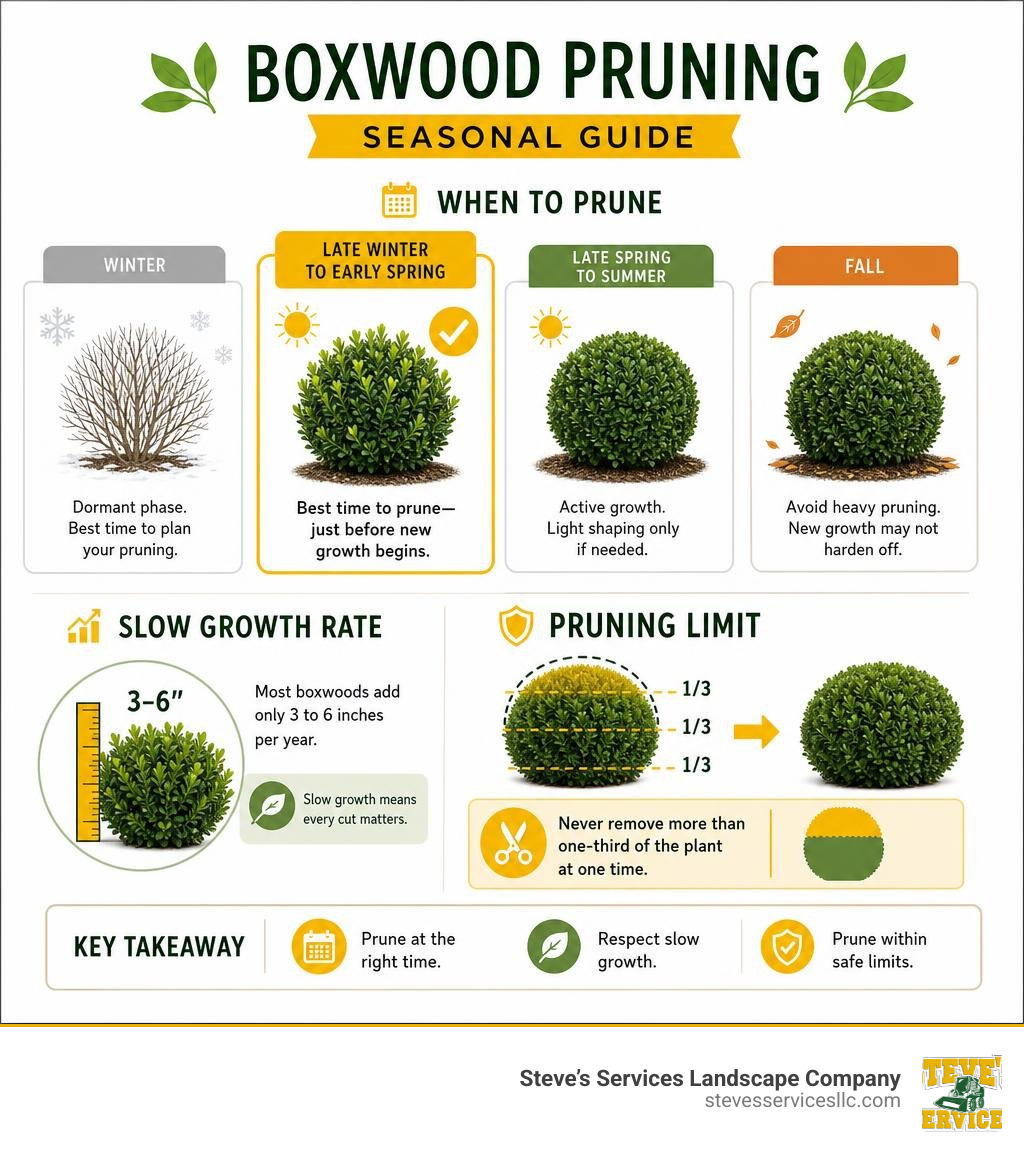
Boxwoods are slow growers — most varieties add only 3 to 6 inches per year — so every cut matters. Whether you’re maintaining a crisp formal hedge, shaping a topiary, or trying to rescue an overgrown shrub, the right timing and technique make all the difference.
They’re easy to prune. They’re also easy to neglect. And after a few missed seasons, what looked like a manageable task can turn into a full renovation project.
I’m Steve Sylva, owner of Steve’s Services Landscape Company in Malden, MA, with over 25 years of hands-on experience in landscape maintenance — including boxwood bush pruning for residential and commercial properties across the greater Boston area. In the sections below, I’ll walk you through everything you need to know to prune your boxwoods with confidence.
Boxwood bush pruning glossary:
The Essentials of Boxwood Bush Pruning

To maintain the architectural beauty of boxwoods throughout Middlesex and Essex Counties, understanding their growth biology is key. Unlike many other evergreen varieties, boxwood (Buxus) is exceptionally resilient when it comes to structural cuts. However, because they are slow-growing plants typically adding only a few inches of new growth each year, hasty mistakes can take seasons to grow out.
Our professional shrub pruning and landscaping services are designed to work in harmony with the natural growth cycle of these plants, ensuring they remain robust assets to your property.
Best Time of Year for Boxwood Bush Pruning
Timing is everything when it comes to boxwood bush pruning. In Massachusetts, our changing seasons dictate exactly when shears should touch your plants.
The absolute best window for significant structural pruning or hard renovation is late winter to early spring, before the first flush of new leafy growth emerges. Pruning during dormancy—typically around late March or early April in towns like Winchester, Melrose, and Saugus—allows the plant to funnel its stored spring energy directly into producing fresh, healthy shoots.
According to experts at How and When to Prune Boxwood for a Healthy, Perfectly Shaped Hedge Year-Round, light maintenance trimming and shaping can also be performed in late spring or early summer, once the initial spring growth has hardened off.
However, we must avoid any significant pruning during the late summer and autumn months. Trimming boxwoods in September or October stimulates tender new growth that will not have enough time to harden before the first harsh Massachusetts frosts. This leaves the plant highly susceptible to winter burn, frost damage, and structural dieback.
Safe Pruning Limits and Plant Health
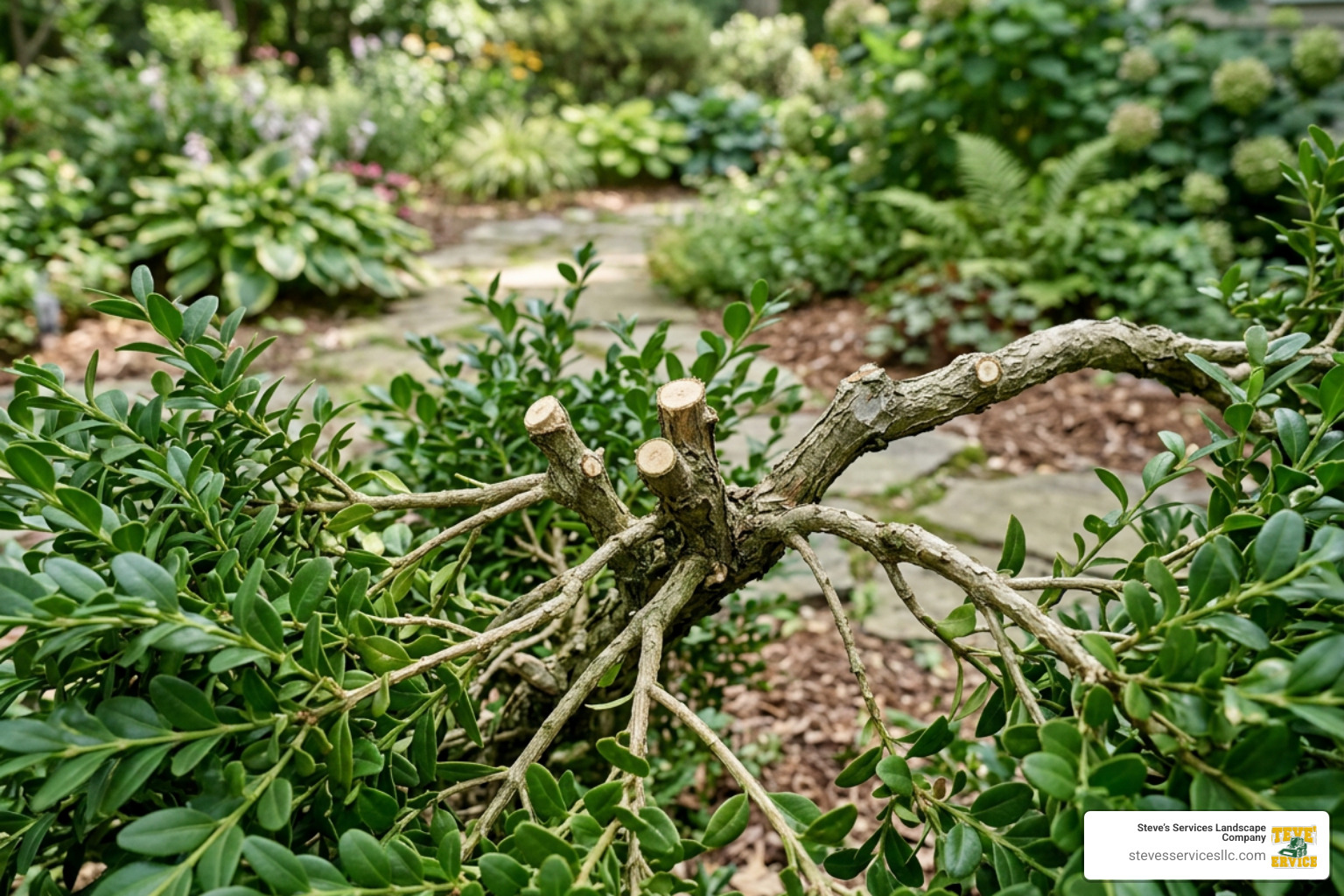
One of the most remarkable biological traits of boxwoods is their ability to regenerate from old, leafless wood. Many evergreen trees, such as pines, firs, and spruces, will never sprout new growth if cut back to bare branches. Boxwoods, however, possess latent buds buried deep within their woody stems. If cut back hard, these buds will eventually break dormancy and produce new leaves.
But just because you can prune them back to bare wood does not mean you should do so recklessly. To maintain plant health and minimize physiological stress, we follow the one-third rule. For standard maintenance and size reduction, we never remove more than one-third of the plant’s total volume in a single season.
Removing too much foliage at once deprives the root system of vital nutrients generated through photosynthesis, leaving the shrub vulnerable to opportunistic pests and environmental stress. If a boxwood requires drastic size reduction, we phase the work over two to three years to protect the integrity of the shrub.
For more detailed information on safe cutting limits, you can read How & When to Trim Boxwoods for Lush, Shapely Shrubs.
Pruning Techniques: Shearing, Thinning, and Shaping
Different landscape styles require different pruning techniques. Whether your property in Lynnfield or Woburn features crisp, geometric English parterres or soft, naturalistic woodland borders, selecting the correct method of boxwood bush pruning is vital for both aesthetics and long-term health.
Our team utilizes specialized bush and shrub trimming techniques to balance visual appeal with plant vitality.
Mastering the Art of Boxwood Bush Pruning
There are three primary methods we use to shape and maintain boxwood shrubs:
- Shearing: This involves trimming the outermost tips of the foliage to create a uniform, smooth surface. It is the primary technique used to maintain formal hedges, clean globes, and complex topiaries. Shearing is best done using manual hedge shears for maximum precision, though electric trimmers can be used on long, straight commercial hedges.
- Thinning: This is the selective removal of specific inner branches. Rather than cutting the outer surface, we reach inside the canopy to remove older, crowded, or crossing branches. Thinning is essential for maintaining natural-form boxwoods and preserving the health of sheared specimens.
- Cloud Pruning: An artistic technique growing in popularity, cloud pruning involves shaping individual boxwood shrubs into soft, rounded “puffs” or clouds. This creates an organic, undulating texture that mimics natural stone formations, offering a beautiful alternative to rigid geometric shapes.
For formal hedges and topiaries, shaping requires a steady hand and a strategic eye. One professional secret we utilize is shaping the hedge with a slight “batter”—meaning the base of the shrub is kept slightly wider than the top. This subtle taper ensures that sunlight can reach the lower branches, preventing the bottom of the hedge from thinning out and becoming bare.
To learn more about Buxus growth forms, explore the insights in How to Grow Common Box.
Thinning vs. Shearing for Disease Prevention
While shearing creates a beautiful, dense outer shell, relying only on shearing can actually harm your boxwoods over time. Continuous shearing causes the outer canopy to become extremely thick, completely blocking sunlight and fresh air from reaching the interior of the plant. This leads to a hollow “Wiffle ball” effect, where the inner branches lose all their leaves and die.
Furthermore, a dense, stagnant interior creates a humid microclimate—the perfect breeding ground for devastating fungal pathogens like boxwood blight (Calonectria pseudonaviculata).
To prevent this, we pair formal shearing with selective annual thinning. As part of our 10 smart strategies for hedge trimming services, we aim to remove approximately 10 percent of the interior branches each year.
By creating small, invisible pockets in the canopy, we allow sunlight to penetrate to the center of the shrub and improve airflow. This ensures the leaves dry quickly after a New England rainstorm, drastically reducing the risk of fungal infections.
Renovation Pruning and Pest Management
When boxwoods are neglected for several years, they can grow to block windows, spill over walkways, and lose their dense, vibrant form. Similarly, the arrival of invasive pests can quickly turn a beautiful landscape feature into an eyesore. In these situations, standard maintenance trimming isn’t enough; specialized renovation and pest mitigation are required.
Bringing Overgrown Boxwoods Back to Life
If your boxwoods have grown out of control on your property in Medford, Stoneham, or Reading, renovation pruning can restore them to their proper scale. Because boxwoods possess the rare ability to regenerate from old wood, we can perform hard pruning that would kill other evergreen species.
According to the guide on Cutting Back Box (Buxus), old, overgrown boxwood hedges can be cut back hard to within 15 to 30 cm (6 to 12 inches) of the ground. This drastic rejuvenation is best performed in late spring (May).
While the shrubs will look bare and sparse immediately after this treatment, they will push out a flush of fresh, vibrant green growth from dormant buds along the old wood. To minimize shock, we often recommend performing this hard renovation in stages over two seasons—pruning one side of the hedge hard the first year, and the remaining side the following year.
Identifying and Treating Box Tree Moth Damage
In recent years, landscapers and homeowners across Massachusetts have had to stay vigilant against a relatively new threat: the Box Tree Moth (Cydalima perspectalis). The larvae of this invasive pest feed voraciously on boxwood foliage and can completely defoliate a mature hedge in a matter of weeks. If left untreated, they will eventually chew through the bark, killing the entire plant.
Before we begin any boxwood bush pruning project, our technicians perform a thorough pest inspection. Signs of box tree moth infestation include:
- Fine, sticky webbing spun across the outer leaves and branches.
- Bright green and black striped caterpillars feeding on the foliage.
- Leaves that appear skeletal, chewed, or completely brown and crispy.
- A sudden accumulation of dry, brown leaf debris beneath the shrub.
If we detect box tree moth activity, we treat the plants with a targeted biological control agent, such as BTK (Bacillus thuringiensis kurstaki), before any pruning takes place. Pruning a pest-stressed plant without treating the underlying infestation can severely weaken or kill the shrub.
For more tips on identifying common boxwood pests, refer to Boxwood Shrubs: Planting, Growing, and Caring.
Professional Maintenance Costs and Aftercare
A successful hard prune is only half the battle; proper aftercare is what ensures your boxwoods recover quickly and push out healthy new growth. Because pruning is a wounding process, the plants require extra support immediately following the service.
First and foremost, deep watering is essential. We recommend watering the root zones of pruned boxwoods deeply once a week, especially during dry spells in June and July.
Additionally, applying a 2-to-3-inch layer of organic mulch (such as shredded pine bark) around the base of the plants helps retain soil moisture and keeps the shallow root systems cool. Be sure to keep the mulch a few inches away from the main stems to prevent rot.
When considering professional maintenance to keep your property looking its best, it is helpful to understand typical market rates. The table below outlines the average internet-based pricing for professional shrub and hedge maintenance.
Please note: These figures represent broad, internet-based national averages and do not represent specific quotes for services provided by Steve’s Services.
| Service Type | Internet-Based Average Cost Range | High-End / Complex Landscape Range |
|---|---|---|
| Individual Shrub Trimming (Per Shrub) | $15 – $45 | $50 – $150+ |
| Small Hedge Maintenance (Under 30 ft) | $150 – $350 | $450 – $1,200+ |
| Large/Overgrown Hedge Renovation | $400 – $900 | $1,200 – $3,500+ |
| Seasonal Landscape Maintenance Package | $300 – $800 | $1,000 – $4,500+ |
Investing in professional maintenance ensures that specialized tools are used, proper sanitation is maintained to prevent the spread of boxwood blight, and cuts are made at the precise anatomical locations to foster lush regrowth. If you are looking for local experts, check out our bush trimming service options.
Frequently Asked Questions about Boxwood Care and Commercial Services
Can boxwoods survive being cut back to bare wood?
Yes, healthy boxwood shrubs can survive and regenerate when cut back to bare wood. This is because they have latent, adventitious buds beneath their bark that are stimulated to grow when the outer foliage is removed.
However, this is a highly stressful process for the plant. It should only be done in late winter or early spring, and the plants must be supported with adequate watering and mulching afterward. For older, weaker plants, we recommend a staged approach over two years rather than cutting the entire plant back at once.
What are the best alternatives to boxwood shrubs?
If boxwood blight or box tree moths are highly active in your immediate neighborhood, or if you simply want a lower-maintenance alternative, there are several excellent evergreen substitutes that offer a similar aesthetic:
- Inkberry Holly (Ilex glabra): A native New England evergreen that can be sheared into neat globes and is highly resistant to pests.
- Japanese Holly (Ilex crenata): Features tiny, dark green leaves that closely mimic the texture of boxwood, making it perfect for formal low hedges.
- Dwarf Arborvitae: Excellent for structured, rounded shapes without the risk of blight.
How does commercial snow plowing protect winter landscaping?
For commercial properties in Malden, Burlington, and Saugus, winter snow management plays a huge role in protecting expensive landscaping assets. Heavy snow piled onto delicate boxwood hedges by standard plows can snap branches, splay the center of the shrubs, and cause permanent structural damage.
Additionally, heavy road salt runoff can scorch evergreen foliage and poison the shallow root systems of boxwoods. Our professional commercial snow management teams are trained to direct snow piles away from sensitive landscape beds and utilize plant-safe deicing methods to ensure your boxwoods emerge from the winter healthy and intact.
Conclusion
Boxwood bush pruning is a delicate blend of science and art. When executed with the proper timing, sharp tools, and correct techniques, it transforms these classic evergreens into stunning, long-lasting focal points for your property. Whether you are maintaining a pristine historic home in Winchester, a modern commercial property in Woburn, or a cozy backyard in Melrose, professional care is the best way to protect your landscaping investment.
At Steve’s Services Landscape Company, we take pride in delivering meticulous, reliable, and expert care to residential and commercial properties throughout our North Shore and Greater Boston service areas. Let our experienced crew take the guesswork and hard labor out of your seasonal maintenance.
Schedule professional landscape maintenance with Steve’s Services today, and let us keep your boxwoods looking spectacular year-round!
