Why Starter Fertilizer is the Secret to a Lush New Lawn
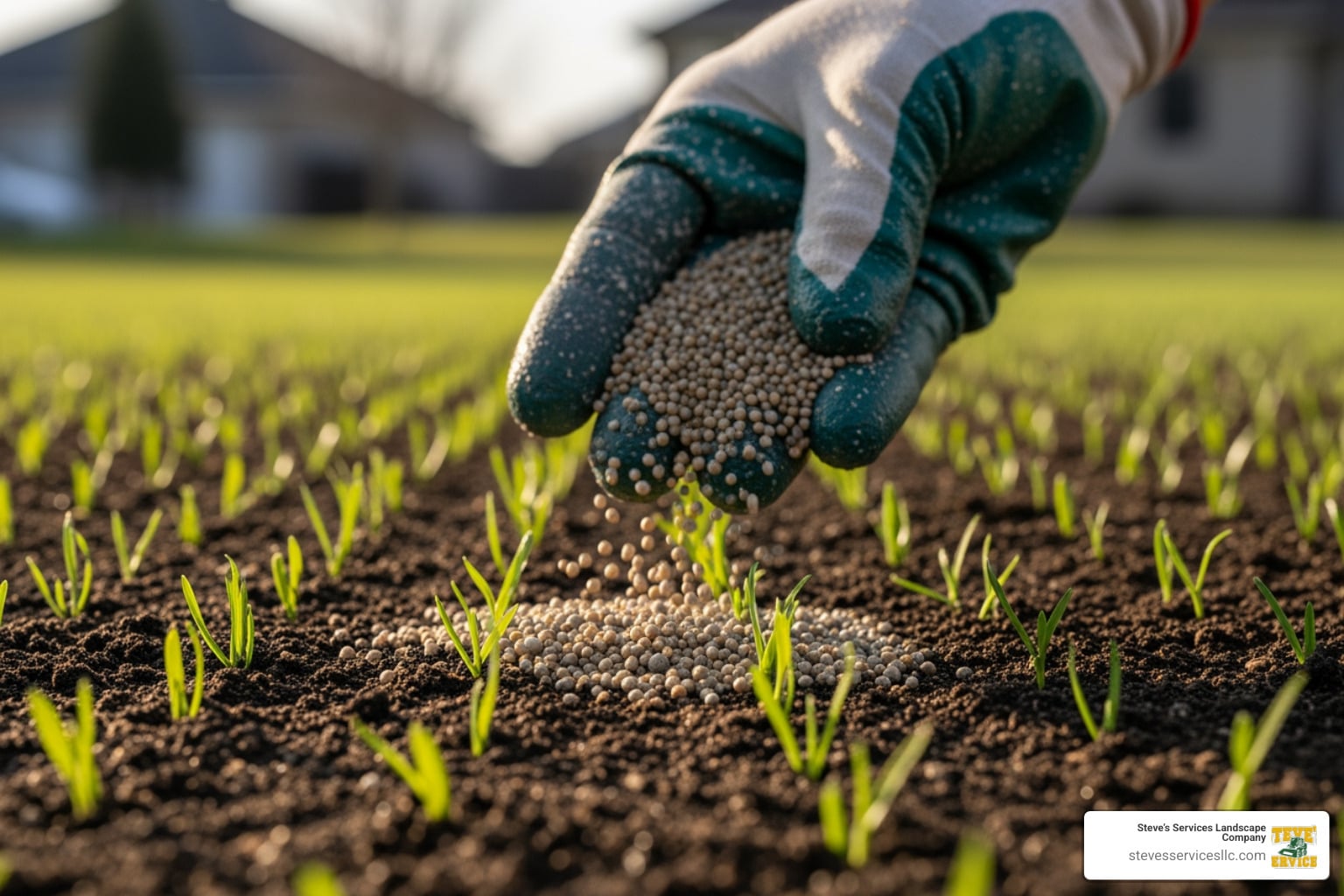
Starter fertilizer for grass seed is the key to changing bare soil into a thick, healthy lawn. Here’s how we approach it on new lawn projects across our Massachusetts service area:
Service snapshot:
- Best time we schedule applications: Early fall (mid-August to mid-October) or spring (mid-March to mid-May) when soil temperatures are consistently above 55°F.
- Application rate we target: Typically 0.5 to 1 lb of nitrogen per 1,000 square feet, adjusted by soil test.
- Application approach: We incorporate nutrients into the top 2-3 inches of soil before seeding whenever site conditions allow. If not, we apply immediately after spreading the seed and water it in thoroughly.
- Watering plan: We set expectations for consistent moisture until new grass reaches at least 2 inches tall.
- Expected results: Germination often occurs in 7-14 days, with new lawns growing up to 70% thicker and 35% quicker than unfed lawns.
Seeding without the right nutrition often underperforms. Starter fertilizer supplies the essential boost for vigorous early growth. Unlike regular fertilizers, it’s higher in phosphorus to drive strong root development. Research shows that using a starter fertilizer can result in a lawn that’s 70% thicker and grows 35% faster.
Proper timing and application are critical. Over-application can harm seedlings, and poorly timed applications are wasteful. With more than 25 years serving Massachusetts, Steve’s Services manages soil testing, product selection, precision application, and watering guidance so your new lawn establishes quickly and evenly.
Understanding Starter Fertilizer: The Foundation for a Healthy Lawn
Think of starter fertilizer for grass seed as a specialized diet for new seedlings, giving them the best possible start in life. It’s formulated to encourage rapid root development and strong initial growth, which is crucial whether you’re planting from seed or laying new sod. For more on general lawn feeding, explore our guide on Lawn Feed Fertilizer.
The N-P-K of New Growth: Decoding the Numbers
Fertilizer bags show an N-P-K ratio, representing Nitrogen (N), Phosphorus (P), and Potassium (K). Each plays a key role:
- Nitrogen (N): Promotes lush, green top growth and overall vigor.
- Phosphorus (P): The star of starter fertilizer for grass seed, essential for strong root development. It helps seedlings establish a deep, dense root system to absorb water and nutrients, which is critical in Massachusetts’s varied soil conditions.
- Potassium (K): Contributes to the overall health and toughness of the grass, improving its resistance to disease, drought, and extreme temperatures.
For instance, Penn State Extension notes that formulations like 10-10-10, 20-10-10, 16-8-8, 15-10-10, or 10-6-4 are all acceptable for starter fertilizers, as they all promote good early growth.
Starter vs. Regular Fertilizer: What’s the Key Difference?
-
Starter fertilizer
- Nutrient profile: Higher in phosphorus (P)
- Primary purpose: Accelerate root development and establishment of new grass from seed or sod
- Application timing: At or just before seeding or sodding
-
Regular lawn fertilizer
- Nutrient profile: Typically higher in nitrogen (N) for sustained green, leafy growth
- Primary purpose: Maintain color and vigor of established lawns
- Application timing: Applied periodically throughout the growing season
Why Starter Fertilizer is the Secret to a Lush New Lawn
Starter fertilizer for grass seed is central to turning bare soil into a thick, healthy lawn, and we build it into our new-lawn programs from day one.
At-a-glance: our approach
- Best timing: Early fall (mid-August to mid-October) or spring (mid-March to mid-May) once soil temperatures reach 55°F
- Application rate: Typically 0.5 to 1 lb of nitrogen per 1,000 square feet, tuned by soil test
- When we apply: Either before seeding (incorporated 2-3 inches into the soil) or immediately after seeding and watered in
- Watering plan: Maintain consistent surface moisture until seedlings reach about 2 inches
- Results: Germination in roughly 7-14 days, with turf establishing up to 70% thicker and 35% quicker than unfed lawns
Seeding alone rarely delivers top-tier results. Starter fertilizer provides the targeted phosphorus that young grass needs to build a robust root system quickly. That stronger root platform leads to faster coverage, fewer bare spots, and a lawn better able to resist weeds, drought, and disease.
Applying the right product at the right rate and time makes all the difference. Overdoing it can burn seedlings; mistimed applications waste time and money. As Steve Sylva, owner of Steve’s Services with 25+ years in landscape maintenance, our team follows calibrated, research-backed techniques—soil testing, spreader calibration, and moisture management—so your new lawn establishes fast and uniformly.
The Ultimate Guide to Applying Starter Fertilizer for Grass Seed
In our professional installations, even nutrient delivery is essential to protect young turf and drive healthy, uniform growth.
We select between two proven application types:
- Granular fertilizers: Common, spread with calibrated equipment. Effective but can be “hot” if misapplied; Michigan State University notes uneven distribution can increase burn risk.
- Liquid fertilizers: Favored by some experts (including Michigan State University) for highly consistent coverage and lower burn potential, applied via hose-end or dedicated sprayers.
For larger areas we use broadcast/rotary spreaders; for tight edges, drop spreaders may be used. After aeration and overseeding, which helps integrate seed and nutrients into the soil, applying starter fertilizer for grass seed is even more effective. Learn more about Aeration & Overseeding.
How to Apply Starter Fertilizer for Grass Seed Professionally
Our process is built around precise placement and watering, custom to site conditions:
- Before seeding (preferred): We incorporate starter fertilizer for grass seed into the top 2-3 inches (and up to 4-6 inches when feasible) so nutrients are available right where new roots form. This reduces runoff and improves availability.
- After seeding: If incorporation isn’t feasible, we apply immediately after spreading seed and water thoroughly to dissolve granules and move nutrients into the seed zone while minimizing burn risk.
- On sod: We apply starter fertilizer to the prepared soil before laying sod to encourage quick root knitting. We avoid placing granular fertilizer directly on new sod.
For every application, we calibrate equipment and sweep any granules from hard surfaces back onto turf to reduce runoff and staining.
What is the Recommended Application Rate?
Applying the correct amount is vital for young turf. When a soil test isn’t available, industry guidance targets 0.5 to 1 lb of nitrogen per 1,000 square feet. Product amounts depend on the bag’s first N-P-K number. For example, a 10-10-10 (10% nitrogen) delivers 1 lb of nitrogen with 10 lbs of product per 1,000 sq. ft.
We follow label instructions for each formulation and calibrate equipment before every job, as walking speed, terrain, and spreader condition affect output. Exceeding roughly 1.5 lb of nitrogen per 1,000 sq. ft. can burn new turf. For general cost context, see our Lawn Fertilization Cost guide—these are average costs based on internet data and not actual costs for Steve’s Services, and real project pricing varies widely by scope and size (from a few hundred dollars for small areas to several thousand for full renovations).
Perfect Timing: When to Apply Starter Fertilizer
When we plan starter fertilizer for grass seed, timing is everything. The prime windows are early fall (mid-August to mid-October) and early spring (mid-March to mid-May).
- Fall scheduling: Ideal for northern turf due to lower weed pressure and stable soil warmth. Warm soil speeds germination and rooting, while cooler air reduces stress. See our Fall Fertilizer guide.
- Spring scheduling: Also effective, especially following a thorough Spring Yard Clean Up. We account for rising temps and increased weed pressure.
Soil temperature is key. Most cool-season seeds germinate at or above 55°F, with optimal root growth between 55°F and 70°F. We avoid seeding or applying starter fertilizer when soil temps exceed about 75°F, which can hinder establishment.
Why a Soil Test Is Our First Step
Before we select a starter fertilizer for grass seed, we begin with a soil test. It reveals phosphorus, potassium, pH, and more—so we can tailor products and rates, prevent over-application, and optimize pH (most cool-season lawns prefer 6.2–7.0). If you’re seeking a local lab, consult your local Cooperative Extension Office.
The Ultimate Guide to Applying Starter Fertilizer for Grass Seed
Proper, professional application of starter fertilizer for grass seed protects seedlings and promotes even, healthy growth.
We deploy either granular or liquid formulations based on site needs. Granular products are common and applied with calibrated spreaders, but can be “hot” if misapplied. Liquid options, often applied with hose-end or dedicated sprayers, can offer more uniform coverage and lower burn risk. Using the right spreader type and consistent calibration is essential for even distribution. Applying after aeration and overseeding can improve seed-to-soil contact and nutrient integration.
How to Apply Starter Fertilizer for Grass Seed Professionally
Our field process emphasizes nutrient placement and moisture management:
- Before seeding (recommended): We work the fertilizer into the top 2-3 inches of soil, positioning nutrients in the root zone and reducing runoff. This is a core step in our new lawn installation workflow.
- After seeding: If incorporation isn’t feasible, we apply fertilizer immediately after seeding and water thoroughly to move nutrients into the soil and minimize any burn risk.
- On sod: We apply starter fertilizer to the prepared soil before laying sod to hasten rooting. We do not place granular fertilizer directly on new sod.
We ensure even coverage in Burlington, Medford, Stoneham, and beyond, sweeping stray granules off hard surfaces to prevent runoff.
What is the Recommended Application Rate?
We target rates that support seedlings without causing stress. In the absence of a soil test, a common guideline is 0.5 to 1 lb of nitrogen per 1,000 square feet. For a 10-10-10 fertilizer (10% N), delivering 1 lb of nitrogen requires 10 lbs of product per 1,000 sq. ft.
We always follow label directions and calibrate equipment for each site. Applying more than about 1.5 lb of nitrogen per 1,000 sq. ft. can damage new turf. For general pricing context, our Lawn Fertilization Cost page compiles average costs from internet data (not actual Steve’s Services pricing). Actual project costs vary widely with scope—from a few hundred dollars for small areas to several thousand for full renovations.
Aftercare, Safety, and Environmental Responsibility
After applying starter fertilizer for grass seed, we focus on watering consistency, site safety, and environmental best practices.
Watering Your New Lawn for Optimal Growth
Our team sets expectations for moisture management during establishment:
- Initial watering: After seeding and fertilizing, the area is watered to moisten the top few inches of soil without runoff.
- Keep soil moist: For the first few weeks, the surface is kept consistently moist until seedlings reach about 2 inches tall.
- Transitioning: Once grass is 2–2.5 inches tall, we advise reducing frequency and increasing duration to promote deeper roots. For more tips, see our New Sod Watering Guide.
Safety First: Children, Pets, and the Planet
- Children and pets: We recommend keeping them off treated areas until fertilizer is watered in and the lawn is dry. Organic starter options are available and safe for kids, pets, and new roots.
- Environmental impact: We avoid over-application—especially phosphorus—use soil testing to right-size nutrients, sweep granules from hardscapes back onto turf, and do not apply before heavy rain. We follow local regulations, including those for Caring for New Sod.
Frequently Asked Questions
We often get asked a lot of great questions about starter fertilizer for grass seed. Here are some of the most common ones we hear from homeowners in places like Everett, Malden, and Woburn:
Can starter fertilizer be used on established lawns?
Generally, no. Starter fertilizer for grass seed is specifically formulated for the high phosphorus needs of new grass seedlings and newly laid sod. Established lawns have different nutritional requirements. Once your lawn is mature, it’s typically better to use a well-balanced fertilizer designed for established grass, which will usually have a lower phosphorus content (unless a soil test indicates a deficiency). Using a starter fertilizer on an established lawn might not provide all the nutrients needed for continued growth and health, and could even contribute to excess phosphorus in the environment if not required. For information on feeding a new lawn once it’s established, check out our guide on Lawn Feed for New Lawn.
Does starter fertilizer work for all grass types?
Yes, absolutely! Whether you’re planting cool-season grasses like fescues, bluegrass, or rye (which are very popular here in Massachusetts), or warm-season turfgrasses, starter fertilizer for grass seed provides universal benefits. The fundamental need for strong root development in new seedlings is common across all grass types. The phosphorus content will encourage deep root growth, and the nitrogen and potassium will support overall vigor, regardless of the specific variety of grass you’re establishing.
How soon will I see results after using a starter fertilizer for grass seed?
You’ll be delighted by the speed! With proper application of starter fertilizer for grass seed and consistent watering, you can expect to see grass seed germination in as little as 7 to 14 days, though some varieties or conditions might take up to 30 days. The benefits go beyond just speed. Studies have shown that new grass treated with starter fertilizer can grow up to 70% thicker and 35% quicker compared to unfed grass. This means you’ll have a denser, more robust lawn much faster, with fewer bare spots and a healthier appearance from the get-go. Various factors, including grass type, soil temperature, and consistent moisture, will influence the exact timing of results.
Ensure Seeding Success with Professional Lawn Services
Planting a new lawn is an investment in your home’s beauty and value. While using starter fertilizer for grass seed is a key step, proper application is crucial for achieving a lush, green lawn instead of a patchy disappointment.
We’ve seen how professional fertilization transforms lawns across Massachusetts, from Reading to Revere. The benefits are clear: faster establishment, thicker turf, and a more resilient lawn that stands up to foot traffic, pests, and our challenging New England weather.
At Steve’s Services, our skilled team offers personalized solutions based on your soil and grass type. We take the guesswork out of lawn care, ensuring every step, including the precise application of starter fertilizer for grass seed, is handled with expertise.
Ready to transform your outdoor space into the lawn of your dreams? Contact us today to learn more about our New Lawn Installation Services and let us help you achieve a vibrant, healthy lawn that will be the envy of your neighborhood.