
Fall Fertilizer: 7 Powerful Reasons for Greener Lawns 2025
Why Fall Fertilizer is Your Lawn’s Best Friend
Fall fertilizer is the secret weapon for achieving that picture-perfect lawn your neighbors will envy come spring. While most homeowners focus on spring feeding, smart property managers know that autumn applications deliver superior results.
Quick Fall Fertilizer Facts:
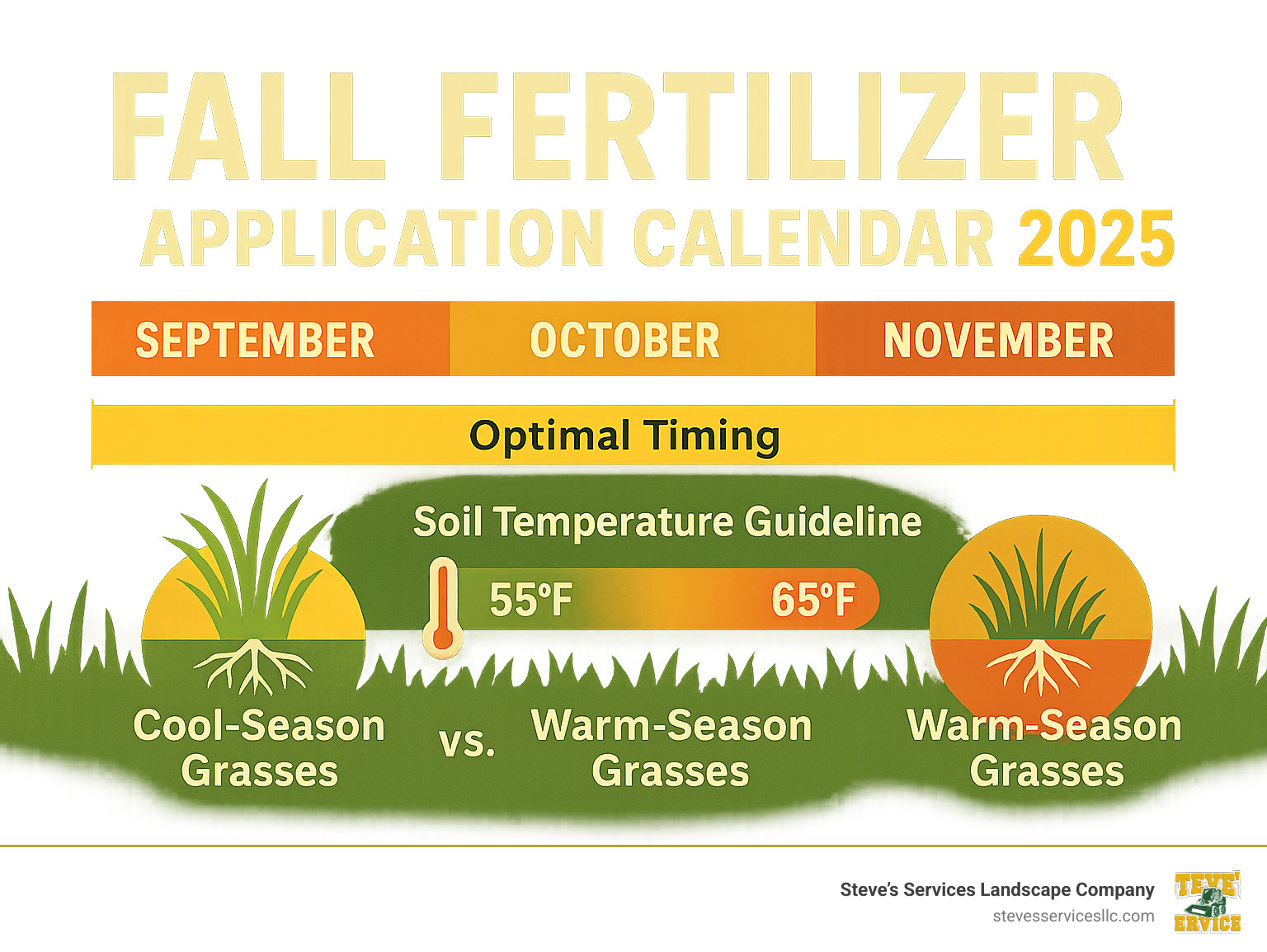
- Best timing: When soil temperatures hit 55-65°F (typically mid-October in Massachusetts)
- Ideal formula: High-nitrogen blends like 24-4-12 for cool-season grasses
- Key benefit: Promotes deep root growth and carbohydrate storage for winter survival
- Spring payoff: Lawns green up 2-6 weeks earlier than unfertilized turf
- Application rate: 1 pound of nitrogen per 1,000 square feet
Think about the most gorgeous lawn in your neighborhood – chances are, the owner has found this simple trick. Fall is the most important time to fertilize your lawn, not spring. Here’s why it works so well:
When temperatures drop, your grass shifts energy from growing tall blades to building strong roots and storing nutrients. This makes fall the perfect window for feeding. Your turf uses these stored nutrients to survive winter and explode with green growth when warm weather returns.
The research backs this up. Lawns receiving proper fall fertilization show dramatically improved spring performance, better drought resistance, and thicker overall growth compared to spring-only feeding programs.
I’m Steve Sylva, owner of Steve’s Services Landscape Company, and I’ve been helping Massachusetts homeowners achieve healthier lawns through strategic fall fertilizer programs for over 25 years.
Find more about fall fertilizer:
Why Fall Beats Spring for Feeding Your Turf
Here’s something that might surprise you: fall fertilizer applications work so much better than spring feeding that it’s almost unfair to compare them. After working with Massachusetts lawns for over 25 years, I can tell you this timing difference is like the difference between planting a seed in perfect soil versus throwing it on concrete.
When autumn arrives and soil temperatures settle into that magical 55-65°F range, something fascinating happens beneath your lawn. Cool-season grasses like Kentucky bluegrass, perennial ryegrass, and tall fescue essentially flip a switch. They stop putting all their energy into growing taller and start building what really matters – deeper, stronger roots.
This biological shift is why fall fertilizer works so brilliantly. Your grass isn’t distracted by rapid top growth anymore. Instead, it can focus on absorbing and storing nutrients efficiently. The cooler soils make nitrogen uptake incredibly efficient. Your grass can actually use what you’re giving it, rather than watching half of it wash away or evaporate in summer heat.
University research backs up what we see in the field every spring. Lawns that receive proper fall fertilizer applications green up 2 to 6 weeks earlier than their unfed neighbors. That’s a huge advantage when you want your property looking its best as soon as possible.
The two-application strategy delivers the best results. We typically recommend one feeding in early fall around September, followed by another in late fall through early November. This approach provides sustained nutrition throughout the entire root-building period.
For more detailed scientific research on nutrient timing, university extension services offer excellent resources on optimal fertilization schedules.
How fall fertilizer turbocharges root growth
When you apply fall fertilizer, you’re essentially giving your grass a secret weapon for next year’s growing season. The real magic happens underground, where most homeowners never think to look.
During fall, grass plants naturally change their priorities. Instead of channeling energy into leaf growth, they shift their focus to root development and carbohydrate storage. This change in the shoot-to-root ratio is like switching from building the house’s exterior to reinforcing the foundation.
Those stored carbohydrates work like a battery pack. They power early spring growth before the soil warms enough for new nutrient uptake. The sugar-rich plant cells also resist freezing damage much better than cells filled with plain water – think of how antifreeze protects your car’s engine.
This improved winter survival is crucial for Massachusetts lawns. Our harsh winters can be brutal on grass that isn’t properly prepared. Fall fertilizer helps your turf build the reserves it needs to weather whatever winter throws at it.
The deeper root development pays dividends all year long. Those strong, deep roots can access moisture from lower soil layers during summer dry spells. The result is a lawn that’s more drought-resistant, recovers faster from stress, and maintains better color throughout the growing season.
Selecting Your Fall Fertilizer Formula (NPK Done Right)
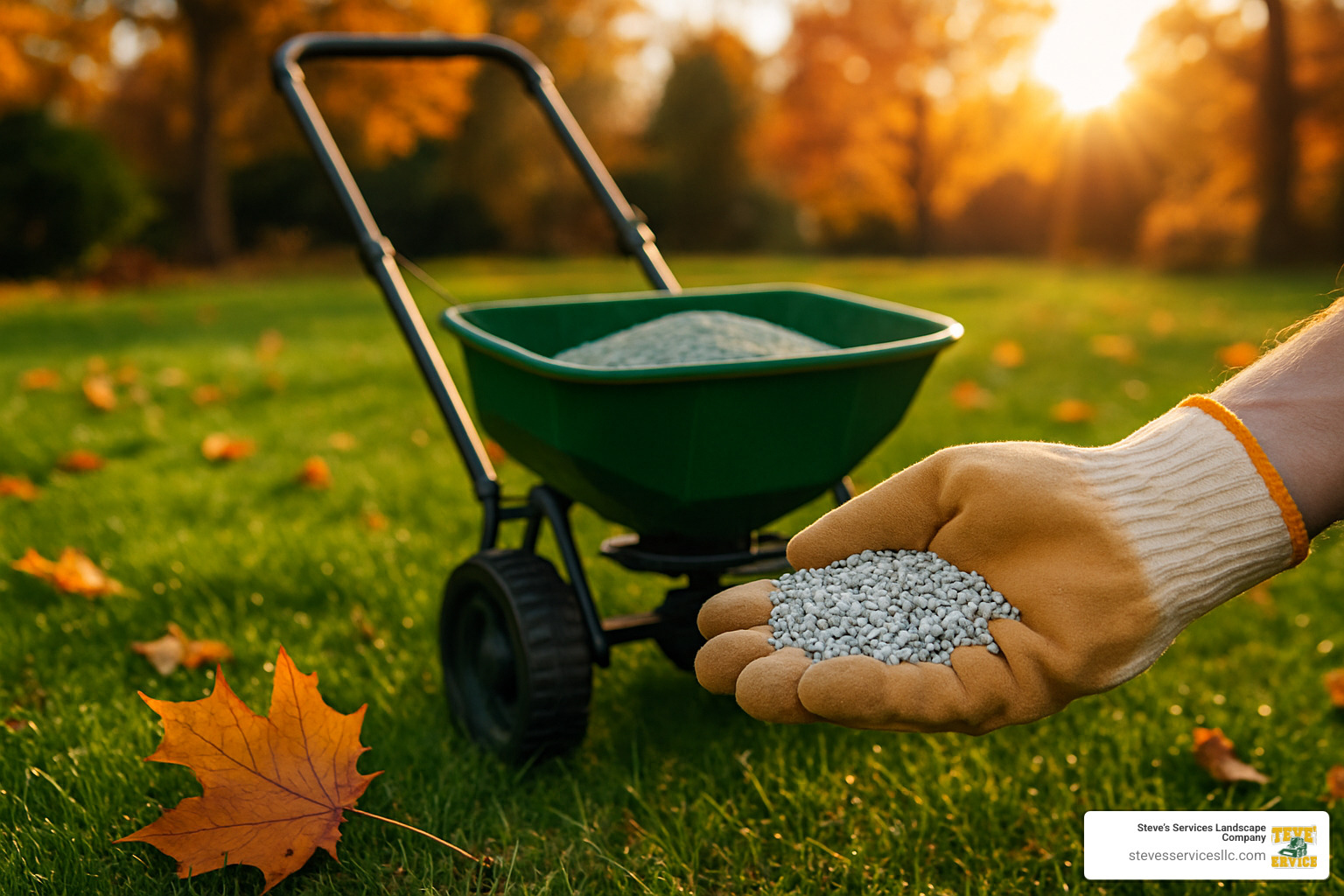
Walking down the fertilizer aisle at your local garden center can feel overwhelming. All those numbers, fancy terms, and colorful bags promising miracle results – it’s enough to make anyone’s head spin. But here’s the good news: choosing the right fall fertilizer is actually pretty straightforward once you know what to look for.
The magic formula for Massachusetts lawns is a 24-4-12 NPK ratio. That high nitrogen number (24) is exactly what your cool-season grass craves in fall. Think of nitrogen as the fuel that powers root growth and helps your lawn store energy for winter. The lower phosphorus (4) prevents environmental runoff, while the potassium (12) acts like a winter coat, helping your grass survive harsh New England weather.
Here’s what makes this formula perfect for our climate: cool-season grasses like Kentucky bluegrass and perennial ryegrass stay active well into fall. They’re hungry for nitrogen during this critical root-building period, unlike warm-season grasses that start shutting down when temperatures drop.
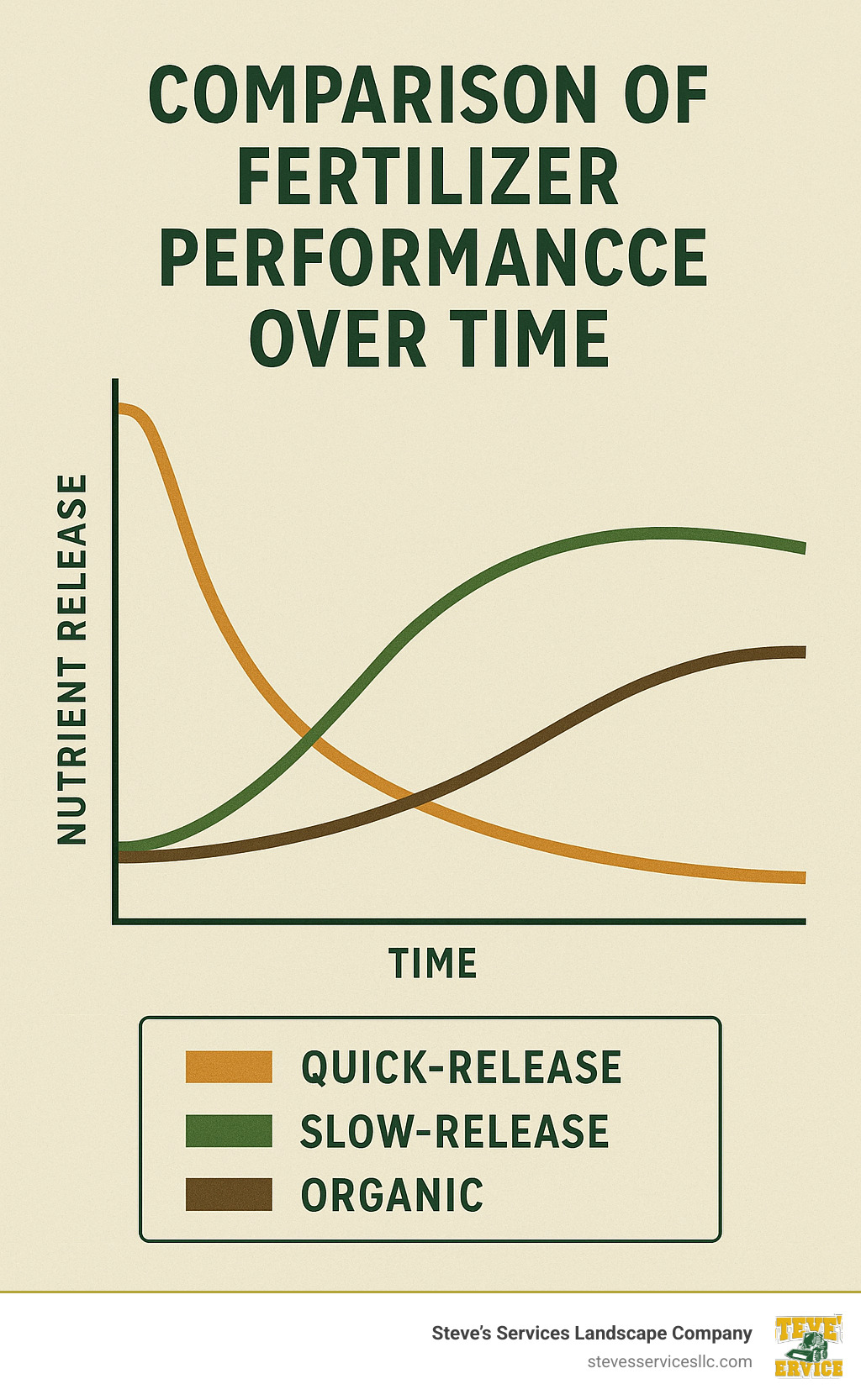
Slow-release fertilizers are worth the extra investment. They feed your lawn steadily over 6-8 weeks instead of dumping all the nutrients at once. This means less risk of burning your grass and better environmental protection. Look for products with polymer-coated urea or IBDU (isobutylidene diurea) – these fancy names just mean the nitrogen releases gradually.
Don’t overlook the bonus ingredients. Iron gives your lawn that deep green color that makes neighbors jealous, while sulfur helps your grass absorb nutrients more efficiently. Many premium fall fertilizers include these micronutrients, and they’re worth seeking out.
Before you buy anything, though, consider getting a soil test. Your soil might be loaded with phosphorus already, or your pH could be off. We recommend testing every 2-3 years – it’s like getting a check-up for your lawn.
Reading labels when buying fall fertilizer
Those three numbers on every fertilizer bag aren’t trying to confuse you – they’re actually your best friends when shopping for fall fertilizer. The NPK ratio tells you exactly what percentage of each major nutrient you’re getting by weight.
Let’s break down a typical 24-4-12 fertilizer. In a 50-pound bag, you’re getting 12 pounds of actual nitrogen (50 x 0.24), 2 pounds of phosphorus (50 x 0.04), and 6 pounds of potassium (50 x 0.12). The rest is carrier material and other additives that help deliver the nutrients to your grass.
The coverage calculation is simple math once you know the trick. If you want to apply 1 pound of nitrogen per 1,000 square feet (the standard rate), that 12 pounds of nitrogen will cover 12,000 square feet. For a typical 5,000 square foot lawn, you’d use just under half the bag.
Pay attention to the guaranteed analysis section – that’s where you’ll find the good stuff. Look for iron (Fe) for deeper green color, sulfur (S) for better nutrient uptake, and sometimes even beneficial microorganisms that improve soil health.
For more detailed guidance on choosing the right fertilizer for your specific lawn needs, check out our Lawn Feed Fertilizer page.
When to schedule your fall fertilizer visit
Forget what the calendar says – your fall fertilizer timing should be based on what’s happening in your soil. We’ve learned over 25 years of service that soil temperature is the most reliable guide for optimal application timing.
The sweet spot is when soil temperatures consistently stay between 55-65°F. In Massachusetts, this usually happens in mid-October, but Mother Nature doesn’t always follow our schedule. Some years it’s early October, others it’s pushing into November. A simple soil thermometer takes the guesswork out of timing.
Your first frost date provides another helpful reference point. Apply fall fertilizer about 2-3 weeks before you expect that first frost. This gives your grass enough time to absorb and use the nutrients before growth really slows down. In our service area, first frost typically arrives between mid-October and early November.
Professional calibration makes a huge difference in results. We see too many lawns with striped patterns from uneven spreader application or burnt spots from over-application. Our team uses calibrated equipment to ensure every square foot gets exactly the right amount of nutrition.
Professional Application & Complementary Fall Services

When it comes to fall fertilizer, the difference between professional and DIY application is like comparing a surgeon’s precision to a paint roller. Both get the job done, but the results speak for themselves.
Professional application starts with proper mowing before we even touch the fertilizer. We cut your grass at the highest recommended setting for your specific grass type, leaving those clippings right where they fall. Those clippings aren’t lawn litter – they’re free fertilizer that breaks down and feeds your soil naturally.
The magic happens with calibrated spreaders. Our equipment ensures every square foot gets exactly the right amount of nutrients. No missed spots, no burned stripes, just even coverage that creates uniformly healthy turf. After 25 years in this business, I’ve seen too many lawns damaged by uneven application to trust this step to chance.
Light irrigation after application helps activate those granular fertilizers, but timing matters enormously. Too much water too soon washes nutrients away before your grass can use them. We monitor weather forecasts closely and adjust our application schedule accordingly.
The real beauty of professional service lies in how we integrate fall fertilizer with other essential treatments. Overseeding and fertilization work together like peanut butter and jelly – each makes the other better. Pre-emergent weed control prevents spring weeds while your newly fed grass establishes dominance. Core aeration creates direct pathways for nutrients to reach root zones.
Average service costs for professional fall fertilization typically range from $75 to $225 per 1,000 square feet, with specialized high-end treatments reaching up to $650 per 1,000 square feet. These prices reflect publicly available industry data and don’t represent actual pricing from Steve’s Services Landscape Company.
For comprehensive information about our integrated approach to lawn care, visit our Landscape Maintenance Services page.
Pairing fall fertilizer with overseeding for thick turf
Here’s where the magic really happens. Combining fall fertilizer with overseeding creates what we call the “double boost effect” – new grass gets the nutrition it needs to establish quickly, while existing turf builds stronger roots for winter survival.
The seed-to-fertilizer ratio isn’t just guesswork. Research shows that using four parts fertilizer to one part grass seed by weight delivers optimal results. This ratio provides enough nutrition for both your existing grass and those tiny new seedlings without overwhelming anyone in the process.
Cultivar selection plays a bigger role than most homeowners realize. Modern grass varieties are often more nutrient-efficient than older types, meaning they can thrive with less fertilizer input. We work closely with property managers to choose varieties that match their specific conditions and maintenance goals.
The germination window for cool-season grasses runs from late August through mid-September here in Massachusetts. This timing aligns perfectly with our early fall fertilization schedule, creating ideal conditions for both seed establishment and root development in your existing turf.
Integrating weed control into a fall fertilizer program
Fall presents a golden opportunity to knock out broadleaf weeds while feeding your lawn. Many perennial troublemakers like dandelions and clover are actively storing energy in their roots during fall, making them sitting ducks for targeted treatments.
Timing is everything with fall weed control. Broadleaf weeds are most vulnerable in September and October when they’re busy moving nutrients down to their root systems for winter storage. Herbicide applications during this period can be devastatingly effective at controlling established weeds.
However, labeled weed-and-feed products require careful consideration, especially if you’re overseeding. Pre-emergent herbicides can prevent grass seed germination just as effectively as they stop weeds. Post-emergent herbicides should be delayed 6-8 weeks after seeding to avoid damaging young grass plants.
We often recommend a two-step approach: apply fall fertilizer first, then follow with targeted weed control treatments after new grass is well-established. This strategy maximizes both fertilizer effectiveness and weed suppression while protecting your desirable grass.
Environmental Stewardship & Product Choices

Being a good neighbor to our Massachusetts waterways isn’t just the right thing to do – it’s essential for keeping our communities beautiful for generations to come. When we apply fall fertilizer responsibly, we protect the Charles River, Mystic River, and countless local streams that make our region special.
Here’s something we’ve learned after 25 years in this business: the best fertilizer application is one that stays exactly where you put it. That’s why we take extra care with every step of the process, from choosing the right products to timing applications perfectly.
Runoff prevention starts before we even open a bag of fertilizer. Our team inspects every property for slopes, drainage patterns, and potential trouble spots. We never apply fertilizer to driveways, sidewalks, or streets – and if any granules accidentally land there, we sweep them back onto the lawn immediately.
Massachusetts has been getting stricter about phosphorus restrictions, and honestly, that’s a good thing. Many communities now limit or ban phosphorus in lawn fertilizers unless a soil test proves you actually need it. We stay on top of these local rules and adjust our recommendations accordingly.
Buffer zones near water features are non-negotiable. We maintain appropriate distances from streams, ponds, and wetlands when applying any fertilizer. Think of these buffer strips as nature’s insurance policy – they filter runoff and keep nutrients where they belong: feeding your grass, not algae in the local pond.
Our spreader calibration might seem like technical overkill, but it’s actually environmental protection in action. When we apply exactly the right amount of fertilizer, nothing gets wasted. Over-application doesn’t just burn your lawn – it increases the risk of nutrients washing away during the next storm.
For more detailed information about scientific research on nutrient pollution, researchers have documented how proper fertilizer practices protect water quality.
Organic, synthetic, or hybrid fall fertilizer?
The great fall fertilizer debate doesn’t have to be complicated. Each type has its place, and the best choice depends on what you’re trying to achieve with your lawn.
Organic fertilizers like biosolids work like a slow-cooked meal for your grass. They release nutrients gradually, feed beneficial soil microbes, and rarely cause burning. Milorganite is probably the most famous example – it’s been around for decades and has a loyal following. The downside? Organic options typically cost more per pound of nitrogen and won’t give you that instant green-up some people want.
Synthetic fertilizers are more like fast food – quick, predictable, and convenient. Products with coated urea provide excellent slow-release characteristics while giving you precise control over nutrients. They’re usually more budget-friendly for larger areas. The catch is they require more careful application to avoid environmental issues.
Hybrid approaches try to capture the best of both worlds. Some products blend organic base materials with synthetic additives to provide both immediate and long-term nutrition. Compost-based blends with synthetic components can improve soil health while delivering reliable results.
For most Massachusetts lawns, we’ve found that high-quality slow-release synthetic fertilizers or premium organic products work best for fall fertilizer applications. The choice often comes down to your budget and personal preferences about organic versus synthetic materials.
Frequently Asked Questions about Fall Fertilizer
Why is fall fertilizer often high in nitrogen?
Fall fertilizer packs a nitrogen punch for good reason – it’s exactly what your grass needs during autumn’s underground growth phase. While spring fertilizers focus on making your lawn look green and lush above ground, fall applications are all about building the foundation for next year’s success.
Think of nitrogen as your lawn’s energy drink during fall. It powers the chlorophyll production that keeps photosynthesis humming, even as temperatures drop. This ongoing photosynthesis is crucial because your grass is working overtime to store carbohydrates in its roots – like a squirrel gathering nuts for winter.
The high nitrogen content also supports something most homeowners never see: continued root growth long after the top of your grass stops growing. Roots stay active at much cooler temperatures than shoots, so they can keep using that nitrogen to grow deeper and stronger even when your mower is stored away for the season.
This extended root development period is what separates okay lawns from exceptional ones. Those deep, nitrogen-fed roots are what will give you that early spring green-up that makes your neighbors wonder what your secret is.
How many pounds of product does my 5,000 ft² lawn need?
For your 5,000 square foot lawn, the math is straightforward once you understand how fall fertilizer labels work. You’re aiming for 1 pound of actual nitrogen per 1,000 square feet, which means your lawn needs 5 pounds of nitrogen total.
Here’s where it gets interesting – you need to look at the first number on that fertilizer bag. If you’re using a 24-4-12 fertilizer (which is 24% nitrogen), you’ll need about 21 pounds of product to get those 5 pounds of nitrogen. A typical 50-pound bag would actually cover about 12,000 square feet at this rate, so you’d use less than half the bag.
For slow-release fertilizers, you might bump that up to 1.5 or even 2 pounds of nitrogen per 1,000 square feet. This would mean using 31-42 pounds of that same 24% nitrogen product for your 5,000 square foot lawn.
The product label will give you coverage information, but now you understand the math behind it. This knowledge helps you compare products and understand exactly what you’re paying for – the actual nutrients, not just the weight of the bag.
Should I water immediately after a fall fertilizer treatment?
The watering question trips up a lot of homeowners, but the answer depends on what Mother Nature has planned and what type of fall fertilizer you’ve applied. The good news is that fall applications are much more forgiving than summer treatments.
For granular fertilizers, a light watering (about 0.25 inches) helps dissolve those granules and move nutrients down to the root zone where they’re needed. But here’s the key – light is the operative word. Heavy watering can wash away your investment, especially if your lawn slopes or has compacted soil.
Morning dew often provides enough moisture to activate many fertilizer products, which makes fall applications pretty convenient. If rain is forecast within a day or two, you can usually skip the sprinkler entirely. Fall’s naturally higher humidity and cooler temperatures work in your favor.
The mistake to avoid is letting granular fertilizer sit completely dry for weeks, or flooding the area like you’re trying to fill a swimming pool. Think of it like making tea – you need enough water to dissolve the nutrients, but not so much that you dilute everything away.
Liquid fertilizers are already dissolved, so they don’t need additional watering. Just let the grass dry before anyone walks on it to avoid tracking and ensure proper absorption.
Conclusion
Your lawn’s future starts with the decisions you make this fall. Fall fertilizer isn’t just another item on your autumn to-do list – it’s the foundation for a healthier, more beautiful lawn that will make your property stand out in the neighborhood.
Everything we’ve covered in this guide points to one simple truth: timing matters more than you might think. When those soil temperatures hit that sweet spot of 55-65°F in mid-October, your grass is primed and ready to make the most of every nutrient you provide. Miss this window, and you’re essentially asking your lawn to survive winter on an empty stomach.
The science backs up what we see in the field every day. Lawns that receive proper fall fertilizer applications consistently outperform those that don’t. They green up weeks earlier in spring, develop deeper roots that resist drought, and maintain that thick, lush appearance that makes property managers proud.
Professional application makes all the difference between good results and great ones. Our team has spent over 25 years perfecting the timing, formula selection, and application techniques that deliver consistent results across Massachusetts. We understand that every lawn is different, and we tailor our approach to match your specific grass type, soil conditions, and goals.
The environmental responsibility aspect isn’t just about following regulations – it’s about protecting the communities we serve. From proper spreader calibration to maintaining buffer zones near waterways, we take pride in delivering beautiful lawns while protecting our local environment.
At Steve’s Services Landscape Company, we’ve seen how the right fall fertilizer program transforms struggling lawns into the kind of turf that adds real value to your property. Our commitment goes beyond just spreading fertilizer – we’re invested in your lawn’s long-term health and your satisfaction with the results.
Ready to give your lawn the autumn nutrition it needs to thrive? The window for optimal fall fertilizer application is shorter than you might think, and the results speak for themselves. Contact us today to schedule your application and find why proper fall care makes all the difference when spring arrives.
For more information about our comprehensive approach to year-round lawn health, visit our Regular Landscaping Maintenance page to learn how we can help lift your property’s exterior throughout every season.
Average costs mentioned in this article are based on publicly available data and do not represent actual pricing from Steve’s Services Landscape Company.
