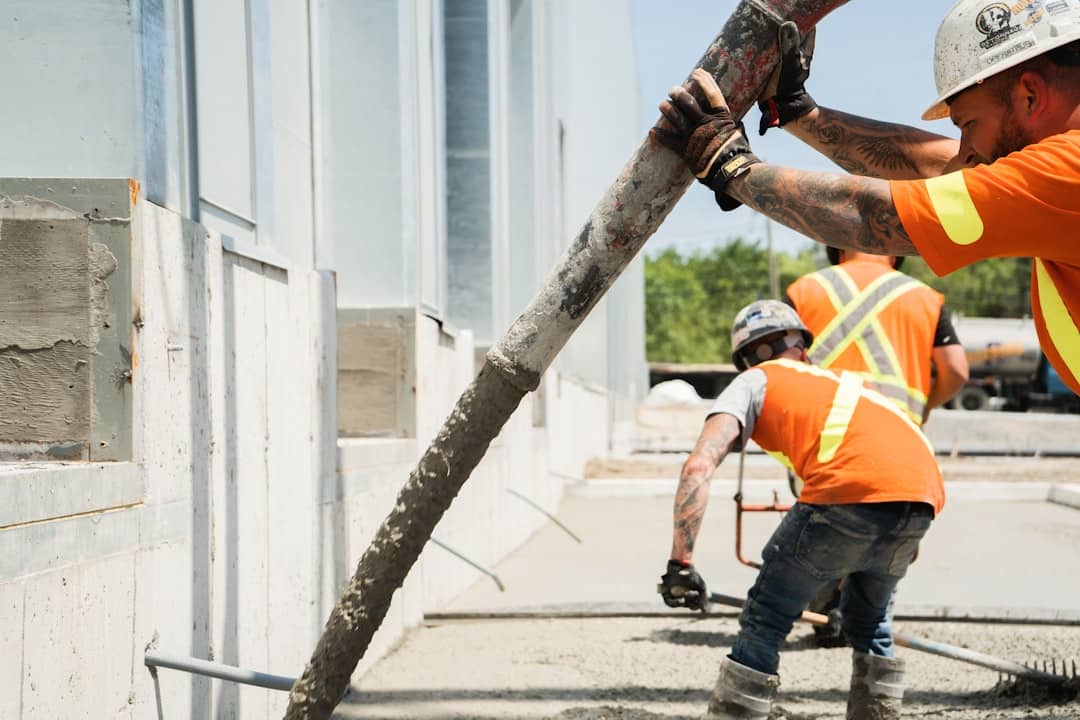
What Are Concrete General Contractors – and Do You Need One?
Concrete general contractors are construction professionals who manage the full scope of a concrete project – from planning and estimating to pouring, finishing, and final inspection. Unlike specialty subcontractors who handle just one piece of the puzzle, a concrete GC coordinates the entire build.
Here’s a quick breakdown of what they do and when you need one:
| What You Need | Best Fit |
|---|---|
| A small driveway or patio | Concrete subcontractor or specialty contractor |
| A commercial foundation or structural slab | Concrete general contractor |
| A large infrastructure or industrial project | Concrete GC with self-perform crews |
| Historic renovation or complex site work | Experienced concrete GC with specialty project history |
| Full project management from start to finish | Concrete general contractor |
Major concrete work can cover a wide range of project types, from parking structures and medical facilities to roadwork, retaining systems, and industrial slabs. Whether the job is a commercial foundation, a structural slab, or a complex site package, the right concrete GC can make or break the project.
I’m Steve Sylva, owner of Steve’s Services, and after 25+ years in the landscaping and hardscaping industry, I’ve worked alongside concrete general contractors on everything from site prep to finished flatwork. In this guide, I’ll walk you through everything you need to know to find the right one without the headache.
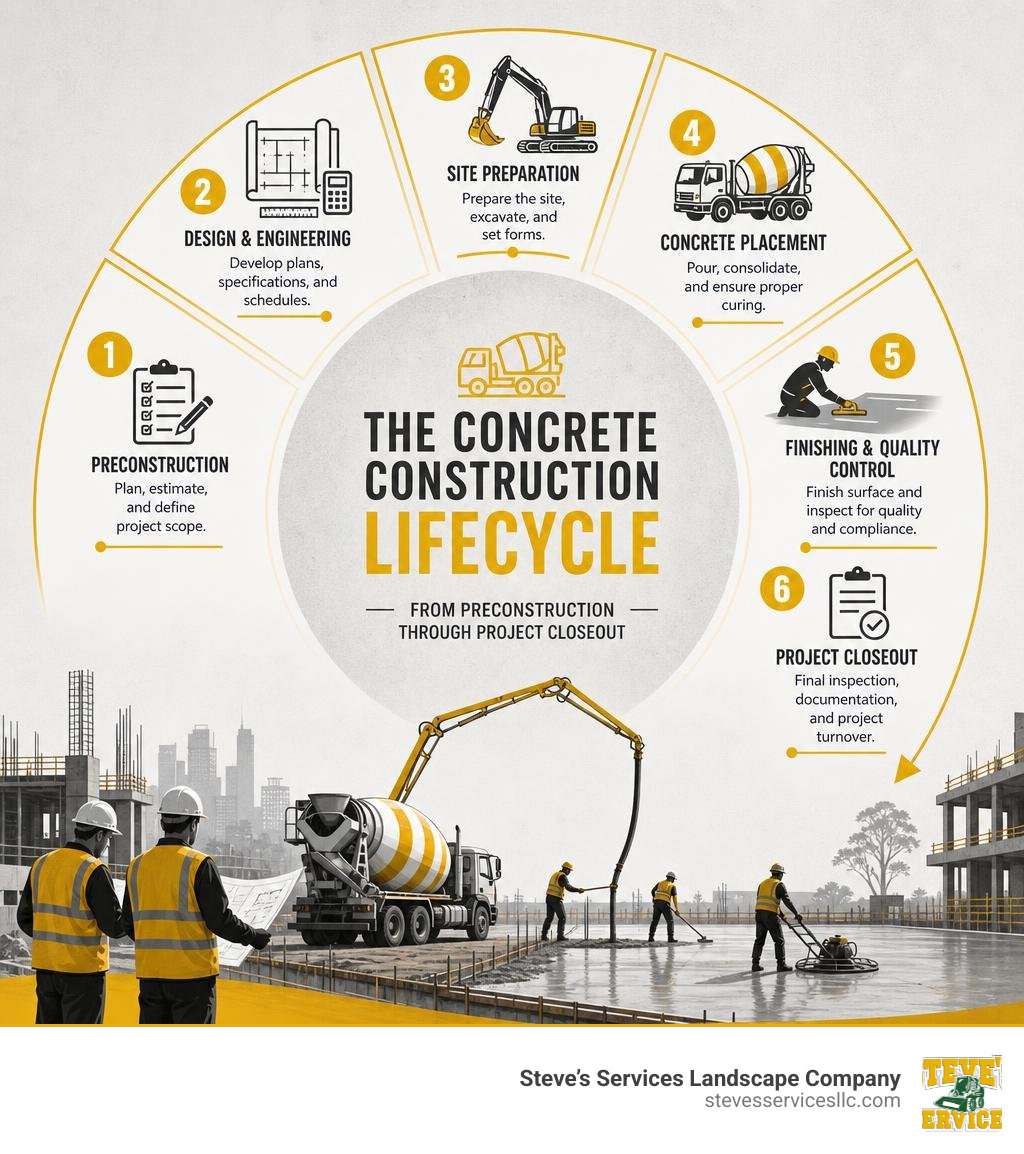
Concrete general contractors terms at a glance:
Why You Need Specialized Concrete General Contractors for Major Projects

When you are dealing with large-scale projects, concrete is not just a material; it is the structural backbone of your entire investment. Major builds require a level of engineering oversight, logistical planning, and heavy civil construction expertise that goes far beyond simply mixing and pouring. This is where specialized concrete general contractors come in.
For projects involving complex structural framing, heavy foundations, or extensive site preparation, you need a team capable of managing the entire project delivery lifecycle. From the initial groundbreaking to the final curing phase, a dedicated concrete GC ensures that the structural elements integrate seamlessly with other trades. If you are starting from scratch, working with experienced excavation and concrete contractors is essential for ensuring that the earthwork, drainage, and structural footings are perfectly coordinated.
How Concrete General Contractors Differ from Subcontractors
It is common to confuse a concrete general contractor with a concrete subcontractor, but their roles on a jobsite are vastly different.
A concrete subcontractor is typically hired to execute a specific, isolated task. For example, they might be brought in solely to pour a designated flatwork slab or install decorative finishes. They focus entirely on their trade and do not manage the broader project logistics, site safety, or other trades.
Conversely, a concrete general contractor acts as the prime contractor. They assume total responsibility for project coordination. This includes:
- Securing the necessary local building permits and ensuring environmental compliance.
- Managing the overall construction schedule and coordinating with other utility and structural trades.
- Handling material logistics, quality control testing, and jobsite safety.
Understanding these distinctions is crucial when planning your project. To learn more about how different contracting roles fit into a construction project, check out our guide on From Building to Remodeling: A Guide to Contractor Classifications.
Managing Preconstruction and Value Engineering
The success of a major concrete project is often decided long before the first concrete truck arrives on site. Experienced concrete general contractors dedicate significant resources to preconstruction planning, where they can identify potential hurdles and optimize project costs.
During this phase, they perform several critical functions:
- Constructability Reviews: Analyzing architectural and engineering blueprints to identify potential physical conflicts, structural challenges, or logistical bottlenecks before construction begins.
- Cost Estimation: Providing highly accurate material and labor estimates based on current market rates as of June 2026.
- Value Engineering: Finding alternative materials, design adjustments, or construction methods that reduce overall costs without sacrificing structural integrity or safety.
- Schedule Development: Mapping out precise timelines to ensure that site excavation, formwork installation, rebar placement, pouring, and curing occur in a seamless, efficient sequence.
Strong preconstruction planning helps prevent costly field modifications, avoid scheduling conflicts, and improve communication between ownership, engineering teams, inspectors, and field crews.
The Power of Self-Performance in Concrete Construction
In the commercial construction industry, you will often hear the term “self-performance.” When a general contractor self-performs their concrete work, it means they utilize their own in-house, skilled labor crews to execute the structural concrete work rather than outsourcing it to external subcontractors.
Choosing a self-performing concrete general contractor offers several massive advantages:
- Schedule Control: Because the GC employs the crew directly, they do not have to wait on a subcontractor’s availability. They can shift labor resources dynamically to keep the project on track.
- Cost Competitiveness: Eliminating the subcontractor middleman removes an extra layer of markup, passing those savings directly to the client.
- Consistent Quality: In-house crews are trained to the GC’s exact standards, ensuring consistent execution across every phase of the project.
If you are looking for local professionals who understand the nuances of structural and site concrete, exploring masonry and concrete contractors near me is an excellent starting point for finding teams with self-performing capabilities.
Controlling Quality, Schedule, and Safety
Safety and quality control are the twin pillars of any reputable concrete operation. Structural concrete failure is not an option, which is why elite contractors build a rigorous safety culture and strict risk management protocols into their daily routines.
A qualified concrete GC treats safety as a core value rather than a mere compliance checklist. That means comprehensive daily safety briefings, continuous field training, documented hazard assessments, and strict adherence to OSHA standards.
Quality control is maintained through:
- Slump Testing: Testing the consistency and workability of each batch of concrete before it is poured.
- Core Sampling: Casting test cylinders on-site to verify that the concrete achieves its designated compressive strength, measured in PSI, after curing for 7 and 28 days.
- Laser-Guided Leveling: Utilizing advanced screeding equipment to ensure high-tolerance slab flatness on commercial and industrial floors.
Handling Complex Projects and Structural Upgrades
Modern architectural designs often push the boundaries of traditional construction. Professional concrete general contractors are equipped to handle highly complex projects that require specialized engineering techniques, including:
- Tilt-Up Construction: A highly efficient method where concrete wall panels are cast horizontally on-site and then lifted into place using massive cranes.
- Mass Timber Integration: Providing the specialized concrete foundations, elevator shafts, and heavy topping slabs required to support mass timber structures.
- Historic Renovations: Preserving historic structures by carefully underpinning foundations, adding structural shotcrete, or installing modern seismic retrofits to bring older buildings up to code.
These types of projects require specialized equipment, trained crews, detailed engineering coordination, and disciplined quality control from start to finish.
Key Factors in Selecting the Right Concrete Partner

Selecting the right partner for your project requires looking beyond the lowest bid. Because concrete is permanent, a poor installation can lead to catastrophic structural issues down the road. You need a partner who prioritizes risk mitigation, transparent communication, and long-term durability. When vetting companies, treating the selection process with the same diligence you would use for a commercial building contractor will help you protect your investment.
Licensing, Certifications, and Compliance Standards
A reputable concrete general contractor must hold all necessary state and local licenses, but elite contractors carry additional industry-specific certifications that prove their technical mastery.
When reviewing potential partners, look for the following credentials:
- American Concrete Institute (ACI) Certifications: ACI-certified flatwork finishers, field testing technicians, and inspectors help ensure that your concrete is placed and finished according to recognized industry standards. You can learn more about certification categories through the American Concrete Institute.
- Department of Transportation (DOT) Certifications: Essential for any public infrastructure, highway, or bridge work, proving the contractor’s materials and methods meet strict state guidelines.
- National Ready Mixed Concrete Association (NRMCA) Certifications: Ensures that the concrete mixing and delivery processes meet strict quality benchmarks.
In Massachusetts, owners should also verify applicable registrations, insurance documentation, and permitting requirements through the appropriate local building department or state agency before work begins.
Evaluating Experience and Project Portfolios
A contractor’s past work is the best indicator of their future performance. When evaluating portfolios, look for projects that match the scale, complexity, and specific requirements of your proposed build.
Furthermore, look for contractors who actively invest in workforce development and maintain strong community ties. In our local service areas throughout Massachusetts, finding the right team involves researching established regional specialists who have a proven track record of high-quality installations.
To compare potential contractors across North Shore and Middlesex County communities, review:
- Completed project examples that match your scope and site conditions.
- References from property owners, construction managers, architects, or engineers.
- Proof of licensing, bonding, insurance, safety programs, and quality control procedures.
- Communication practices during estimating, scheduling, change orders, and closeout.
A strong concrete partner should be able to explain their process clearly, document their qualifications, and show how they manage risk before the first crew arrives on site.
Understanding Project Costs and Timelines
Planning a successful concrete project requires a clear understanding of how timelines are structured and how budgets are determined. Concrete work is highly sensitive to external factors, particularly weather conditions. Extreme heat can dry concrete too quickly, causing surface cracks, while freezing temperatures can halt the hydration process entirely, ruining the structural integrity of the pour.
The table below outlines typical project timelines for residential versus commercial concrete installations:
| Project Phase | Residential Projects (e.g., Driveways, Patios) | Commercial Projects (e.g., Foundations, Slabs) |
|---|---|---|
| Preconstruction & Permitting | 1 to 3 Weeks | 4 to 12+ Weeks |
| Site Prep & Excavation | 1 to 3 Days | 1 to 3+ Weeks |
| Formwork & Reinforcement | 1 to 2 Days | 1 to 2+ Weeks |
| The Pour & Finishing | 1 Day | 1 to 5+ Days (often in phases) |
| Curing & Form Removal | 3 to 7 Days | 7 to 28 Days (structural loading) |
Average Costs for Hiring Concrete General Contractors
When budgeting for your project, it is helpful to understand the general market rates. Please note that the pricing details provided below are internet-based averages and do not represent specific quotes for Steve’s Services.
Actual project costs can vary wildly based on site accessibility, soil conditions, structural reinforcement requirements, and current material costs as of June 2026. Because of these variables, concrete project pricing spans a exceptionally broad range, where high-end custom or heavily engineered commercial projects can easily cost at least triple the standard average.
- Commercial Foundations: Average costs typically range from $8 to $25 per square foot, with highly engineered, deep-footing commercial foundations reaching $75 or more per square foot on the high end.
- Structural Slabs (Slab-on-Grade): Average costs generally run between $6 and $18 per square foot, while heavy-duty, fiber-reinforced industrial slabs can exceed $54 per square foot depending on thickness and load requirements.
- Excavation and Site Preparation: Typically averages $1,500 to $5,000 for standard sites, but complex commercial site preparation involving extensive utility relocation or retaining structures can scale up to $15,000 or more.
To better understand how these costs are structured and what goes into professional construction estimates, take a look at our comprehensive guide: Contractor 101: Everything You Need to Know About Their Services.
Frequently Asked Questions
What is the difference between a concrete contractor and a general contractor?
A concrete contractor is a specialized trade contractor who focuses specifically on concrete work, such as pouring slabs, foundations, or decorative hardscapes. A general contractor, or prime contractor, manages the entire project scope. They coordinate all trades, handle permitting, manage schedules, and oversee the entire job site from start to finish. A concrete general contractor combines these roles, acting as the prime contractor on projects where concrete is the primary structural element.
How do concrete general contractors handle cold-weather pouring?
Pouring concrete in cold weather requires specialized curing methods to prevent the water in the concrete mixture from freezing. Contractors monitor the ambient and concrete temperatures closely. They utilize heated aggregate mixes, chemical accelerators to speed up the hydration process, and heavy-duty thermal blankets to trap heat. For large structural pours, they may construct temporary heated enclosures to ensure the concrete cures safely and achieves its target strength.
How does commercial snow plowing impact concrete durability, and how is it managed?
Commercial snow plowing and winter weather can be incredibly harsh on concrete surfaces. Heavy steel plow blades can chip or scrape concrete if not operated carefully, while the frequent use of chemical deicers (like rock salt) accelerates the freeze-thaw cycle. This cycle causes water to penetrate the concrete pores, freeze, expand, and break apart the surface paste—a destructive process known as concrete scaling.
At Steve’s Services, we manage this through professional mitigation techniques. We utilize rubber-edged or polyurethane plow blades on sensitive concrete surfaces to prevent physical damage. Furthermore, we highly recommend applying high-quality silane or siloxane-based concrete sealers before the winter season to create a protective barrier against moisture and chemical penetration.
Conclusion
Finding the right concrete general contractor does not have to be an overwhelming process. By understanding the power of preconstruction planning, the benefits of self-performing crews, and the importance of industry certifications, you can confidently select a partner who will deliver a durable, high-quality structure.
While major structural concrete builds require highly specialized heavy civil general contractors, adding beautiful, durable hardscaping to your property requires a different kind of expertise. At Steve’s Services Landscape Company, we specialize in high-end hardscaping services, residential excavation, and professional site work.
Based proudly in Malden, MA, we serve homeowners and businesses throughout Burlington, Everett, Lynnfield, Medford, Melrose, Reading, Revere, Saugus, Stoneham, Wakefield, Winchester, and Woburn. Whether you are looking to install a stunning new paver patio, build structural retaining walls, or prepare your site for a new project, our team is here to help.
Ready to transform your property? Explore our general contracting services or contact us today to discuss your next project!