
Navigating Your Next Construction Project

A full service general contractor is your single point of contact for managing a construction project from design to completion. They handle everything from permits and subcontractor coordination to material sourcing and quality control.
Key characteristics of a full-service general contractor:
- Complete project management: Oversees all phases from planning to completion.
- Single accountability: One contact for all project communication.
- Comprehensive services: Design, permitting, construction, and post-completion support.
- Subcontractor coordination: Manages all specialized trades like electrical and plumbing.
- Quality assurance: Maintains consistent standards throughout the project.
- Budget and timeline control: Keeps projects on track through proactive planning.
Whether you’re planning a home renovation or a new commercial build, understanding contractor types is key. Traditional general contractors manage subcontractors, while self-performing contractors use their own skilled workforce for much of the work. The complexity of modern construction—from building codes to coordinating trades—makes choosing the right partner critical to avoid costly delays and quality issues.
I’m Steve Sylva, owner of Steve’s Services. While we focus on landscape and hardscaping, my 25+ years in construction have involved close work with full service general contractors on comprehensive property improvements. This has given me valuable insight into what makes a project successful.
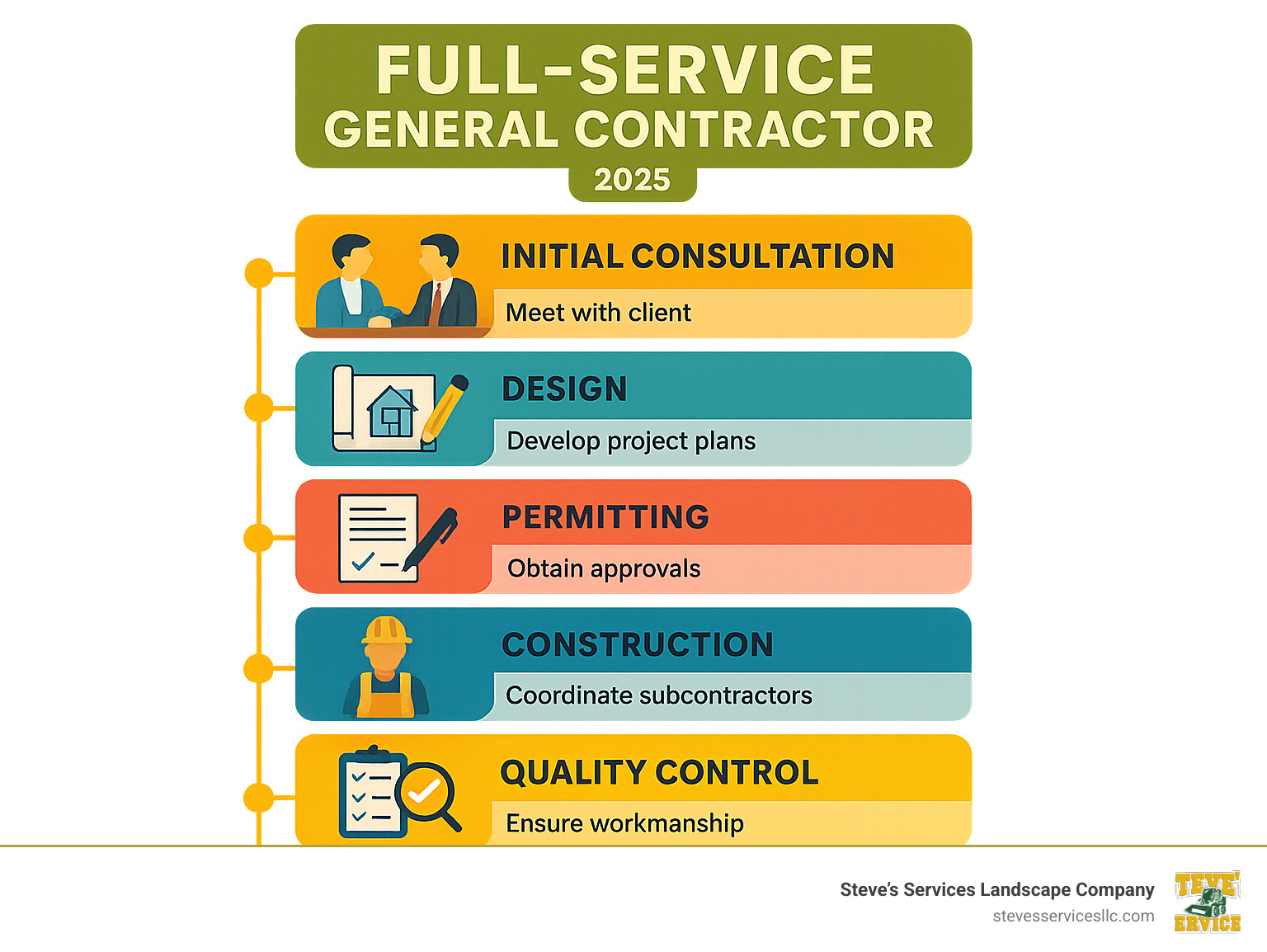
Handy full service general contractor terms:
What is a Full-Service General Contractor?
Picture this: you’re ready to tackle a dream renovation, but the thought of coordinating architects, plumbers, and electricians is overwhelming. That’s where a full service general contractor becomes your single point of contact for the entire project.

A full service general contractor is your project’s quarterback, handling everything from initial planning to final completion. Instead of juggling multiple contacts, you get one trusted professional who takes complete project oversight. Their turnkey solutions approach means you share your vision, and they make it happen, managing building codes, permits, and scheduling.
This end-to-end management and client-centric approach ensures clear communication and a smooth process. For commercial projects, a dedicated Commercial Building Contractor can handle the unique demands of business construction.
The Comprehensive Scope of Services
“Full service” means your contractor covers every phase of construction, so you don’t have to become a project manager.
- Pre-construction: This planning phase involves working with architects and designers to create buildable plans that fit your budget and timeline.
- Design and planning: Your contractor develops detailed drawings, breaks down costs, and handles all permitting requirements, navigating building codes and zoning laws for you.
- Subcontractor management: They use their network of trusted electricians, plumbers, and carpenters, coordinating schedules and managing contracts to ensure everyone works together efficiently.
- Construction execution: On-site daily, they supervise work quality, manage material deliveries, and solve problems before they escalate. A Renovation General Contractor is ideal for projects involving existing structures.
- Post-construction support: The job isn’t done until you’re satisfied. This includes a final walkthrough, addressing any last-minute details, and providing warranty support. This comprehensive approach is why many homeowners choose General Home Improvement Contractors.
Managing Your Project from Concept to Completion
The journey with a full service general contractor is designed to minimize stress and maximize results.
It begins with an initial consultation to discuss your vision, lifestyle, and budget. From there, the contractor creates a realistic timeline and cost breakdown during budgeting and scheduling. Their expertise in material sourcing helps you get the best value, leveraging supplier relationships for better pricing and access.
Once construction starts, on-site organization is key. The contractor coordinates crews, deliveries, and safety standards, acting as your eyes and ears on the project. Quality control checks are performed regularly to ensure work meets building codes and your expectations. The process concludes with a final walkthrough, where your contractor explains all completed work and new systems, ensuring you’re completely happy with your new space.
The Advantage: Full-Service GC vs. Hiring Individual Specialists
When planning a major renovation, you could spend weeks coordinating different specialists, or you could make one call to a full service general contractor and let them handle it. The choice is between managing chaos and enjoying a streamlined process.

Choosing a full service general contractor over juggling individual specialists offers several key advantages:
- Simplified process: A single point of contact handles all the behind-the-scenes coordination, freeing you to focus on your vision.
- Cost efficiency: Contractors often secure better material prices and subcontractor rates due to their buying power and relationships. Their experience also helps avoid costly mistakes and delays common in self-managed projects.
- Risk management: A reputable contractor carries comprehensive insurance and has the experience to anticipate and manage potential issues, from structural problems to material delays.
- Consistent quality: With one entity overseeing the entire project, quality standards are uniform from start to finish. There’s no finger-pointing between trades, just a commitment to excellent results.
- Time savings: You get your evenings and weekends back while professionals handle the complexities of the project. For more on how this works, see our approach as Home Improvement Contractors Near Me.
Streamlined Communication and Accountability
Communication breakdowns can derail construction projects. When you hire multiple independent contractors, you become the information hub, a role most homeowners aren’t prepared for.
A full service general contractor provides a single point of accountability. One person knows every detail of your project, which means faster problem-solving and clearer decision-making. This centralized communication eliminates confusion and keeps the project moving forward.
The coordinated trades approach ensures everyone is on the same page. Your contractor schedules work in the proper sequence, ensures materials arrive on time, and keeps the team updated. Learn more about our commitment to clear communication on our About Us page.
Ensuring Quality, Budget, and Timeline Adherence
Achieving success in quality, budget, and timeline requires professional orchestration. A full service general contractor excels at this through proactive planning, developing detailed schedules and budgets with contingencies for unexpected issues.
Budget control is managed with transparent cost breakdowns and careful expense tracking. Schedule adherence is maintained through experience and established relationships, minimizing downtime. Quality assurance is implemented with consistent oversight and regular inspections throughout every phase.
Here’s how the two approaches compare:
| Factor | Full-Service General Contractor | Hiring Individual Specialists |
|---|---|---|
| Communication | Single point of contact, streamlined updates | Multiple contacts, potential miscommunication |
| Cost Control | Bulk purchasing power, coordinated budgeting | Individual pricing, potential cost overruns |
| Timeline Management | Professional scheduling, proactive coordination | Homeowner coordination, potential delays |
| Quality Assurance | Consistent standards, unified oversight | Variable standards, divided responsibility |
For professional coordination that makes all the difference, explore our Commercial General Contracting services.
Self-Performing vs. Traditional General Contractors
Within full-service general contracting, there’s a key distinction between traditional and self-performing contractors. Understanding this can impact your project’s efficiency, quality, and cost.
A traditional general contractor acts as a project manager, coordinating a network of subcontractors to perform the physical work. They excel at scheduling and oversight but rely on external teams for construction.
A self-performing general contractor takes a more hands-on approach. While still managing the entire project, they use their own skilled workforce to complete a significant portion of the work. This provides greater project control and flexibility. Homeowners and business owners can find local options by searching for Site Contractors Near Me.
The Self-Performing Difference
The defining feature of a self-performing contractor is their in-house skilled labor. By employing their own carpenters, masons, and other tradespeople, they gain direct control over quality, scheduling, and efficiency.
This direct control over work means fewer communication gaps and more consistent standards. Common examples of self-performed work include carpentry, masonry, concrete work, excavation, and various finishing tasks. At Steve’s Services, we offer comprehensive Excavation Services with our own equipment and skilled operators. This self-performing model allows us to maintain tight schedules and quality control, demonstrating the benefits of in-house capabilities.
Advantages of a Self-Performing In-House Team
Choosing a self-performing full service general contractor often leads to better project outcomes.
- Improved coordination: With in-house teams, communication is seamless, leading to a smoother workflow and faster problem-solving.
- Higher quality standards: Companies are directly accountable for their employees’ workmanship, resulting in a stronger commitment to quality and clear ownership of results.
- Increased flexibility: A self-performing contractor can quickly reallocate their own resources to address unexpected issues, reducing delays.
- Potential cost efficiency: By reducing subcontractor markups and minimizing coordination delays, self-performing contractors can offer better cost control.
- Improved safety compliance: Consistent safety protocols can be implemented and enforced across their own teams.
This philosophy guides our Hardscaping Services, where our skilled crews ensure meticulous attention to detail and lasting results.
How to Select Your Ideal Partner
Finding the right full service general contractor is the most critical decision for your project. You need a partner who is reliable, experienced, and trustworthy.

The vetting process is essential. Start by examining their experience and expertise, looking for a track record of projects similar to yours. Read client reviews and references to identify patterns in communication, timeliness, and service. Finally, verify their insurance and licensing are current to protect yourself from liability.
For businesses seeking reliable partners in Massachusetts, our network of Local Commercial Contractors includes thoroughly vetted professionals.
Essential Qualities of a Top-Tier Full-Service General Contractor
When evaluating contractors, look for these key qualities:
- Proven experience: Seek contractors who have successfully completed projects similar to yours in scope and style.
- Strong references: A confident contractor will provide references. Ask past clients about budget adherence, problem-solving, and overall satisfaction.
- Full insurance coverage: This must include general liability and workers’ compensation. Always ask for and verify current certificates.
- Proper licensing: Legitimate contractors hold all necessary credentials for your location, such as a Régie du bâtiment du Québec (RBQ) licence in Quebec or state registration in Massachusetts. Find licensed professionals with our guide to Licensed Home Improvement Contractors Near Me.
- Transparent communication: The best contractors are responsive, clear, and upfront about challenges, timelines, and costs.
- Financial stability: A financially stable contractor is less likely to cut corners or abandon a project.
The Role of a Full-Service General Contractor in Design and Planning
A top-tier full service general contractor contributes significantly during the planning phase, long before construction begins.
They assist with concept development, turning your ideas into concrete plans by asking the right questions about your needs and budget. Through collaboration with architects and engineers, they provide practical feedback to align your vision with construction realities. Their expertise in material selection helps you balance quality, cost, and availability.
Contractors also add value through value engineering, finding efficient ways to achieve your goals without compromising quality. They may use 3D renderings to help you visualize the final product and prevent costly mid-project changes. Finally, they manage all permit handling, navigating local building codes and bureaucracy to keep your project on track. Just as we help clients envision outdoor spaces with our Landscaping Services, a great GC creates a clear roadmap for your entire project.
Frequently Asked Questions about General Contractors
Here are answers to some of the most common questions homeowners and business owners have about working with a full service general contractor.
What is the difference between a general contractor and a project manager?
While the roles can overlap, the distinction is important. A general contractor is primarily focused on the physical construction, managing subcontractors and the job site. A project manager often has a broader role, focusing on overall strategy, budget, and scheduling from the client’s perspective, often starting earlier in the planning phase.
A full service general contractor effectively combines both roles. They handle the big-picture strategic planning and the day-to-day realities of construction, providing a single, unified point of contact for the entire project.
How do general contractors handle unexpected issues or changes?
Surprises are a part of any construction project. Experienced contractors anticipate this by building contingency plans into the budget and timeline from the start, typically a buffer of 10-20%.
When an issue arises, a good contractor acts as a problem-solver. They assess the situation, present you with viable options, and maintain transparent communication. Any significant changes to the scope, cost, or timeline are documented in a formal change order, so you are never caught by surprise. This ensures you are always informed and in control.
When should I hire a full-service general contractor?
You should hire a full service general contractor for any project that is complex, requires permits, or involves multiple specialized trades (like plumbers, electricians, and carpenters).
They are essential for:
- New construction projects: Building from the ground up requires coordinating dozens of specialists, a task best left to a professional.
- Major renovations: Gutting a kitchen, adding a bathroom, or moving walls involves structural, electrical, and plumbing work that demands expert coordination.
- Home additions: Connecting new construction to an existing structure requires careful planning to ensure a seamless and structurally sound result.
- Commercial projects: These projects have stricter codes and tighter timelines, making professional management from a commercial building contractor indispensable.
Even for smaller projects, a full-service contractor can be a worthwhile investment for the time savings and peace of mind they provide.
Conclusion: Bringing Your Vision to Life with the Right Partner
As we’ve seen, a full service general contractor is more than just a builder; they are your project’s central coordinator and stress-reducer. They provide a single point of contact, streamlined communication, and total accountability, ensuring a higher standard of quality from start to finish.
The result is a stress-free process where you can focus on your vision while a professional handles the complex logistics, permits, and coordination. Choosing the right qualified partner is the most important step toward a successful outcome. Look for proven experience, strong references, proper licensing and insurance, and a commitment to transparent communication.
At Steve’s Services, while we specialize in landscaping, hardscaping, and snow management, our years of collaborating on comprehensive property improvements have shown us the immense value a great general contractor brings. The right partner doesn’t just provide a service—they invest in your peace of mind and deliver a final product that will serve you for years to come.
For comprehensive project management from site work to finishing touches, explore our General Contracting Services.