What Is a Hawthorn Hedge and Why Is It So Popular?
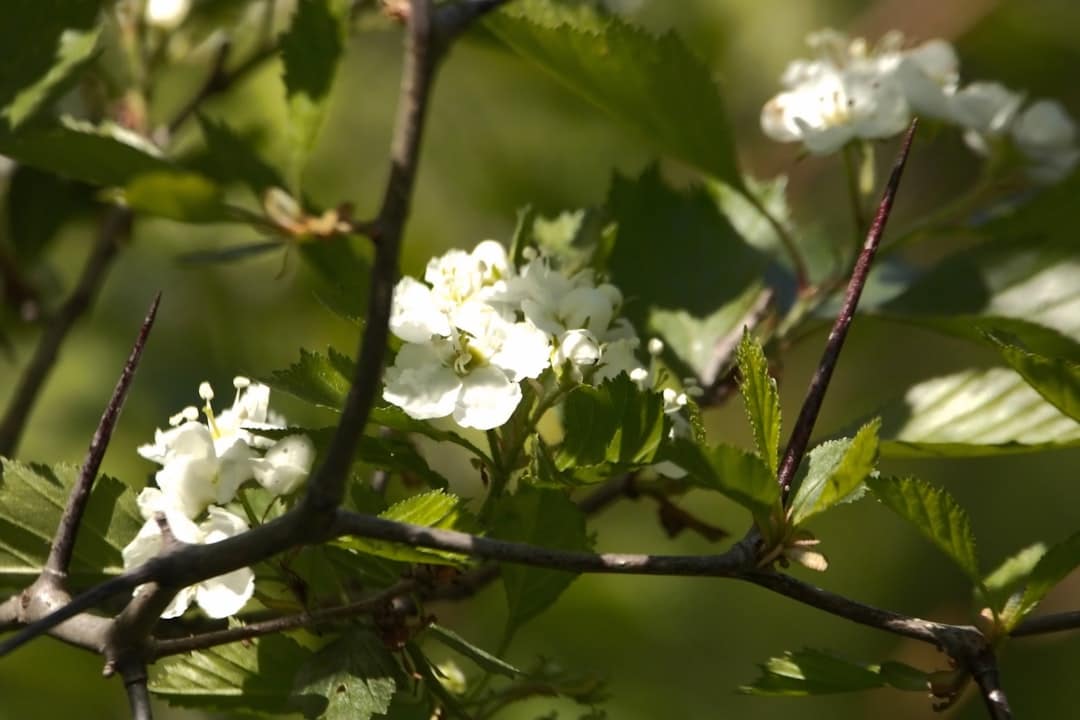
A hawthorn hedge, primarily composed of the species Crataegus monogyna (commonly known as quickthorn, whitethorn, or May blossom), is a deciduous shrub native to the UK and widely cultivated across temperate regions. Renowned for its rapid establishment and tough, resilient nature, it is a staple of traditional countryside hedgerows. It features dense, tangled branching, sharp thorns that can grow up to 3 inches long, beautiful white or pink spring flowers, and deep red autumn berries called “haws.”
What makes hawthorn particularly beloved is its extreme adaptability. It has a high tolerance for almost any soil type—including clay, sand, and chalky soils—and can thrive in exposed, windy sites where other hedging plants might struggle. While it is highly valued for informal, natural-looking boundaries, it can also be kept neat with regular maintenance, though it has formal limits compared to species like boxwood or privet.
Why Hawthorn Is Popular in UK and Temperate Gardens
Hawthorn is hard to beat as a boundary hedge because it serves as an incredibly effective, long-lasting barrier. Historically used by farmers to contain livestock, it has transitioned beautifully into residential gardens where it acts as a robust privacy screen and adds a rustic, rural character to both countryside and urban spaces.
Young bare-root saplings establish quickly, growing at an impressive rate of 40–60 cm per year under good conditions. This means you can expect a fully functional, dense boundary within 3 to 5 years of planting. Additionally, hawthorn boasts an incredibly long lifespan, with some specimen plants living for up to 400 years. It can tolerate wet soils (though not constant waterlogging) and withstands harsh coastal winds, making it one of the most reliable choices for properties in exposed locations.
Wildlife and Security Benefits of Hawthorn Hedges
From an environmental standpoint, a hawthorn hedge is a powerhouse for local biodiversity. According to the Woodland Trust, hawthorn supports over 150 species of insects. Its dense, thorny framework provides secure, predator-proof nesting sites for wild birds, such as thrushes and finches, as well as shelter for small mammals like hedgehogs. In the spring, the abundant blossoms supply vital nectar for bees and other pollinators, while the nutrient-rich red haws provide essential winter food for migrating birds and resident wildlife.
Beyond its ecological value, the security benefits of hawthorn are unmatched by almost any other native hedge. The sharp, sturdy thorns create an impenetrable, natural security barrier that deters intruders far more aesthetically than a wooden fence or security wire. If you want to explore the botanical details of this versatile plant, the How to grow hawthorn / RHS Growing Guide is an excellent resource.
Hawthorn Hedge Pruning: When to Cut for Health, Flowers, and Berries
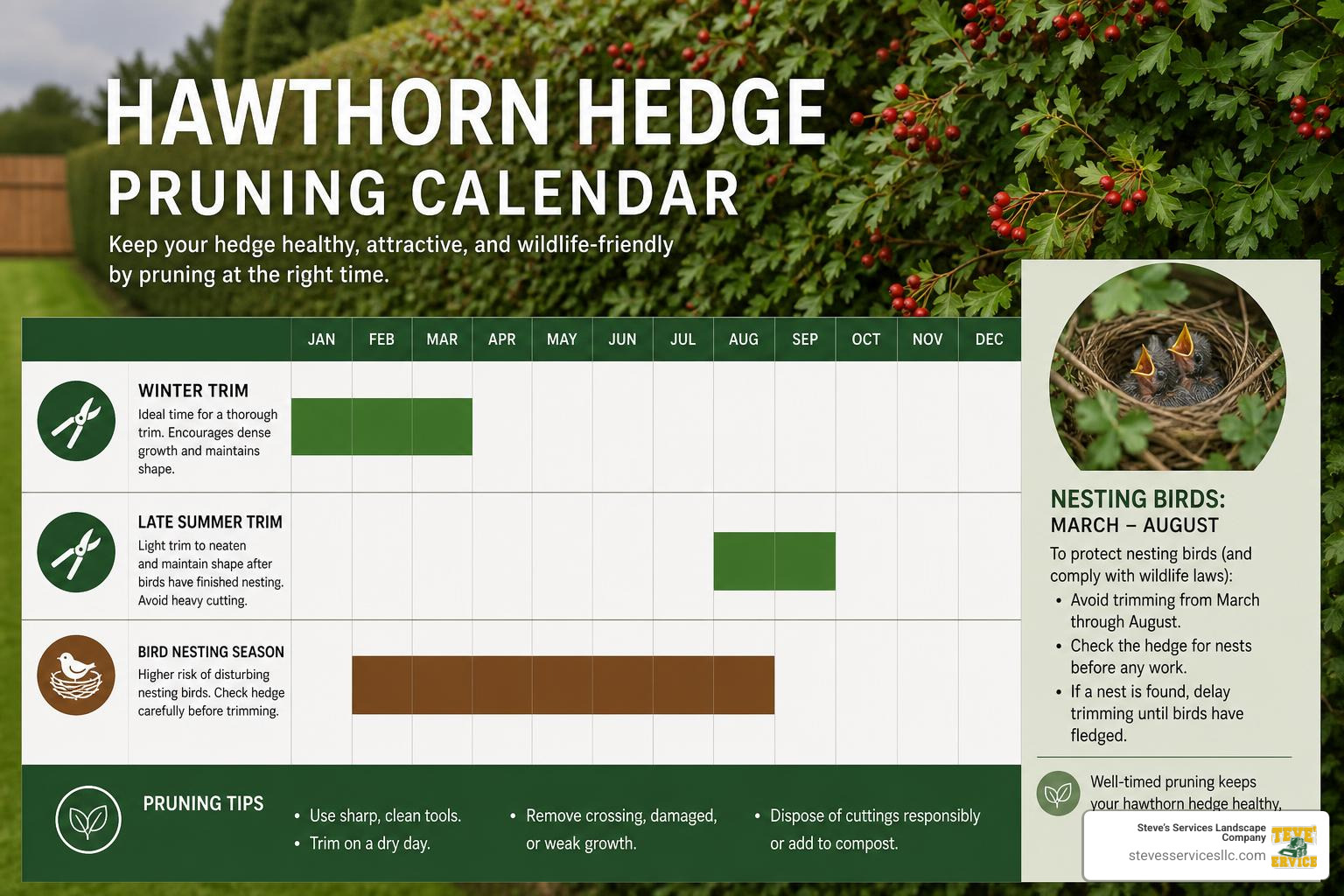
Determining the best time for hawthorn hedge pruning depends on your primary goals: are you prioritizing a neat shape, abundant spring blossoms, winter berries, or wildlife protection? For the vast majority of established hedges, late winter (specifically February) or late summer to early autumn are the most effective times to prune.
Pruning during the plant’s dormant period in late winter prevents sap bleeding and stimulates vigorous new growth when spring arrives. However, timing is heavily constrained by wildlife protection. In the UK, the breeding season for nesting birds runs from March to August, and it is a criminal offence to disturb or damage active nests. Therefore, any major trimming must be scheduled outside of this window.
Best Time for Hawthorn Hedge Pruning by Hedge Goal
- Formal Hedges: To maintain a crisp, tidy shape, a formal hawthorn hedge can be trimmed twice a year—once in late spring or early summer (after checking thoroughly for nests) and again in early autumn.
- Informal and Wildlife Hedges: If you prefer a natural, rugged look that maximizes wildlife benefits, trim the hedge once a year in late summer or early autumn, after the nesting season has concluded.
- Renovation Pruning: If you need to tackle a severely overgrown hedge, this hard reduction should only be done in mid-to-late winter (January or February) when the plant is completely dormant and bare.
- Young Hedges: Formative pruning is typically carried out in late winter or early spring during the first two to three years to encourage dense branching from the base.
How Pruning Affects Blossom and Berry Production
Hawthorn produces its flowers and subsequent berries on short shoots that develop on older wood (growth from previous seasons). This growth habit means that your pruning schedule directly impacts the visual display of your hedge.
If you trim the hedge heavily in early spring or late winter, you will inevitably cut away the wood that would have produced this year’s flowers, reducing the spring display and the autumn berry crop. To balance a tidy shape with beautiful blossoms, the best approach is to prune the hedge immediately after flowering in early summer. However, if your goal is to feed winter birds, keep your summer trims light and selective, leaving plenty of older wood intact to support the developing haws.
When Not to Prune Hawthorn
There are several critical periods when you should keep your shears away from a hawthorn hedge:
- During Active Nesting (March to August): Unless you are absolutely certain there are no birds nesting in your hedge, avoid any mechanical trimming.
- During Severe Frosts: Pruning during freezing conditions can cause the wood to split and exposes the open cuts to frost damage, which can kill off outer branches.
- During Drought or Heatwaves: Cutting back a hedge during dry, hot spells stresses the plant, making it difficult for the hawthorn to recover and leaving it vulnerable to pests.
- When Tools Are Wet or Dirty: Pruning in damp conditions with unsterilized tools is an open invitation for fungal infections like fireblight.
For more general advice on managing hedge health, check out the Pruning Hedges: Expert Tips | RHS Advice guide.
How Professionals Prepare for Hawthorn Hedge Pruning
At Steve’s Services, we treat hawthorn hedge pruning as a precise, systematic task. Because of the plant’s formidable thorns and dense growth, proper preparation is essential to ensure safety, efficiency, and the long-term health of the hedge. Before making a single cut, our professional crew performs a thorough risk assessment, checks for nesting wildlife, and prepares specialized commercial-grade tools.
Tools and Safety Gear for Thorny Hawthorn
Pruning a thorny hawthorn hedge requires heavy-duty protective gear and sharp, high-quality cutting tools. Here is the standard equipment we use:
- Thick Leather Gauntlets: Heavy-duty, puncture-resistant gloves are non-negotiable to protect hands and forearms from 3-inch thorns.
- Safety Goggles and Long Sleeves: Eye protection prevents stray twigs from causing serious injury, while durable long sleeves protect the arms.
- Sharp Secateurs: For cutting thin twigs up to 0.6 cm in diameter.
- Heavy-Duty Loppers: Essential for clean cuts on branches up to 2.5 cm thick.
- Sharp Pruning Saws: Used for thick, woody branches over 3 cm in diameter.
- Disinfectant Spray: We sanitize our blades between hedges to prevent the spread of diseases like fireblight.
- Debris Tarps: Placed along the base of the hedge to collect thorny clippings, ensuring your lawn and walkways remain safe to walk on.
Using dull tools is one of the worst things you can do to a hedge, as it crushes the wood fibers rather than slicing them, leaving ragged edges that invite decay. If your hedge is particularly tall or expansive, hiring our team for professional hedge trimming ensures the job is done safely with professional-grade equipment.
What to Inspect Before Any Cuts Are Made
Before starting, we inspect the entire length of the hedge to map out our cuts. We look for:
- Dead, Diseased, or Damaged Wood: These branches are always the first to be removed, cut back to healthy wood or the main trunk.
- Crossing or Rubbing Branches: Branches that rub against each other wear away their protective bark, creating entry points for fungal spores.
- Suckers and Basal Growth: We check the base for unwanted suckers that drain energy from the main hedge structure.
- Nesting Birds or Wildlife: A meticulous visual check is conducted to ensure no active nests are disturbed.
- Structural Integrity: We assess if the hedge is leaning, has bare spots, or has suffered damage from pests or winter snow loads.
Professional Techniques That Keep Hawthorn Dense and Healthy
To keep a hawthorn hedge looking its best, we utilize specific pruning techniques tailored to the age and condition of the hedge. Whether we are conducting light maintenance or a heavy renovation, our goal is always to encourage a tight, bushy structure that remains green from top to bottom.
| Pruning Type | Purpose | Timing | Technique |
|---|---|---|---|
| Formative Pruning | Establishes density in young hedges | Late winter (first 2–3 years) | Cut back leading shoots by one-third to half to stimulate lateral branching. |
| Maintenance Pruning | Maintains shape, size, and neatness | Late summer or early autumn | Lightly trim the sides and top using a tapered “A” profile. |
| Renovation Pruning | Restores old, overgrown, or bare hedges | Mid-to-late winter (dormant) | Hard cuts back to 15–20 cm stumps, often staged over 2–3 years. |
Light Pruning vs Hard Pruning for Hawthorn
Light pruning, or maintenance trimming, involves clipping back the soft, new growth of the current season. This keeps formal hedges looking sharp and encourages the development of dense side shoots within the canopy. Because hawthorn is highly resilient, it can also tolerate incredibly hard pruning.
However, hard pruning—which involves cutting into thick, old wood to reduce the height or width of an overgrown hedge—should be approached with caution. While hawthorn has a strong root system capable of recovering from severe cuts, removing more than 25% of the canopy in a single season can stress the plant. For severely overgrown boundaries, we recommend staging the renovation over two to three years, cutting back one side of the hedge at a time to allow the plant to recover gradually. For a deeper understanding of how different hedge species handle hard cuts, you can read our analysis on whether privet will cope with hard pruning.
Hawthorn Hedge Pruning Techniques for Dense Growth
The secret to a healthy, dense hawthorn hedge lies in its shape. We always prune hedges into a tapered “A” shape (also known as cutting to a “batter”), where the base of the hedge is wider than the top.
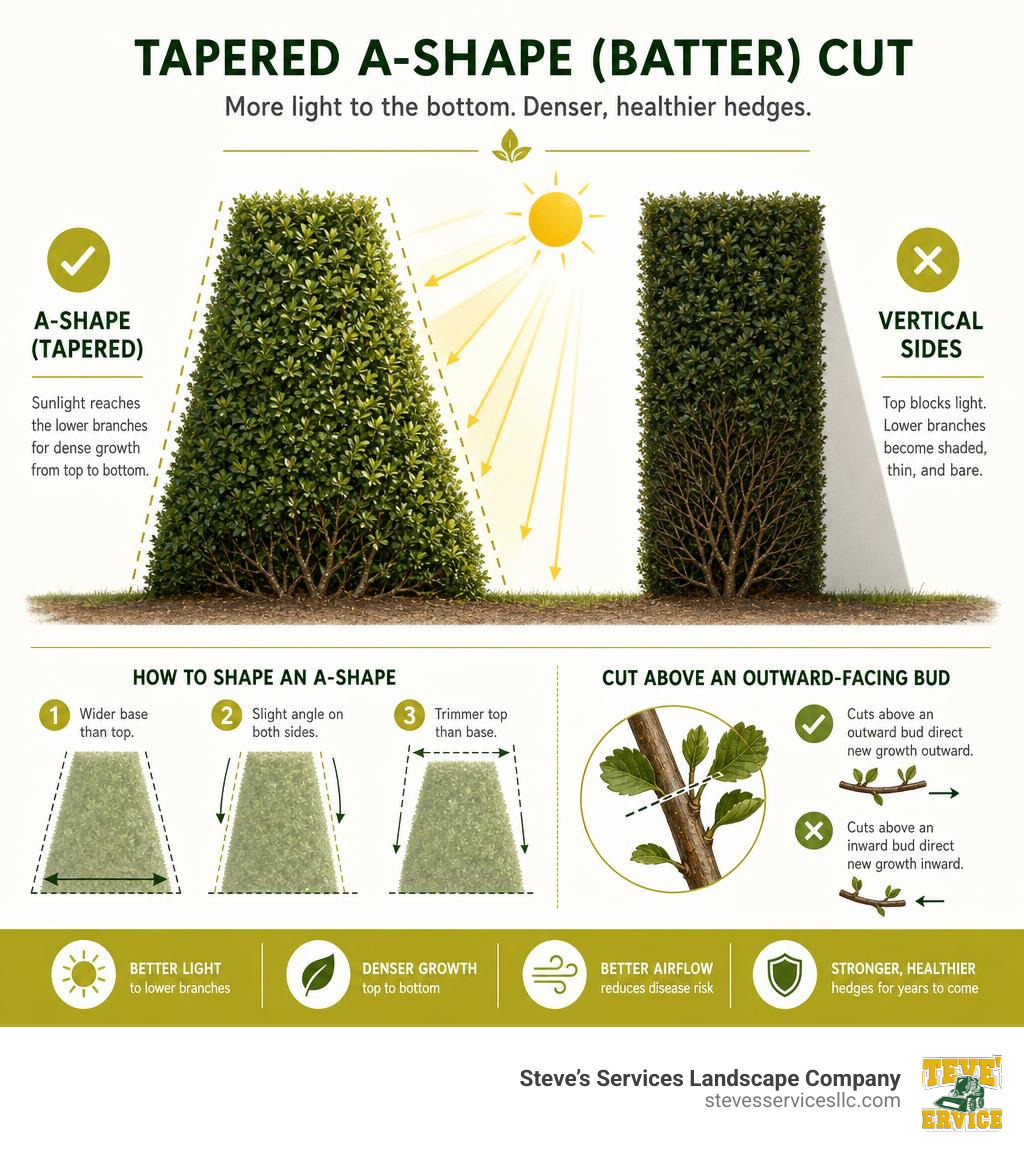
This tapered profile ensures that sunlight can reach the lower branches, preventing them from shedding their leaves and becoming thin and bare. If you prune a hedge with perfectly vertical sides, the top branches will cast a shadow over the bottom, leading to a top-heavy, hollow-bottomed hedge over time.
Additionally, when making individual cuts on larger branches, we always cut just above a healthy, outward-facing bud or lateral twig. This directs new growth outward rather than inward, keeping the center of the hedge open for good air circulation, which reduces the risk of fungal diseases. For more details on professional hedge shaping, explore our 10 smart strategies for hedge trimming services.
How to Prune Hawthorn Into a Tree Shape
If left unclipped, a single hawthorn plant will naturally grow into an elegant, small-to-medium-sized tree reaching 5 to 10 meters in height. To guide a young hawthorn into a beautiful tree shape, we use a process called “crown lifting”:
- Select a Strong Leader: Identify the straightest, strongest central stem to serve as the main trunk.
- Remove Lower Branches: During the winter dormant season, gradually prune away the lower lateral branches using a sharp pruning saw. Always cut just outside the branch collar—never cut flush with the trunk, as this damages the tree’s natural healing zone.
- Thin the Canopy: Lightly thin out crossing or congested branches in the upper canopy to improve light penetration and airflow.
- Clear Suckers: Keep the base of the trunk clear of suckers and competing shoots.
This structural training should be done gradually over several years to avoid shocking the tree. For expert assistance with specimen trees, our tree pruning services can help you achieve a perfectly balanced canopy.
Common Hawthorn Pruning Mistakes That Damage Hedges
Even though hawthorn is an incredibly tough species, improper pruning can lead to long-term structural issues, sparse growth, and increased susceptibility to pests and diseases. Here are the most common mistakes we see home gardeners make—and how to avoid them.
Mistakes That Reduce Density
The most common mistake that ruins a hedge’s density is cutting the sides perfectly vertical or, worse, making the top wider than the bottom. This deprives the lower stems of light, causing them to die back and leaving the base of your hedge completely bare and see-through.
Another mistake is neglecting formative pruning during the hedge’s first two years. Many people let a young hedge grow straight up to their desired height before trimming it. This results in a tall, spindly hedge with no density at the bottom. Cutting back the leading shoots early on forces the plant to branch out near the ground, establishing a thick, secure base.
Mistakes That Harm Flowers, Berries, and Wildlife
Trimming your hawthorn hedge at the wrong time of year is a major threat to local wildlife. Heavy shearing in late spring or early summer can destroy active bird nests and wipe out the seasonal flowers that bees rely on. Similarly, hard trimming in mid-summer cuts away the green berries before they have a chance to ripen into winter food for birds. To protect the local ecosystem, always aim to do your primary maintenance trim in late summer or early autumn, after the nesting birds have fledged.
Mistakes That Increase Disease or Safety Risks
Using dirty, blunt tools is a recipe for disaster. Ragged cuts take much longer to heal, leaving the wood exposed to fungal spores. Furthermore, failing to sanitize your blades after cutting away diseased wood can spread infections like fireblight across your entire hedge.
Safety is another major concern when dealing with hawthorn. The long, sharp thorns can easily pierce standard gardening gloves, leading to painful scratches that frequently become infected. Always wear puncture-resistant gauntlets and safety goggles, especially when using powered hedge trimmers. If you are dealing with a tall, heavy hedge, attempting to trim it from an unstable ladder is highly dangerous. For large or complex jobs, it is always safer to bring in professionals who specialize in shrub pruning.
Frequently Asked Questions About Hawthorn Hedge Pruning
Can an Overgrown Hawthorn Hedge Be Cut Back Hard?
Yes, hawthorn is highly resilient and responds exceptionally well to renovation pruning. If you have a mature hedge that has become wildly overgrown, sparse at the bottom, or structurally unstable, you can cut it back hard.
The most effective method is to cut the entire hedge back to 15–20 cm stumps in late winter (January or February) while the plant is dormant. While this leaves you without a hedge for a season, hawthorn’s robust root system will quickly push out vigorous, dense new shoots in the spring. Alternatively, you can stage the renovation over two to three years by hard-pruning one side of the hedge at a time, allowing the remaining side to provide privacy while the cut side recovers.
How Often Should a Hawthorn Hedge Be Trimmed?
For an informal, wildlife-friendly hedge, a single trim once a year in late summer or early autumn is ideal. This keeps the hedge within bounds while preserving the spring flowers and autumn berries. If you prefer a highly manicured, formal look, the hedge may require two to three light trims between late spring and early autumn to maintain its crisp lines.
Where Can You Learn More or Buy Hawthorn Hedging Plants?
For detailed botanical guidelines and variety selections, the Royal Horticultural Society (RHS) offers excellent resources. When purchasing new hawthorn plants, we highly recommend sourcing high-quality bare-root whips from reputable local nurseries during the dormant winter planting season (November to March).
For a dense, secure hedge, plant 5 whips per meter in a double staggered row spaced 30 cm apart. If you are looking for professional assistance with planting, maintaining, or pruning your boundaries, search for quality hedge trimming near me to find our local expert team.
Conclusion
Mastering hawthorn hedge pruning is the key to maintaining a beautiful, secure, and wildlife-friendly boundary for your property. By timing your trims correctly—avoiding the crucial March-to-August nesting season—and using professional shaping techniques like the tapered “A” profile, you can ensure your hedge remains dense, healthy, and vibrant from the ground up.
While light maintenance can be managed with the right tools and safety gear, tackling large, tall, or severely overgrown hawthorn hedges can be a daunting, thorny task. At Steve’s Services, our experienced team proudly serves Malden, MA, and the surrounding communities, including Burlington, Everett, Lynnfield, Medford, Melrose, Reading, Revere, Saugus, Stoneham, Wakefield, Winchester, and Woburn. We have the commercial-grade equipment and horticultural expertise to keep your hedges in pristine condition.
Ready to transform your landscape? Contact us online today to book professional hedge trimming and let us handle the hard work for you!