Why Choosing the Right Fertilizer for Grass Makes or Breaks Your Lawn
The best fertilizer for grass gives your lawn the right balance of nitrogen, phosphorus, potassium, and micronutrients to grow thick, green, and resilient all season long.
Quick answer — what to look for in a lawn fertilizer:
| Nutrient | Role | What to Look For |
|---|---|---|
| Nitrogen (N) | Green color, leafy growth | Highest number on the label |
| Phosphorus (P) | Root development | Important for new sod |
| Potassium (K) | Stress and disease resistance | Supports heat and drought tolerance |
| Micronutrients | Overall vitality | Iron, sulfur, and chelated minerals |
A balanced fertilizer — like a 19-12-15 blend with added micronutrients — works well for new sod, established lawns, and older lawns that need a boost. For most Massachusetts lawns, applying 3 to 4 times per year builds the deep root system your grass needs to survive heat, drought, and heavy use.
Dollar for dollar, fertilization has more impact on lawn quality than almost any other lawn care practice. Yet most homeowners either under-fertilize, over-fertilize, or apply at the wrong time — and the results show.
I’m Steve Sylva, owner of Steve’s Services Landscape Company in Malden, MA, and with over 25 years of hands-on experience selecting and applying fertilizer for grass across Massachusetts properties, I’ve seen what works and what wastes your money. In this guide, I’ll walk you through everything you need to make the right call for your lawn.
Fertilizer for grass terms you need:
- hydro mousse seed coating formula
- liquid lawn feed
- lawn feed for new lawn
Understanding the Essential Nutrients in Fertilizer for Grass
To understand how fertilizer for grass works, we have to look at the biology of the plant. While carbon, hydrogen, and oxygen make up about 90-95% of a grass plant’s dry weight (mostly from air and water), the remaining portion consists of essential soil-derived nutrients.
Nitrogen is the most critical nutrient because it is responsible for the lush green color and rapid leafy growth we all want. In a healthy lawn, nitrogen should make up between 2.75% and 4.2% of the plant’s dry weight. However, nitrogen is highly mobile in the soil, meaning it washes away with rain or irrigation, requiring regular replenishment.
Phosphorus and potassium are the other two “big” macronutrients. Phosphorus (sufficiency range: 0.3-0.55%) is the fuel for root development, while potassium (sufficiency range: 1.0-2.5%) acts like an immune system booster, helping the grass resist heat, cold, and disease. For a deep dive into the science behind these inputs, the Turfgrass Fertilization: A Basic Guide for Professional Turfgrass Managers provides excellent research-based insights.
When we manage properties in Malden or Melrose, we emphasize that fertilizing-lawn isn’t just about dumping chemicals; it’s about replacing what the soil loses over time.

How to Read a Fertilizer for Grass Label
Every bag of fertilizer for grass features three prominent numbers, known as the N-P-K ratio. This represents the percentage by weight of Nitrogen (N), Phosphate (P2O5), and Potash (K2O). For example, a 16-4-8 analysis means the bag contains 16% nitrogen, 4% phosphorus, and 8% potassium. This specific ratio is a 4-1-2 ratio, which is often recommended for mature lawns. You can learn more about this specific blend in our guide to fertilizer-16-4-8.
Beyond the big numbers, look at the “Guaranteed Analysis” on the back. This section breaks down the types of nitrogen. You’ll often see “Water-Insoluble Nitrogen” (WIN). This is a crucial metric because it tells you how much of the nitrogen is “slow-release.” If a bag has 16% total nitrogen and 5.6% WIN, you can calculate the slow-release percentage: (5.6 / 16) x 100 = 35%. A high WIN percentage means the grass is fed steadily over weeks rather than all at once.
Selecting the Right Fertilizer for Grass Types
In our service areas—from Everett to Reading—we primarily deal with cool-season grasses like Kentucky Bluegrass, Perennial Ryegrass, and Tall Fescue. These grasses have different “appetites.” Kentucky Bluegrass typically needs 2 to 4 lbs of nitrogen per 1,000 square feet annually, while Fine Fescues are much leaner, needing only 1 to 2 lbs.
The stage of your lawn also dictates the formula. For example, fertilizer-for-new-sod usually requires a higher phosphorus count (the middle number) to encourage roots to knit into the soil. Established lawns, on the other hand, often benefit from a “maintenance” fertilizer with high nitrogen and zero or low phosphorus, as many Massachusetts soils already have adequate phosphorus levels.
Comparing Quick-Release, Slow-Release, and Organic Options
Choosing a fertilizer for grass often comes down to how quickly you want to see results versus how long you want those results to last.
- Quick-Release Nitrogen: These are water-soluble sources like urea or ammonium sulfate. They provide an almost immediate “green-up” but are susceptible to leaching into groundwater and can easily burn the grass if applied too heavily.
- Slow-Release/Controlled-Release: These particles are coated (often with sulfur or polymers) to break down slowly. This provides a steady growth rate and reduces the risk of nitrogen runoff.
- Organic Fertilizers: Derived from natural sources like bone meal or manure, these promote overall soil health by feeding the microorganisms in the dirt. While they release nutrients more slowly and often have lower N-P-K ratios, they are excellent for long-term sustainability.
For those who prefer a more modern approach, a liquid-lawn-feed can offer high precision, especially when combined with professional Fertilizer Recommendations from university experts.
Benefits of Slow-Release Nitrogen
We almost always prefer slow-release fertilizer for grass for residential properties in Winchester and Woburn. Why? Because it prevents “surge growth.” When you use quick-release nitrogen, the grass grows at an exhausting rate for two weeks, requiring constant mowing, and then “crashes.”
Slow-release options prevent nutrient leaching—where nitrogen passes through the root zone and into the water table—and ensure that the nutrients stay where they belong: in your lawn. By using the WIN calculation mentioned earlier, we ensure our clients’ lawns get a sustained “spoon-feeding” of nutrients for up to three months.
Micronutrients and Soil pH
A bag of fertilizer for grass isn’t complete without micronutrients. Iron is the standout here; it provides a deep, “blue-green” color without causing the grass to grow faster. This is a great trick for getting a beautiful lawn without having to mow every three days.
However, no amount of fertilizer will work if your soil pH is off. In New England, our soils tend to be acidic. If your pH is below 6.0, the grass literally cannot “unlock” the nutrients you’re providing. This is why we recommend soil testing every 2-3 years. If the soil is too acidic, we apply lime to bring it back into the ideal 6.0 to 6.5 range. This is often done alongside aeration-overseeding-and-fertilizing in the fall.
Seasonal Application Schedules and Best Practices
Timing is everything. If you fertilize when the grass is dormant or the ground is frozen, you aren’t feeding the lawn—you’re feeding the local storm drain.
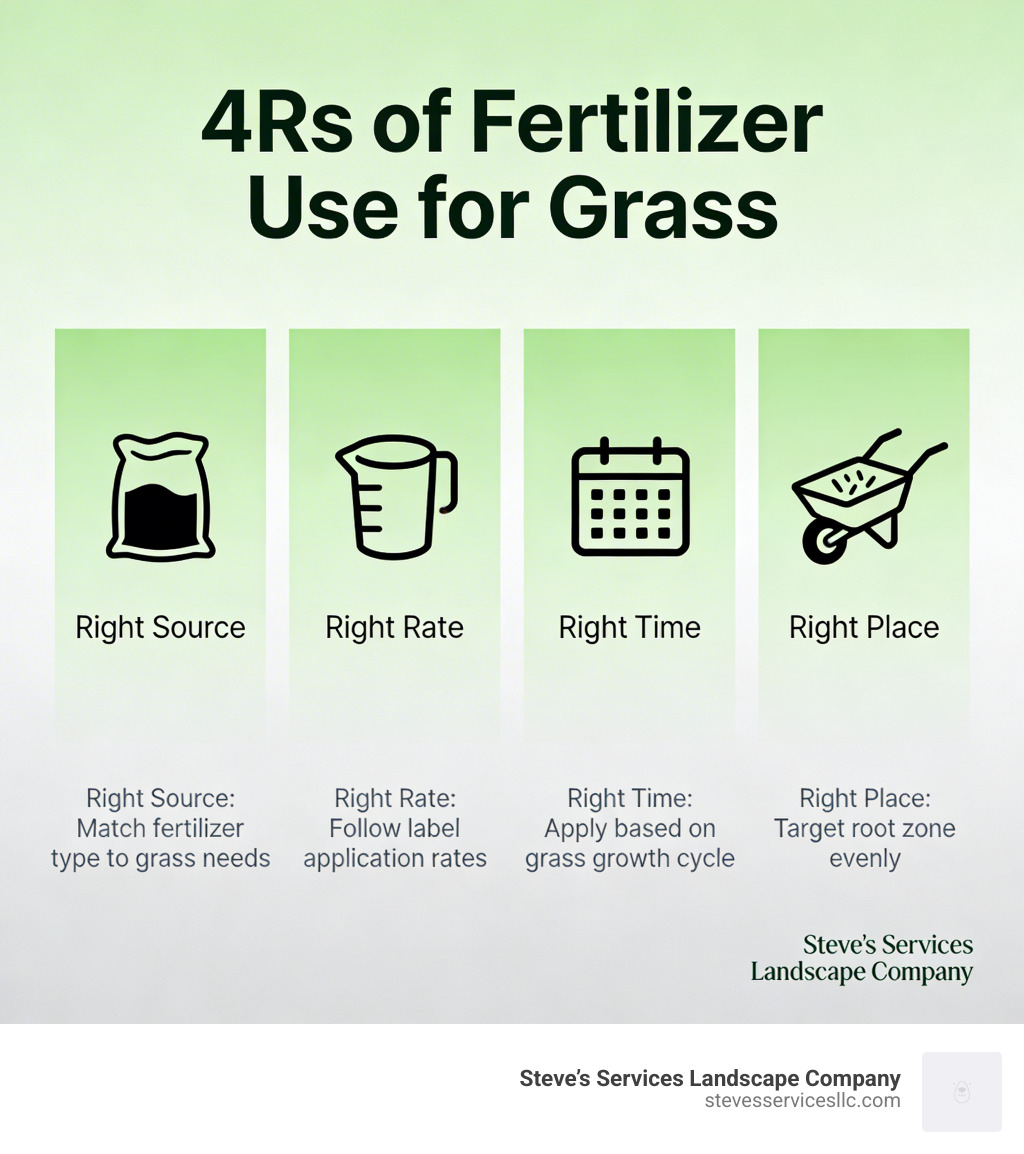
For our Massachusetts climate, the “4Rs” are the gold standard: the Right Source, at the Right Rate, at the Right Time, and in the Right Place. According to the AGR-212: Fertilizing Your Lawn guide, cool-season grasses should receive the bulk of their nutrition in the late summer and fall.
- Early Spring (April/May): Apply after the ground thaws and the grass begins to green up. This supports early growth.
- Late Summer (Late August/September): This is the most important feeding of the year. It helps the lawn recover from summer stress.
- Fall Feeding (November): Often called a “winterizer,” this application helps the grass store carbohydrates in its roots for a quick green-up next spring. You can find more details on this in our fall-fertilizer guide.
Optimal Timing for Massachusetts Lawns
In towns like Saugus and Lynnfield, we wait for the “spring flush” to subside before the second application. We generally advise against heavy fertilization during the peak heat of July and August unless you have a robust irrigation system. For more on managing these hot months, see our tips on summer-lawn-feeding.
The goal is to stop fertilizing before the first hard frost. This allows the grass to naturally harden off for the winter. Returning your grass clippings to the lawn is another pro tip—it can actually reduce your nitrogen needs by up to one-third because those clippings act as a natural, slow-release fertilizer for grass.
Avoiding Fertilizer Burn and Environmental Impact
“Fertilizer burn” happens when the salts in the fertilizer draw moisture out of the grass blades, leaving yellow or brown streaks. To prevent this:
- Water it in: Most granular fertilizers need about a quarter-inch of water after application to move the nutrients into the soil.
- Clean up hardscapes: Always sweep or blow granules off driveways and sidewalks back onto the grass to prevent runoff into sewers.
- Check the weather: Never apply before a torrential downpour, which will simply wash your investment away.
Calculating Coverage and Application Rates
One of the biggest mistakes we see is the “more is better” mentality. Over-applying fertilizer for grass doesn’t make it greener; it just causes disease and pollution. The standard rule is to never apply more than 1 pound of actual nitrogen per 1,000 square feet in a single application.
To figure out how much you need, use a tool like the Purdue Turf Fertilizer Calculator. If you are doing it manually, here is the math: Divide 100 by the first number on the bag. If the bag is 20-0-0, then 100/20 = 5. You need 5 pounds of that product to get 1 pound of nitrogen over 1,000 square feet.
Understanding Bag Coverage Statistics
Bag sizes can be confusing. Here is a quick look at common coverage rates we see in the industry:
| Bag Weight | Coverage Area (Approx.) | Notes |
|---|---|---|
| 8 kg (17.6 lbs) | 1,700 sq. ft. | Heavy nutrient concentration |
| 5.7 kg (12.5 lbs) | 3,767 sq. ft. | Often high-efficiency blends |
| 5.46 kg (12 lbs) | 4,306 sq. ft. | Light maintenance blends |
| 14.5 kg (32 lbs) | 12,000 sq. ft. | Large property standard |
That if your lawn is 5,000 square feet and the bag says it covers 5,000 square feet, you must set your spreader correctly to ensure the bag lasts exactly the length of the yard. For more on the logistics, check out our lawn-fertilization-cost breakdown.
Professional Cost Considerations
While many homeowners attempt this themselves, hiring a professional service ensures the right ratios are used for our specific Massachusetts soil.
Based on internet data, the average cost for a professional lawn fertilization application ranges from $25 to $225 per treatment. These are average costs based on internet data and not actual costs for Steve’s Services. Factors that influence this range include the size of your lot, the type of nutrients required (organic vs. synthetic), and whether weed control is included. For a full breakdown of what to expect, read our lawn-fertilizer-service-ultimate-guide.
Frequently Asked Questions about Fertilizer for Grass
What is the best fertilizer for grass rejuvenation?
For an older lawn that has lost its luster, we recommend a balanced “complete” fertilizer with an N-P-K ratio like 19-12-15. The phosphorus helps repair the root system, while the nitrogen brings back the color. Adding micronutrients like iron and sulfur can also help “wake up” the soil.
How often should I fertilize my lawn in New England?
For most lawns in Malden, Reading, and surrounding areas, 3 to 4 applications per year is the “sweet spot.” This typically includes an early spring application, a late spring/early summer feeding, a late summer recovery application, and a late fall winterizer.
Is organic fertilizer safer for pets and children?
Generally, yes. Organic fertilizers are made from natural materials and have a much lower salt index, which reduces the risk of skin irritation or “burn” if a pet or child touches the grass shortly after application. However, we always recommend staying off the lawn until the fertilizer has been watered in and the grass is dry, regardless of the type used.
Conclusion
Feeding your lawn isn’t a “one and done” chore. It’s a seasonal commitment to the health of your soil and the strength of your turf. By choosing the right fertilizer for grass, understanding your N-P-K ratios, and timing your applications with the Massachusetts seasons, you can achieve a lawn that is the envy of the neighborhood.
At Steve’s Services Landscape Company, we’ve spent decades perfecting the science of lawn care for our neighbors in Malden, Burlington, Winchester, and beyond. We know that every lawn has a unique “fingerprint” based on its soil pH and grass type.
If you’re ready to take the guesswork out of your lawn care, let us help. From professional soil testing to our specialized liquid grass seed and fertilization programs, we have the tools to make your grass thrive. Contact us today to feed your lawn the best and see the difference professional expertise makes!