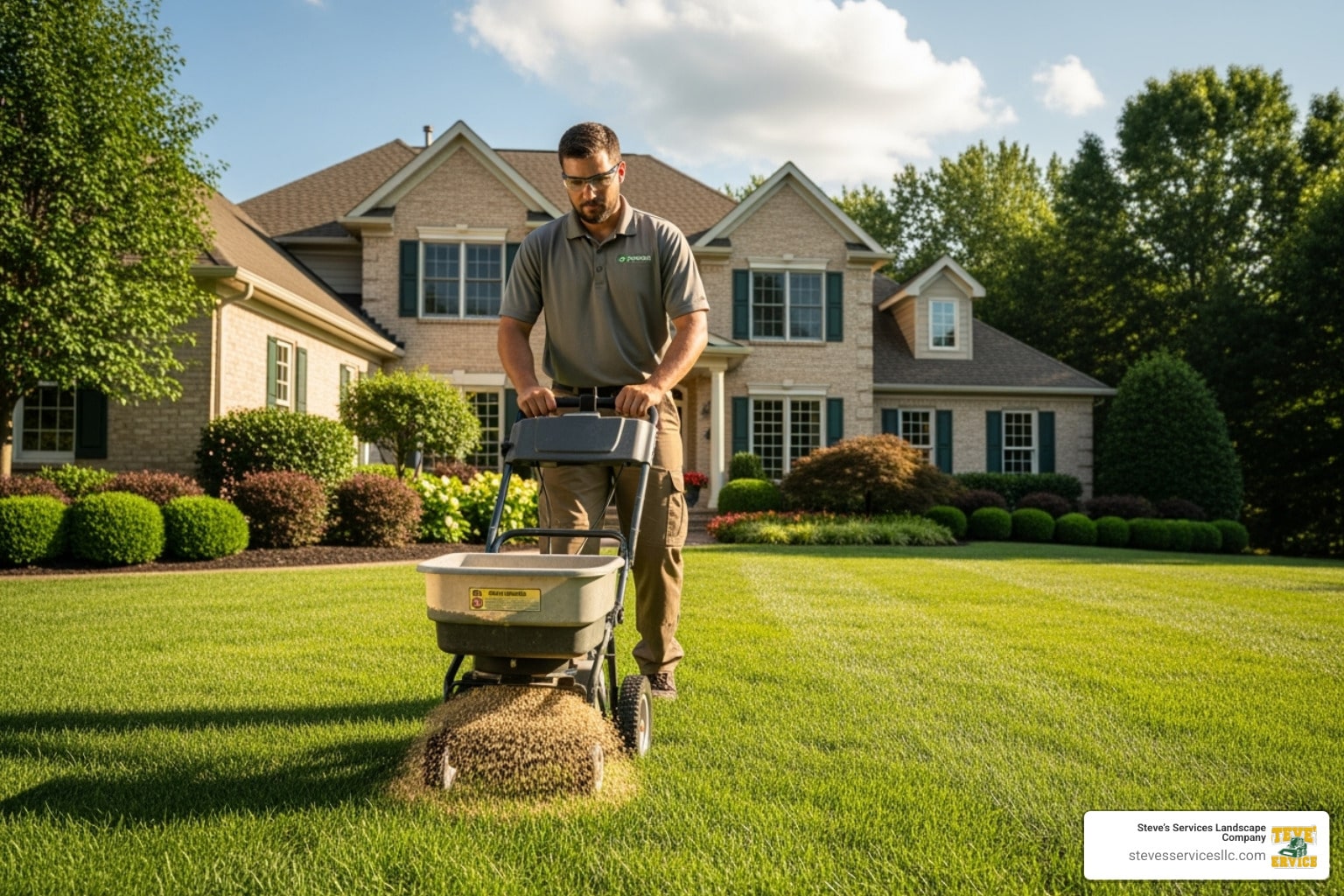
Why Fertilizing Your Lawn Is the Foundation of a Healthy Landscape

Fertilizing lawn is the single most important practice for achieving thick, vibrant turf that can withstand stress, resist weeds, and stay green throughout the growing season. Here’s what you need to know:
Quick Answer: How to Fertilize Your Lawn
- Test your soil every 3-4 years to identify nutrient needs
- Choose the right fertilizer based on your soil test (look for N-P-K ratios)
- Apply 3-4 times per year during active growing periods
- Focus on fall fertilization (September-October) for cool-season grasses in Massachusetts
- Water deeply after application to move nutrients to the roots
- Use no more than 1 lb of nitrogen per 1,000 square feet per application
A thick, green lawn doesn’t happen by accident. It’s the result of providing your grass with the nutrients it needs, when it needs them.
Most homeowners struggle with discoloration, thinning patches, and persistent weeds because their lawn is literally starving. Every time you mow, walk across the yard, or endure a hot summer, your grass loses vital nutrients from the soil. Without regular replenishment, even the best grass seed will eventually fade and thin out.
The solution? A strategic, professional fertilization plan that delivers the right nutrients at the right time.
This handbook will walk you through the science behind lawn nutrition, decode fertilizer labels, explain seasonal timing for Massachusetts lawns, and show you why professional application matters. You’ll learn when to fertilize, what products work best, and how to avoid common mistakes that waste money and harm the environment.
I’m Steve Sylva, owner of Steve’s Services, and over the past 25+ years, I’ve developed fertilizing lawn programs for hundreds of properties across the Malden area and surrounding Massachusetts communities. My team and I have seen how proper nutrition transforms tired, weedy turf into the kind of lawn that makes neighbors take notice.

Quick fertilizing lawn terms:
Why Your Lawn Craves Nutrients: The Science of a Healthy Turf
Just like any living organism, your lawn needs consistent nourishment to thrive. Without it, grass becomes weak and susceptible to problems. Several factors deplete nutrients from your soil:
- Mowing Stress: Each time we mow, we remove a portion of the grass blade, which contains stored nutrients. While mulching mowers can return some of these nutrients, consistent removal depletes the soil over time.
- Foot Traffic & Activity: Lawns in busy areas like Burlington, Danvers, or Woburn endure foot traffic from kids and pets. This compacts the soil and increases the grass’s demand for nutrients to repair itself.
- Environmental Stressors: The fluctuating weather in Massachusetts, from hot, dry summers to harsh winters, puts immense strain on your lawn. Fertilization helps your grass build resilience against heat, drought, and cold.
- Nutrient Washout: Over time, nutrients can leach out of the soil, especially in sandy soils, or be carried away by heavy rains.
Regular feedings provide essential nutrients to withstand these stresses. This strengthens grass roots, making them more resilient. A well-fertilized lawn also fends off pests and weeds by creating a dense turf that acts as a natural barrier. Fertilization improves your lawn’s aesthetic appeal, fostering a lush, green landscape.
Signs Your Lawn Needs Fertilizing
Your lawn communicates its needs through its appearance. Here are some clear indicators that your lawn is craving nutrients and could benefit from professional fertilizing lawn services:
- Yellowing Grass (Chlorosis): A yellowish or pale lawn often indicates a nitrogen deficiency, which is crucial for green color.
- Slow Growth: If your lawn seems to be growing very slowly or sparsely, it may not be receiving enough nutrients to fuel healthy growth.
- Thin or Patchy Areas: A thinning lawn with bare or patchy spots is a common sign of nutrient deficiency, making it vulnerable to weeds and disease.
- Increased Weed Presence: A weak, undernourished lawn is less competitive against weeds. If you’re seeing more weeds pop up, it’s often because your turf isn’t dense enough to choke them out.
- Poor Recovery from Drought or Foot Traffic: If your lawn struggles to bounce back after a dry spell or heavy use, its root system may be weak due to insufficient nutrients.
The Critical Role of Soil Testing
Before we even think about what fertilizer to apply, the most crucial step is understanding what your soil already has, and what it lacks. This is where professional soil testing comes in. A soil test provides invaluable insights into your lawn’s specific needs, preventing us from over-applying unnecessary nutrients and potentially harming the environment.
A comprehensive soil analysis helps us with several key factors:
- Determining Nutrient Deficiencies: A soil test indicates the amounts of phosphorus (P), potassium (K), calcium (Ca), and magnesium (Mg) your soil can provide to the turfgrass. This allows us to tailor a fertilization plan that addresses precise shortcomings.
- Measuring Soil pH: The pH level affects how well your grass can absorb nutrients. Most commonly grown turfgrasses in Massachusetts do best at a pH in the 6.0 to 6.5 range. If the pH is too high or too low, some nutrients become unavailable to the grass, even if they are present in the soil.
- Assessing Phosphorus (P) and Potassium (K) Levels: For established lawns in many parts of Massachusetts, phosphorus levels are often adequate or even high. Applying phosphorus unnecessarily can contribute to water pollution. A soil test tells us if supplemental phosphorus or potassium is truly needed.
While a soil test can’t reliably evaluate nitrogen (N) requirements, it provides the foundation for our fertilization strategy. By understanding your soil’s unique composition, we can develop a precise, effective, and environmentally responsible fertilizing lawn program. This is especially important for any new lawn installs to ensure the best start. For those interested in deeper scientific understanding, resources like Lawn Fertilization in Virginia offer extensive information on soil analysis, though we apply these principles with our knowledge of Massachusetts’ specific soil types and climate.
Decoding the Fertilizer Bag: N-P-K and Beyond
When it comes to fertilizing lawn, the numbers on the bag are a crucial code. Understanding this analysis is key to choosing the right product for your lawn.
Understanding the “Big Three”: N-P-K
Every fertilizer bag displays three prominent numbers, representing the percentage by weight of the three primary macronutrients essential for plant growth: Nitrogen (N), Phosphorus (P), and Potassium (K). This is often referred to as the N-P-K ratio.
- Nitrogen (N) for Lush, Green Leaf Growth: Nitrogen is the most essential nutrient for a home lawn, promoting the strong, vibrant green growth that gives turf its lush color. Without it, grass appears pale and weak.
- Phosphorus (P) for Strong Root Development: Phosphorus is critical for root growth and plant maturity. While many established Massachusetts lawns have enough, it’s beneficial for fertilizer for new sod to establish a strong root system. Soil tests determine if P is needed, as excess amounts can cause water pollution.
- Potassium (K) for Overall Health, Stress Tolerance, and Disease Resistance: Often called the “health nutrient,” potassium helps grass take up water and strengthens the roots, improving its resilience against environmental stresses like drought, heat, cold, and disease. It’s particularly important for preparing your lawn for the harsh Massachusetts winters. Coarse-textured (sandy) soils, common in some of our service areas like Everett or Saugus, often need added potassium.
Choosing the Right Formula: Types of Fertilizers
The type of fertilizer we select depends on your lawn’s current condition, soil test results, and our seasonal goals. Fertilizers come in various forms and release rates:
| Feature | Natural Organic Fertilizers | Manufactured Fertilizers |
|---|---|---|
| Release Speed | Typically slow-release, nutrients become available as microbes break down organic matter. | Can be fast-release (water-soluble, quick green-up) or slow-release (coated, extended feeding). |
| Nutrient Conc. | Lower concentration of nutrients, requiring more product to supply the same amount. | Higher concentration of nutrients, often requiring less product per application. |
| Soil Benefits | Improves soil structure, adds organic matter, supports beneficial microbial life. | Primarily provides direct nutrient boost; less impact on soil structure. |
- Slow-release vs. Quick-release:
- Quick-release fertilizers provide an immediate nutrient boost for rapid green-up. They are water-soluble but have a shorter response period and a higher risk of fertilizer burn if not applied correctly.
- Slow-release fertilizers release nutrients gradually, providing consistent feeding, reducing burn risk, and minimizing nutrient loss. They are preferred on sandy soils. Many natural organic fertilizers are inherently slow-release.
- Granular vs. Liquid:
- Granular fertilizers are solid pellets applied with a spreader, ideal for most large areas.
- Liquid fertilizers are sprayed onto the lawn for immediate absorption. Learn more on our liquid lawn feed page.
- Water-Insoluble Nitrogen (WIN): This term on fertilizer labels indicates the portion of nitrogen that is slowly available. If WIN is not listed, the nitrogen is likely quick-release.
We often recommend a mixture of quick and slow-release nitrogen sources, adjusting based on the season.
What is the Right N-P-K Ratio for Your Lawn?
Determining the ideal N-P-K ratio is a strategic decision guided by:
- Soil Test Results: This is paramount. If your soil test indicates sufficient phosphorus, we will opt for a “phosphate-free” fertilizer, which is common for established lawns in our Massachusetts service areas. Many homeowners prefer a product with an NPK ratio like 33-0-3.
- Lawn’s Needs: Is your lawn established or newly seeded? Does it need a quick green-up or long-term feeding? Mature lawns generally require much more nitrogen than phosphorus and potassium.
- Grass Type: Different grass species have varying nutrient requirements. Cool-season grasses, prevalent in Massachusetts, have specific needs throughout the year.
- Our Professional Expertise: Our team analyzes all these factors to select the optimal fertilizer blend. For example, a Fertilizer 16-4-8 might be suitable in some cases where a balanced approach is needed. This custom approach helps us avoid nutrient imbalances that can harm your lawn and the environment.
The Professional Approach to Fertilizing Lawn
Effective fertilizing lawn is a careful process of preparation, application, and aftercare. Our professional approach ensures maximum benefit while minimizing risks.
Lawn Preparation
Before any fertilizer touches your turf, we ensure your lawn is properly prepared:
- Proper Mowing Height: We mow before fertilizing to ensure granules reach the soil. We maintain a height of 2.5 to 3.5 inches, removing no more than one-third of the blade to avoid stress.
- Watering Before Application: Watering a few days before fertilizing ensures the soil is moist. Applying fertilizer to dry, stressed soil can cause “fertilizer burn.” We wait for the lawn to rebound from drought stress before feeding.
- De-thatching & Aeration: For lawns with excessive thatch or compacted soil, we may recommend de-thatching or aeration. These services improve air, water, and nutrient penetration, making fertilization more effective. Our aeration overseeding and fertilizing services address these needs.
Proper Application for Even Coverage
Achieving an evenly green lawn requires precise application and professional-grade equipment. We never scatter lawn food by hand.
- Broadcast Spreaders: For large areas typical of properties in Reading or Stoneham, we use commercial-grade broadcast spreaders for quick, efficient coverage.
- Drop Spreaders: For smaller, intricate areas or around garden beds in Lynnfield or Melrose, we might use drop spreaders for more control and precision.
- Calibrating Equipment for Accuracy: Our team regularly calibrates our spreaders to apply the correct amount of fertilizer per square foot, preventing over- or under-application.
- Techniques to Avoid Streaks and Overlap Marks: To prevent “streaking,” we often apply half the fertilizer in one direction and the other half perpendicularly. We use “header strips” around the perimeter and shut off the spreader over non-turf areas.
- Protecting Walkways and Driveways: We are meticulous about keeping fertilizer off hard surfaces like sidewalks and driveways. Spilled fertilizer can wash into storm drains, so we always sweep any granules back onto the lawn.
The Importance of Watering After Application
Watering immediately after fertilizing lawn is a critical step we prioritize for every application.
- Activating Fertilizer: Watering dissolves granular fertilizers, making nutrients available for root absorption.
- Moving Nutrients to the Root Zone: A deep watering pushes dissolved nutrients down into the soil where roots can access them.
- Preventing Fertilizer Burn: Watering in fertilizer prevents the concentration of salts that can “burn” grass, especially with fast-release products in hot weather.
- Deep Watering Requirements: We ensure your lawn receives a thorough watering, enough to penetrate several inches into the soil. Understanding your irrigation systems and their efficiency is also key.
Mitigating Environmental Impact
As responsible landscapers, we are committed to environmentally sound practices to minimize water pollution.
- Avoiding Runoff into Storm Drains: We apply fertilizer only to planted areas and sweep any stray granules from hard surfaces back onto the lawn. This prevents nutrients from washing into storm drains.
- Not Applying Before Heavy Rain: We check the weather forecast and skip fertilizing if heavy rain is expected, which can wash away the product.
- Using Phosphorus-Free Formulas When Appropriate: Based on soil tests, we use phosphate-free fertilizers on lawns with sufficient phosphorus to prevent water pollution.
- Promoting Healthy Turf: A dense, vigorous lawn binds the soil, promoting infiltration and acting as a natural filter that protects water quality.
- Integrated Pest Management (IPM) Principles: Our approach aligns with IPM principles, often applying fertilizers separately from weed killers to ensure each product is used at its optimal time. For more guidance, resources like Lawn Fertilizing–UC IPM provide valuable insights.
Your Lawn’s Annual Feeding Schedule
For the cool-season grasses common in Massachusetts, a consistent feeding schedule is vital. We recommend fertilizing lawn every 6-8 weeks during the growing season, with timing and fertilizer type changing with the seasons.
Spring Kickstart
As the snow melts and temperatures rise in our service areas like Revere and Medford, your lawn wakes up hungry.
- Late Spring Application: Our spring fertilization, typically from mid to end of April, helps your lawn recover from winter and kickstarts growth with a nitrogen-rich blend.
- Avoiding an Early Growth Surge: Applying nitrogen too early in spring can cause weak top growth at the expense of root development, making the lawn susceptible to summer stress. Our programs encourage balanced growth.
- Timing with Pre-Emergent Weed Control: Spring is also time for pre-emergent crabgrass control. We strategically time these applications, often separately from fertilization, for optimal results.
Summer Sustainment
Summer in Massachusetts can be tough on lawns. Our summer fertilizing lawn program focuses on sustaining health and resilience.
- Maintaining Health During Heat and Drought: We apply in early to mid-June and again in mid to late July. These applications provide continuous nutrition to help the lawn withstand summer stress.
- Using Slow-Release Nitrogen to Prevent Burn: During warmer months, we prioritize slow-release nitrogen sources. This provides a steady supply of nutrients without the risk of burning the grass.
- Avoiding Fertilization During Extreme Heat Waves: We avoid fertilizing during extreme heat or drought. A stressed lawn needs water, not nutrients. We wait until temperatures cool or after the lawn has received adequate moisture.
Key Considerations for Fertilizing Lawn in the Fall
For cool-season grasses in Massachusetts, fall is arguably the most important feeding of the year. This is when your lawn is actively growing roots and storing energy.
- Building Strong Roots for Winter Survival: Our fall lawn fertilizer programs are crucial for developing a deep, robust root system to help grass survive the cold winter.
- Storing Energy for a Quick Spring Green-Up: Nutrients applied in the fall are stored in the roots, fueling a rapid and healthy green-up come spring.
- Optimal Timing (September-October): The best time for fall fertilization in our service areas is typically September and October, allowing the grass to absorb nutrients before the ground freezes.
- Applying 2-3 Weeks Before the Ground Freezes: We aim to complete fall fertilization 2-3 weeks before the ground freezes solid. A late fall application in November (winter fertilizer) provides one last boost to help carry the lawn through the cold months.
Frequently Asked Questions about Lawn Fertilization
How much does professional lawn fertilization cost?
The cost of professional fertilizing lawn services varies based on lawn size, condition, accessibility, and the specific program chosen.
Based on internet data, average costs for a single professional application can range from approximately $60 to over $300+. However, these are general averages and not actual quotes for Steve’s Services. Our comprehensive lawn fertilization cost depends on your unique property. We encourage you to contact us for a personalized estimate.
Can you fertilize too much?
Absolutely. Over-fertilizing is a common mistake that can lead to several problems:
- Fertilizer Burn: Excess fertilizer, especially quick-release types, can cause “fertilizer burn” by drawing moisture out of grass plants, leaving them brown and scorched.
- Weak Growth: Excessive nitrogen can promote weak top growth at the expense of root development, making your lawn more susceptible to stress.
- Increased Disease Susceptibility: A nutrient imbalance can weaken the grass’s natural defenses against fungal diseases.
- Environmental Risk: Over-applying fertilizer increases the risk of nutrient runoff into local waterways.
This is why a professional lawn fertilizer service ultimate guide emphasizes precise application rates to avoid these pitfalls.
What’s the difference between “weed and feed” products and separate applications?
“Weed and feed” products combine fertilizer with herbicide. While convenient, we generally advise against them for several reasons:
- Conflicting Timing: The best time to fertilize often doesn’t align with the best time for effective weed control. For instance, herbicides may need to stay on leaves, while fertilizer needs to be watered in, compromising the effectiveness of both.
- Unnecessary Herbicide Application: These products apply herbicide to the entire lawn, including weed-free zones. Spot treating is more effective and environmentally responsible.
- Professional Approach: Our approach to fertilizing and weed control involves separate, targeted applications. This allows us to use the right product at the right time for maximum effectiveness without over-applying chemicals.
Conclusion: Achieve Your Dream Lawn with Expert Care
A truly lush, resilient, and vibrant lawn is not a stroke of luck—it’s the result of a well-executed fertilizing lawn strategy. We’ve explored why this essential practice provides the foundation for robust growth, stronger roots, improved disease resistance, and natural weed suppression. From understanding the vital N-P-K ratios to mastering seasonal timing and application techniques, a consistent, year-round approach is key to nurturing a healthy landscape.
The value of professional expertise in this process cannot be overstated. With our deep knowledge of Massachusetts soil types and climate, we ensure proper product selection, correct timing, and precise application methods custom to your lawn’s unique needs. Steve’s Services takes the guesswork out of lawn care, ensuring your lawn gets exactly what it needs, when it needs it.
Let us help you transform your yard into the beautiful, thriving space you’ve always envisioned. Take the first step towards a greener, healthier lawn and enjoy the outdoor oasis you deserve.