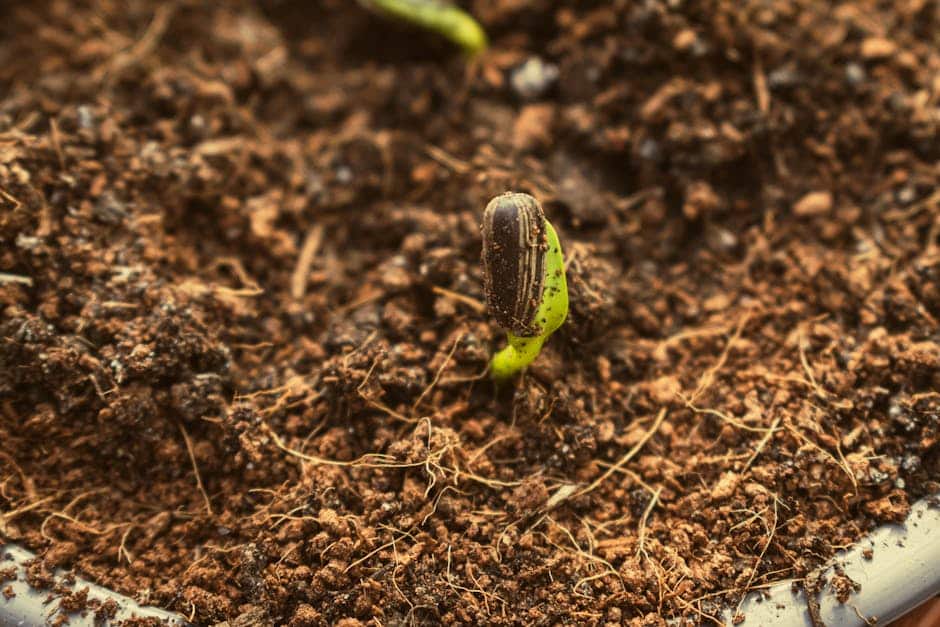
Why Starter Fertilizer Timing Makes or Breaks New Grass Seed
Liquid fertilizer for new grass seed gives young seedlings the fast, accessible nutrients they need right when it matters most — at germination and early root development.
Here’s a quick answer to get you started:
When and how to use liquid fertilizer for new grass seed:
- Before seeding – Apply liquid starter fertilizer and incorporate it into the top 4-6 inches of soil
- At seed down – Apply a light liquid feed to ensure nutrients are in the root zone immediately
- After sprouting – Begin regular liquid applications once seedlings emerge
- After first mow – Feed at 0.15-0.2 lb nitrogen per 1,000 sq ft weekly to support establishment
- Every 4-6 weeks – Continue through the active growing season
Key facts at a glance:
| Factor | Recommendation |
|---|---|
| Best NPK ratio | 16-21-2 or 10-10-10 for new seed |
| First application | Before or at seeding |
| Post-germination feeding | 4-6 weeks after sprouting |
| Application rate | 0.15-0.2 lb N per 1,000 sq ft |
| Safe temperature range | 50-85°F |
| Reapplication interval | Every 4-6 weeks |
Without the right nutrients at the right time, new grass grows thin, weak, and slow to establish. The problem is that most homeowners either apply fertilizer too late — or choose the wrong type entirely.
Liquid starter fertilizers absorb faster than granular options, deliver phosphorus directly to the root zone, and reduce the risk of uneven application. For new seed especially, that speed and precision make a real difference in how quickly your lawn fills in.
I’m Steve Sylva, owner of Steve’s Services Landscape Company, and with over 25 years of hands-on experience in lawn establishment across Massachusetts, I’ve seen how the right approach to liquid fertilizer for new grass seed can turn a patchy, struggling seedbed into a thick, healthy lawn. In the sections below, I’ll walk you through exactly what to use, when to apply it, and how to avoid the mistakes that cost most homeowners weeks of growth.
Basic liquid fertilizer for new grass seed terms:
Why Choose Liquid Fertilizer for New Grass Seed?
When we are establishing new lawns in communities like Everett, Malden, or Winchester, we often get asked why we prefer liquid applications over the traditional bags of “rocks” (granular fertilizer). While granular has its place, liquid fertilizer for new grass seed offers several scientific advantages that are hard to beat during the delicate germination phase.
The biggest factor is absorption speed. Liquid fertilizers are absorbed more quickly by both the plants and the soil compared to granular. When a tiny grass seed sprouts, it has very limited energy stores. It needs nutrients now, not in two weeks when a granule finally breaks down. Liquid applications provide immediate bioavailability.
Another critical advantage is even distribution. Have you ever seen a lawn that looks like a zebra, with dark green stripes and yellow patches? That’s usually the result of a poorly calibrated granular spreader. With liquid lawn feed, the nutrients are suspended in water, allowing for a perfectly even “blanket” of nutrition across the soil.
Liquid vs. Granular: The New Seeding Showdown
| Feature | Liquid Fertilizer | Granular Fertilizer |
|---|---|---|
| Absorption Speed | Immediate (Foliar & Root) | Slow (Must break down) |
| Phosphorus Mobility | High (Reaches root zone fast) | Low (Stays where it lands) |
| Risk of Runoff | Lower (Absorbs quickly) | Higher (Can wash away in rain) |
| Application Precision | Excellent (No “striping”) | Variable (Depends on spreader) |
| Burn Risk | Low (If diluted properly) | Moderate (Salt concentrations) |
One of the most technical reasons we use liquid is phosphorus mobility. Phosphorus is essential for root development, but it doesn’t move easily through the soil. If you drop a granule on the surface, the phosphorus might only move an inch deep over several months. By using a liquid starter, we can saturate the root zone more effectively, ensuring those brand-new roots find exactly what they need to anchor the plant. This is backed by scientific research on soil nutrient movement, which highlights how soil chemistry affects nutrient availability.
Optimal NPK Ratios and Nutrient Selection
If you look at a bottle of liquid fertilizer for new grass seed, you’ll see three numbers (like 16-21-2). This is the NPK ratio: Nitrogen (N), Phosphorus (P), and Potassium (K). For new seeds, the middle number—Phosphorus—is the VIP.
- Nitrogen (N): Drives the green, leafy growth. While important, too much nitrogen too early can force the plant to focus on leaves before it has the roots to support them.
- Phosphorus (P): The “root maker.” This is the most critical nutrient for a newly seeded lawn. It triggers the biological processes that allow a seed to germinate and send down deep roots.
- Potassium (K): Think of this as the plant’s immune system. It helps the new grass resist disease and handle the stress of our Massachusetts weather swings.
Beyond the big three, we look for professional-grade liquids that include micronutrients and bio-stimulants. Ingredients like sea kelp and humic acid act like vitamins for your soil, improving its structure and helping the new grass seedlings absorb nutrients more efficiently.
Ideal NPK Ratios for Liquid Fertilizer for New Grass Seed
Not all fertilizers are created equal. When we’re working on a new lawn install in Burlington or Reading, we typically reach for one of these specific blends:
- The 16-21-2 Ratio: This is a powerhouse starter blend. The high phosphorus content is specifically designed to push root growth.
- The Balanced 10-10-10: A great all-purpose starter that provides a steady diet of all three major nutrients.
- The 18-24-12 Blend: This is a heavy-duty starter often used when soil tests show significant nutrient deficiencies. You can learn more about 18-24-12 fertilizer benefits for aggressive root pushing.
- 20-10-10 Blends: These are better suited for late-stage establishment when you want to shift the focus toward thickening the “carpet” of grass.
Professional Timing and Application Guide
In the landscaping world, timing isn’t just a suggestion—it’s the law. If you apply liquid fertilizer for new grass seed when the soil is too cold or during a heatwave, you’re essentially throwing money into the wind.
For our service areas like Danvers and Woburn, we primarily deal with cool-season grasses (like Kentucky Bluegrass and Tall Fescue). These grasses have specific “temperature windows” where they are most active.
- Cool-season grass: Best fertilized when air temperatures are between 50°F and 85°F.
- Soil Temp: Ideally, you want soil temperatures consistently above 50°F for germination.
If you are dealing with a specialized project, such as a hydroseeded lawn, the timing shifts slightly. You can read our guide on when to fertilize hydroseeded lawn for more specific details on those high-moisture environments.
When to Apply Liquid Fertilizer for New Grass Seed
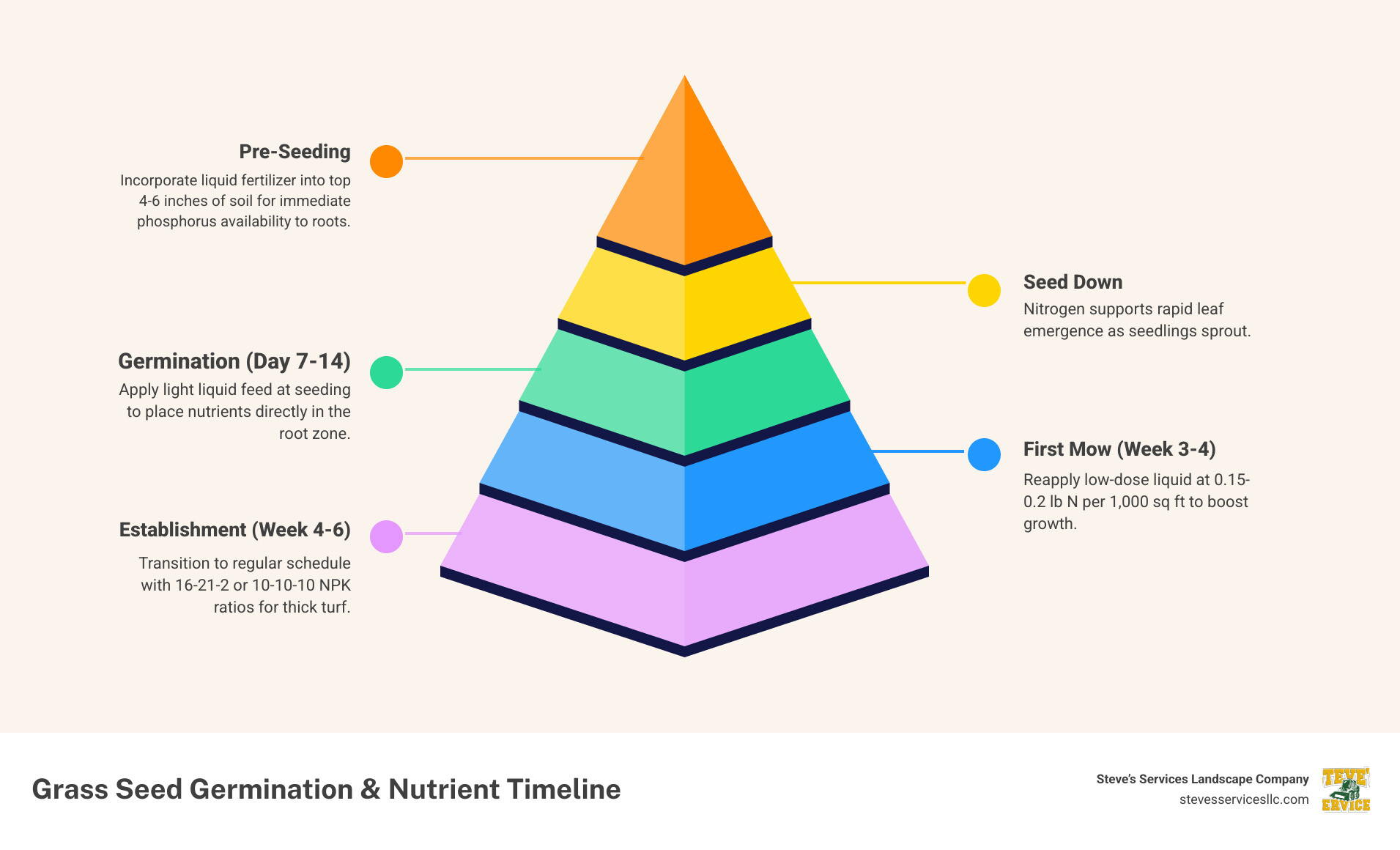
We follow a strict “Four-Phase” feeding schedule to ensure success:
- Pre-Seeding (The Foundation): We often apply a liquid starter and rake it into the top 4 inches of soil before the seed even hits the ground. This ensures the “pantry” is stocked for the seeds.
- Seed Down (The Jumpstart): Applying a liquid feed at the same time as the seed provides immediate moisture and nutrients.
- Post-Germination (The Growth Phase): Once you see that green “fuzz” across the yard (usually 7-14 days), the seedlings are ready for their first foliar (leaf) feeding.
- The First Mow Milestone: This is a critical transition point. After the first mow, we recommend weekly low-dose applications to help the grass “knit” together.
Before you start, we always recommend a soil test. You can get professional advice on soil testing from local extension offices to see if your pH is balanced. In Massachusetts, our soil can be quite acidic, which might require lime to make the fertilizer actually work.
Step-by-Step Application Standards
When we send a crew to a home in Stoneham or Melrose, they follow a precise protocol. Even if you’re using a hose-end sprayer, these standards apply:
- Prep the Area: Remove all debris, rocks, and old thatch. You wouldn’t go to a job interview in sweatpants, so don’t put new seed on a messy “bed.”
- Calibrate Your Rate: For new seedlings, we aim for a light touch: 0.15 to 0.2 lb of Nitrogen per 1,000 square feet. Applying too much can overwhelm the young plants.
- The “S” Pattern: Walk at a steady pace, using overlapping passes to ensure no spots are missed.
- Watering-In: Most liquid fertilizers need to be “watered in” with about 1/8 to 1/4 inch of water immediately after application to move the nutrients to the root zone.
If you’re wondering about the investment, lawn fertilization cost factors usually depend on the total square footage and the current health of your soil.
Avoiding Common Seeding Mistakes
We’ve seen it all—from “burnt” lawns to yards that are 90% weeds because the homeowner used the wrong product. Here is how to keep your new lawn on the right track.
The “Weed and Feed” Trap: This is the most common mistake. Never, ever use a standard “weed and feed” product on new grass seed. These products contain pre-emergent herbicides designed to stop seeds from growing. Guess what? They don’t know the difference between a dandelion seed and your expensive Kentucky Bluegrass seed. They will kill your new lawn before it even starts.
The Salt Index: Fertilizers are essentially salts. If you apply too much liquid fertilizer for new grass seed without enough water, the salt will pull moisture out of the tiny grass plants, causing them to dehydrate and die. This is known as “fertilizer burn.”
Irrigation Overload: While new seeds need to stay moist, you shouldn’t turn your yard into a swamp. Over-saturation can lead to “damping off,” a fungal disease that kills seedlings. We often use products like Hydretain, which can reduce watering requirements by up to 50% by managing soil moisture more efficiently.
For more on protecting your investment, check out our guide on how to care for new sod and seed.
Frequently Asked Questions about Liquid Fertilizer for New Grass Seed
Can liquid fertilizer burn new grass seedlings?
Yes, it can, but it is much easier to avoid with liquids than with granules. Burn happens when the “salt index” of the fertilizer is too high for the plant to handle, or if it’s applied during the heat of the day (above 85°F). To avoid this, always follow the recommended dilution rates and apply during the cooler parts of the day—early morning or late evening. If you’re worried, stick to the 0.15-0.2 lb N/K weekly rate, which is considered a “spoon-feeding” approach that is very safe for babies (the grass babies, that is).
How long after seeding will I see results?
With a high-quality liquid fertilizer for new grass seed, you’ll generally see germination within 7 to 21 days, depending on the grass type (Ryegrass is fast, Bluegrass is slow). However, the “results” you’re looking for—a thick, green lawn—usually take about 4 to 6 weeks. The phosphorus in the liquid starter works behind the scenes to anchor the roots, so even if the top doesn’t look like a golf course yet, the foundation is being built.
How often should liquid starter fertilizer be reapplied?
For the first month, we recommend low-dose weekly applications. This keeps a steady stream of nutrients available as the seedlings grow their first few leaves. After the first 4-6 weeks, you can transition to a more standard lawn feed for new lawn schedule, which typically involves applications every 4 to 6 weeks.
Conclusion
Establishing a new lawn in Massachusetts is a rewarding challenge. Whether you’re in Saugus, Revere, or Lynnfield, using liquid fertilizer for new grass seed is the most effective way to ensure your investment actually grows. By focusing on high-phosphorus NPK ratios, precise timing, and consistent moisture management, you can achieve professional-grade results that will be the envy of the neighborhood.
At Steve’s Services Landscape Company, we specialize in taking the guesswork out of lawn establishment. From expert new lawn installs to long-term maintenance, our team is here to help your yard reach its full potential.
If you are looking into professional help, please note that average costs for professional fertilization are based on internet data and not actual costs for Steve’s Services. A typical professional application for a standard residential lot can range from $75 to $350+ depending on the lawn size, the specific liquid blends required, and the current state of your soil.
Ready for a lush, green lawn without the headache? Give us a call today—we’d love to help you grow something great.